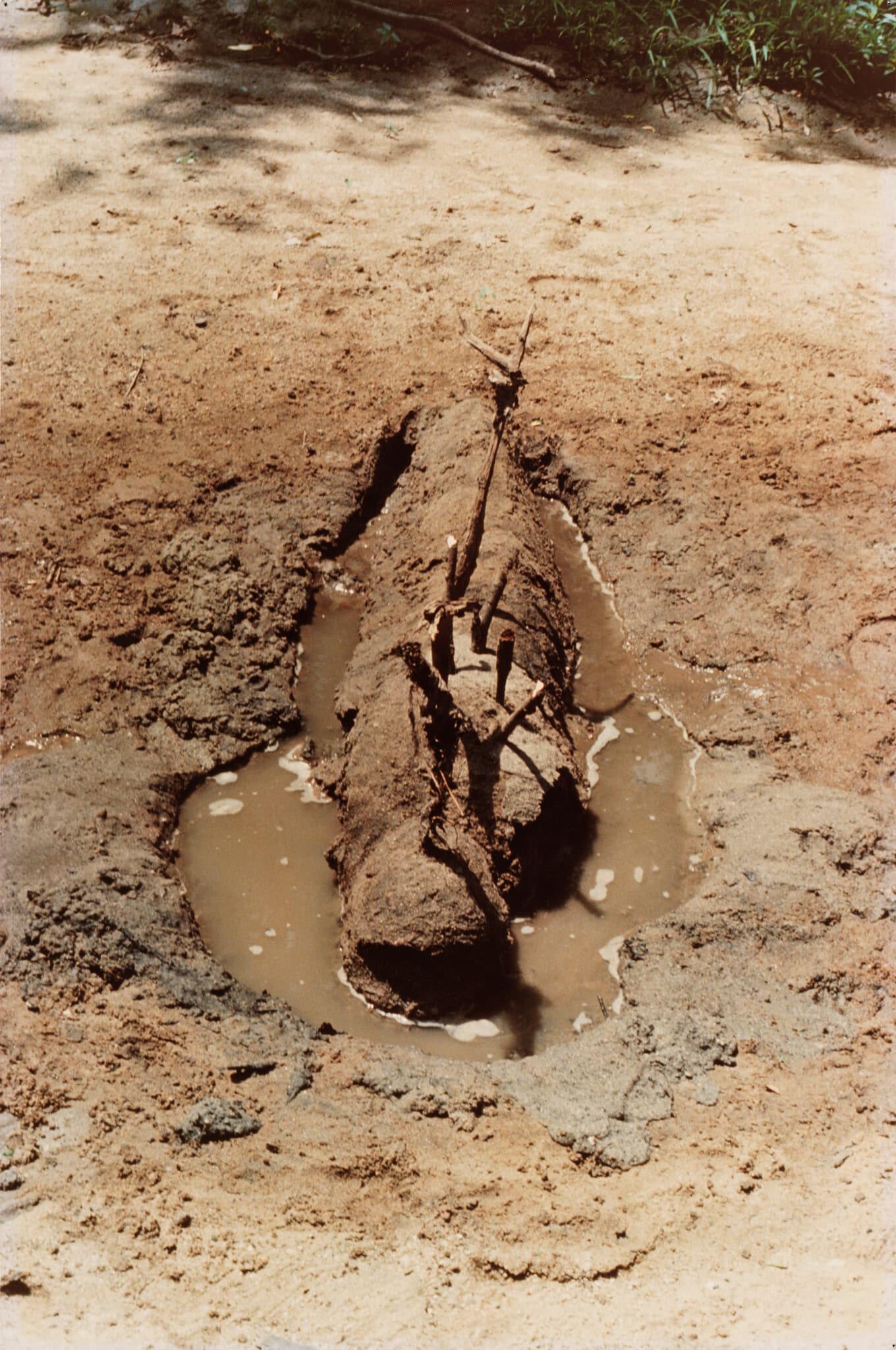
Ana Mendieta's strongest works do not ask whether the body is present or absent. They make that distinction unstable. A mound in a creek bed, a carved silhouette, a trace cut into earth, a form that fire or water will erase: these are not substitutes for performance after the fact. They are the performance continuing under another condition. In Mendieta, absence behaves like a body.
That is why the phrase "earth-body" still feels exact rather than merely poetic. The Whitney describes her work across earthworks, body art, performance, photography, and film, and connects those practices to nature, gender, identity, ritual, and cultural belief.[4] The range can sound broad until the images make it concrete. Mendieta did not simply place a figure in a landscape. She made landscape carry the pressure of a figure that had just been there, might return, or was already being absorbed.
The cover image, Untitled (Fetish Series, Iowa) from 1977, shows this logic without needing spectacle.[1] A mud-covered form lies embedded in shallow water, pierced by sticks and surrounded by a small moat. Whitney's collection text identifies it as an ephemeral earth-body work made at Old Man's Creek in Iowa City, using mud and water to create a figure that would eventually wash back into the creek bed.[1][4] The photograph is quiet, but its quietness is severe. The figure is both made and already on its way out.
Image context: this is a real museum artwork photograph, not a diagram, chart, or generated visual. It matters because Mendieta's art often survives through photographic documentation of temporary actions. The image lets the reader see the key tension directly: a body-like form held long enough for the camera, but made from materials that refuse permanence.[1]
The body becomes a site
Mendieta's work grew from displacement as much as from formal experiment. The Whitney artist page notes that she was sent from Cuba to the United States as a child and resettled in Iowa; it frames that dislocation as a pressure that surfaced in the mature work.[4] The biographical fact should not flatten the art into a simple exile allegory, but it helps explain why place in Mendieta is never neutral. Land is not scenery. It is a place where belonging has to be remade physically.
The Silueta works, made between 1973 and 1980, sharpen that remaking. The Smithsonian American Art Museum describes its 1980 Untitled, from the Silueta series as documentation of an ephemeral sculpture shaped like the artist's silhouette and carved directly into the earth with minimal environmental disruption.[3] The same page reads the series through nature, the female body, feminist subjecthood, land-art process, and exile.[3] Those terms are useful because they keep several pressures in view at once. Mendieta's outline is personal, but it is not private. It is a form made where body, place, ritual, and history overlap.
Spencer Museum's 1978 Untitled: Silueta Series page gives a more tactile version of the same problem. Its label explains that Mendieta built up soil and sand in a streambed in the shape of a woman's body, then photographed the temporary sculpture so the work could be shared after erosion returned the site to ordinary function.[2] That sequence is the work's grammar: make, mark, document, let go. The photograph does not defeat disappearance. It lets disappearance become legible.
A trace is not a lack
The most common misreading of the Silueta works is to treat the silhouette as evidence that something missing needs to be restored. Mendieta's art is more demanding. The trace is not only a lack. It is an active form. It changes how the viewer reads mud, water, grass, stones, flame, and the camera's frame.
This is why her use of natural materials has such force. In weaker earth-art rhetoric, soil can become a generalized symbol of origin or authenticity. Mendieta avoids that softness by making the material perform. Mud holds shape, then softens. Water surrounds, reflects, and erodes. Fire makes a body-outline visible by consuming it. Grass receives an imprint and grows past it. The materials are not symbolic labels attached to a body. They are collaborators in the body's unstable afterimage.
The Whitney's description of Untitled (Fetish Series, Iowa) is especially useful here because it names several visual associations without reducing the work to one.[1] The pierced form can recall martyred saints, ritual objects understood to hold power, and burial mounds. But it also remains stubbornly local: mud, sticks, water, Old Man's Creek. That double register is part of Mendieta's strength. The work can call on archetype without floating away from site.
Photography holds the vanishing
Mendieta's dependence on photographic record is not a documentary compromise. It is one of the work's central tensions. The Spencer Museum label states plainly that the original sculpture was site-specific, intended neither to be moved nor permanently preserved, yet photographed so the idea could reach a wider audience.[2] That does not make the photograph secondary. It means the artwork lives between event and image.
This is a hard balance. If the photograph becomes too autonomous, the temporary action risks turning into a portable object after all. If the event is treated as the only real artwork, viewers who were not present are left with myth. Mendieta works in the charged space between those options. The photograph tells us that something happened. It also tells us that the thing itself is no longer available in the same way.
That is why her images can feel both intimate and unreachable. The camera brings the viewer close to a site where a body has been invoked, but it cannot restore touch, weather, smell, temperature, or duration. The viewer receives a trace of a trace. In Mendieta, that distance is not a failure. It is the condition that makes the work think about memory at all.
Feminist land art without conquest
Mendieta also changes the mood of land art. Large-scale earthworks are often remembered through cutting, moving, measuring, owning, and monumentalizing landscape. Mendieta's scale is frequently different: a body-length form, a creek bed, a hillside, an earthen hollow, a mark made and surrendered. The point is not that small work is automatically more ethical than large work. The point is that Mendieta's intervention rarely behaves like a claim of mastery.
The Smithsonian page emphasizes minimal disruption in the carved earth work.[3] Spencer's labels stress erosion, temporality, and the return of the sculpture to the natural site.[2] Read together, those museum accounts describe a land practice based less on possession than on contact. Mendieta does not present earth as empty material waiting for artistic command. She treats it as a force that receives, changes, and finally reclaims the form.
That is where the feminist charge of the work becomes sharper. The female body is not displayed as a stable object for ownership. Often it is not displayed directly at all. It appears through outline, impression, surrogate, or afterimage. The viewer meets a shape that evokes a body while refusing the usual visual possession of a body. Presence is made powerful by becoming hard to seize.
Why the work keeps returning
Mendieta's art remains contemporary because it understands something our image culture keeps forgetting: visibility is not the same as possession. A body can be strongly present through a mark that will not last. A place can hold memory without becoming a monument. A photograph can preserve an action while still admitting that preservation is incomplete.
That incompleteness is not weakness. It is the work's emotional and formal intelligence. Untitled (Fetish Series, Iowa) looks like an object in a landscape, but it behaves like a threshold.[1] The mud form is figure and ground, ritual and creek bed, made thing and dissolving thing. It asks the viewer to hold several states at once instead of choosing the comfort of one.
Mendieta made absence active by giving it material work to do. Her silhouettes are not empty outlines. They are contracts with weather, earth, water, fire, camera, and memory. The body enters the site, marks it, and leaves; the site answers by changing the mark. What remains is not a stable relic but a charged image of relation. That is why the work still matters. It does not monumentalize disappearance. It teaches disappearance to leave form behind.[1][2][3][4]
Sources
- Whitney Museum of American Art, "Ana Mendieta, Untitled (Fetish Series, Iowa)" - collection page for the 1977 chromogenic print used as the cover image, including medium, dimensions, and object label.
- Spencer Museum of Art, "Ana Mendieta, Untitled: Silueta Series" - collection page for the 1978 gelatin silver print, with labels on soil, sand, streambed, documentation, temporality, and erosion.
- Smithsonian American Art Museum, "Ana Mendieta's Untitled, from the Silueta series" - artwork page describing the 1980 gelatin silver print, the series dates, earth-body sculpture, feminist land-art process, and exile.
- Whitney Museum of American Art, "Ana Mendieta" - artist page summarizing Mendieta's earthworks, body art, performance, photography, films, Iowa dislocation, earth-body works, and Untitled (Fetish Series, Iowa).