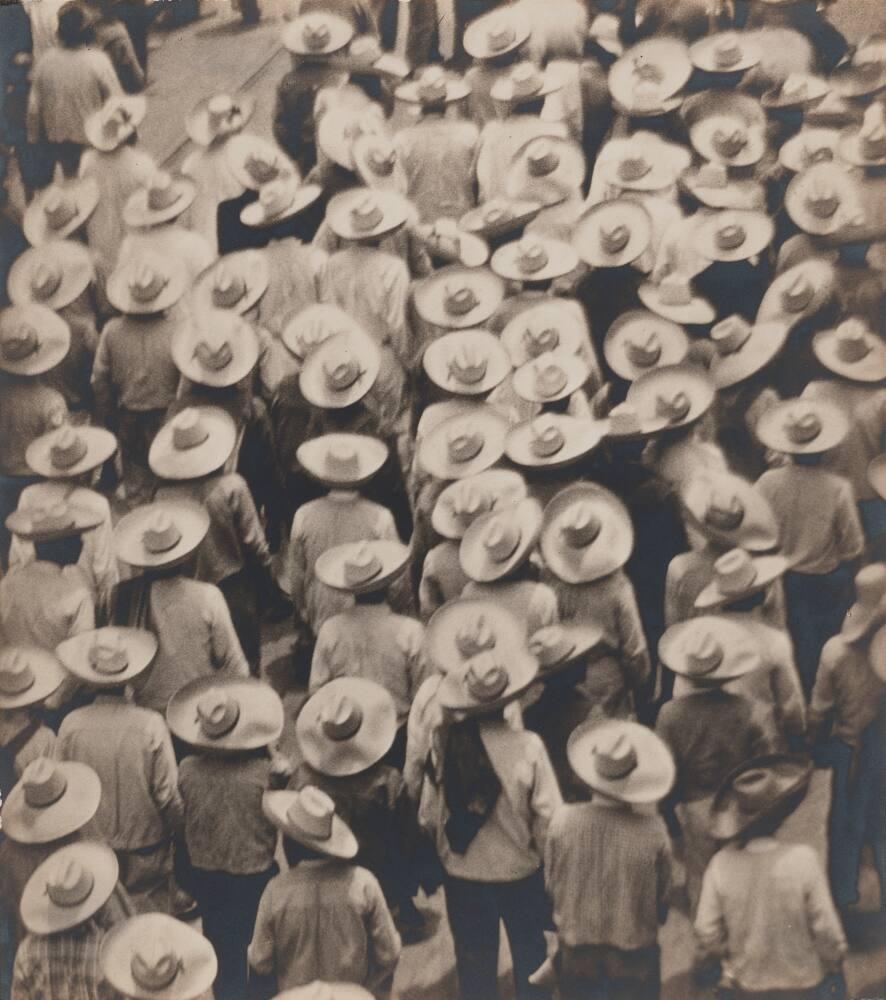
Tina Modotti's Workers' Parade looks simple until the eye tries to find a place to rest. The photograph is all hats, shoulders, spacing, and compression. Seen from above, the May Day crowd in Mexico City becomes a field of repeating pale circles, dark gaps, and forward pressure. No face anchors the picture. No horizon opens it. The image refuses the comforts of portraiture and the drama of a single heroic body. Instead, Modotti makes solidarity visible as pattern.[1][2][4]
That is why the photograph still feels sharper than many political images that announce their politics more loudly. Its subject is collective labor, but its method is not illustration. Modotti uses the camera's coldest gifts: cropping, height, repetition, flattening, and tonal compression. The result is not propaganda pasted onto modernism. It is a political argument made through modernist form.
Image context: the lead image is a real archival photographic image, not a diagram, chart, or generated visual. It is the right image for this essay because the argument depends on the exact look of Modotti's photograph: the high vantage, the absence of faces, the repeating sombreros, and the way the crowd fills the whole frame.[1][2][4]
The Crowd Has No Exit
Museum records give the basic facts plainly. The Museum of Fine Arts, Houston identifies Campesinos (Workers' Parade) as a 1926 gelatin silver print by Modotti, depicting Mexico and measuring a little over eight inches high in the image area.[2] MoMA's collection record for Workers Parade gives a closely related print in the same year and medium.[3] The scale is intimate, but the picture behaves as if it were larger than the sheet. Modotti fills the frame so completely that the crowd seems to continue beyond every edge.
That edge pressure matters. A parade is usually imagined as a line moving through civic space: a route, a banner, a street, spectators, a beginning and an end. Modotti withholds most of that grammar. She does not show the street as setting. She does not give the viewer a dignitary, a speaker, a flag, or even a readable direction. The parade is converted into density. Political presence arrives through the fact that so many bodies share one visual field.
MoMA curator Eva Respini's audio commentary stresses the same formal shock: the photograph shows no faces, offers no horizon line, and makes the mass read as one entity.[4] That is not just a descriptive observation. It names the photograph's politics. By removing the face as the usual point of empathy, Modotti asks the viewer to take the crowd seriously as a collective form rather than as a set of individual stories waiting to be extracted.
Sombreros Become Structure
The sombreros are the photograph's most obvious marks, but Modotti does not use them as picturesque costume. MFAH's object description notes that in Mexico the sombrero was immediately legible as a working-class emblem, and that the absence of individual faces lets the hats unite the workers visually.[2] The point is not folklore. The point is a sign that can be multiplied.
Each hat is slightly different: tilted, clipped, shadowed, interrupted by the next body. Yet together they produce a rhythm close to abstraction. Pale disks move across the print like notes on a staff or stones in a current. The picture remains documentary, but it also approaches an all-over composition. The social fact and the formal fact become inseparable: the workers are not turned into a symbol after the photograph is made; they become visually powerful because the camera discovers a structure in the crowd.
This is where Modotti differs from both sentimental labor imagery and detached formal experiment. A sentimental image might isolate one worker's hardship and ask the viewer to feel for that person. A detached formal image might enjoy the hats as geometry and avoid the social stakes. Workers' Parade does neither. It makes repetition carry political meaning. The hats are beautiful because they organize the print, but that beauty is inseparable from class visibility.[2][4]
Modernism Was Not Neutral
Modotti's biography helps explain why this formal compression does not feel evasive. Britannica places her in Mexico City from 1923, first in relation to Edward Weston and a portrait studio, then in the artistic and political circles around Diego Rivera, David Alfaro Siqueiros, and Anita Brenner.[6] By the mid-1920s, her work had moved from still lifes and architectural studies toward images shaped by leftist politics, working-class subjects, and the visual culture of postrevolutionary Mexico.[6]
The Philadelphia Museum of Art's 1995 exhibition page is useful because it warns against a familiar distortion: Modotti's unconventional life, beauty, political associations, and relationships had often overshadowed her actual aesthetic achievement.[5] Workers' Parade is a good correction to that habit. It is not interesting because Modotti had a dramatic biography. It is interesting because it shows a photographer solving a visual problem with unusual precision: how can a camera picture political collectivity without reducing it to a poster slogan?
Her answer is to refuse the standard hierarchy of political imagery. There is no leader. There is no martyr. There is no single banner that tells us what to think. The photograph's authority comes from the crowd's own organization inside the frame. Form does the work that rhetoric might otherwise do.
That is why the modernist surface is not neutral. Clean lines, high vantage, abstraction, and cropping can easily become a language of cool distance. Modotti turns those devices toward class solidarity. MoMA's audio page describes the picture as a classic example of her ability to combine a modernist aesthetic with political motivation.[4] The photograph proves the point because the politics would be weaker without the form. The high angle makes the crowd legible as mass. The lack of horizon removes escape. The repetition gives solidarity a visual pulse.
Faces Are Not Always the Ethical Center
The absence of faces can feel severe. Modern viewers are trained to look for identity, expression, testimony, and consent in the face. Modotti asks for a different kind of attention. She does not erase people in order to dehumanize them; she withholds individual faces so the viewer cannot reduce the event to a few sympathetic examples.
That decision has risks. Collective images can turn people into texture. They can make political bodies look interchangeable. Workers' Parade walks close to that danger, but it does not collapse into it, partly because the signs of embodied presence remain everywhere. The hats sit on heads. Shoulders and backs press into gaps. The crowd is not a decorative pattern laid over politics. It is made of people moving together.
The photograph's ethics therefore sit in a tension. It protects no single worker's individuality, but it gives the group an image of force. That force matters in a political context where working people were often represented as objects of reform, symbols of national folklore, or anonymous background. Modotti's frame makes anonymity active. The workers become anonymous together, not invisible separately.[2][6]
A Small Print With Public Pressure
One reason Workers' Parade has lasted is that it understands how a small photographic print can feel public. The sheet does not need mural scale. It creates public pressure by refusing empty space. Every inch participates. The crowd occupies the print the way a demonstration occupies a street: by changing what the space can mean.
The Wikimedia Commons file page adds a useful publication clue: the photograph was first published in Mexican Folkways in 1926.[1] That matters because Modotti's image belonged not only to the museum future but also to a printed, circulating culture of Mexican modernism, politics, and cultural interpretation. The photograph could move from event to page to collection while keeping its core operation intact: it turns a crowd into a readable surface without draining the crowd of historical charge.
In that sense, the picture is both documentary and designed. It records workers in a May Day parade, but it also teaches the viewer how to read mass action photographically. The camera does not simply witness the event from above. It reorganizes the event into a visual proposition: collective life has a form, and that form can be seen if the photographer gives up the usual comforts of face, skyline, and narrative center.
Why It Still Works
The photograph still works because it has not become merely nostalgic. Its 1926 politics are specific, but its visual intelligence remains available. We still live inside image systems that prefer the face, the influencer, the leader, the victim, the mascot, the spokesperson. Modotti's picture offers a harder grammar. It says that a crowd can be the subject without being simplified into one representative person.
It also says that beauty need not soften politics. The photograph is elegant, even mesmerizing. But its elegance does not make labor decorative. It makes labor difficult to ignore. The repeated hats pull the eye across the surface, and the filled frame keeps sending the eye back into the mass. The more beautiful the pattern becomes, the harder it is to pretend that the crowd is incidental.
That is Modotti's achievement in Workers' Parade. She made political collectivity visible not by adding explanatory symbols, but by trusting the camera's ability to organize pressure. The crowd does not pose for us. It moves beneath us, fills the frame, and turns the photograph into a surface where modernism and solidarity can no longer be separated.[1][2][3][4][5][6]
Sources
- Wikimedia Commons, "File:Workers' Parade.jpg" - source page for the article image, identifying Tina Modotti as photographer, Mexico City as depicted place, 1926 date, first publication in Mexican Folkways, and the MFAH source record.
- The Museum of Fine Arts, Houston, "Campesinos (Workers' Parade)" - object record for Modotti's 1926 gelatin silver print, including medium, dimensions, working-class sombrero reading, May Day context, and public-domain image access.
- The Museum of Modern Art, "Tina Modotti. Workers Parade. 1926" - collection record with title, date, medium, dimensions, credit line, object number, and department.
- The Museum of Modern Art, "Tina Modotti. Workers Parade. 1926" - audio commentary from Pictures by Women: A History of Modern Photography, discussing the high vantage, absence of faces, massed hats, and fusion of modernist form with political motivation.
- Philadelphia Museum of Art, "Tina Modotti: Photographs" - exhibition archive page for the 1995 retrospective, noting the effort to recover Modotti's aesthetic achievement from biographical overfamiliarity.
- Encyclopaedia Britannica, "Tina Modotti" - biographical overview covering Modotti's move to Mexico City, photographic development, leftist politics, worker imagery, and the short span of her photographic career.