
Jackson Pollock's poured paintings are now so familiar that their radical difficulty can be easy to miss. A large canvas such as One: Number 31, 1950 does not ask the viewer to identify a scene, a figure, or a fixed center. It asks the viewer to accept paint as the record of an event: gravity, arm movement, walking, reach, pause, and speed transferred onto canvas laid on the floor.[4] That is why Hans Namuth's 1951 film still matters. It did not merely document a famous artist. It taught later viewers how to imagine the making of paintings that otherwise seemed to have arrived without a visible procedure.[1][2][5]
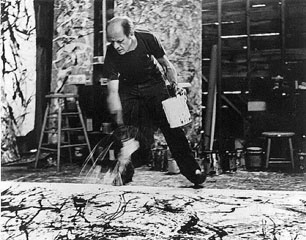
Namuth's problem was also a media problem. Still photographs could show Pollock bent over a canvas, and they did much to create the public image of the painter in motion.[3][7] But the classic poured canvases depend on sequence. The hand moves, the paint arcs, the body circles, the surface answers. A still image freezes the drama and risks turning method into pose. A conventional film angle has the opposite problem: if the camera looks at Pollock, it may lose the painting; if it looks at the painting, it may lose the body.
The short film below, commonly known as Jackson Pollock 51, is important because it tries to solve that problem rather than simply celebrate the artist.[1][2] It was directed by Hans Namuth and Paul Falkenberg, includes music by Morton Feldman, and was produced by Museum at Large in New York.[2] Its most famous device is the glass sheet: Namuth films from below as Pollock paints across a transparent surface. The result is not neutral documentation. It is an engineered encounter between painter, surface, camera, and viewer.
Historical Context
Pollock's mature poured method had emerged before Namuth arrived with cameras. The Art Story's biography places the decisive shift in 1947, when Pollock began flinging and pouring paint, then found that the flat floor-laid canvas let him move around the surface and work from all sides.[4] By 1950, the method had produced large works whose scale mattered as much as their surface. The point was not simply that the paintings were big; it was that their size let movement become compositional evidence.[4]
The Art Story's account adds a useful corrective to the myth of pure rupture. Pollock's mature style grew out of earlier mural scale, Surrealist ideas, Cubist space, and experiments with unorthodox painting materials, not from an ahistorical burst of instinct.[4] That context matters because Namuth's film can otherwise make Pollock look like an isolated inventor performing out of nowhere. The archival value of the footage improves when the viewer sees both sides at once: a painter working in a real historical lineage, and a camera helping to make that lineage look newly physical.
Namuth entered this moment as Pollock's public image was accelerating. The Morgan Library's collection record for Namuth's 1950 photograph notes that he met Pollock at an East Hampton gallery opening in July 1950 and, by October, had made more than five hundred photographs of the artist in his studio.[3] The Morgan also identifies one of those photographs as Pollock working on Autumn Rhythm while Number 32 hangs behind him.[3] The stills and the later film were therefore not side documents. They became part of how Pollock's art was received.
That reception is the hinge of this archival spotlight. The phrase "action painting" can become empty if it is used only as a label. Namuth's camera gives the phrase a body, a room, a floor, a pace, and a line of sight. It also creates a new risk: the artist at work can become more famous than the work itself. The footage is powerful because it lives inside that tension.
Video Provenance
The embedded video is "Jackson Pollock 51" by Hans Namuth (1951), uploaded to YouTube and widely circulated as the ten-minute film of Pollock at work.[1] The Centre du Film sur l'Art's catalogue gives the core film data: 1951, roughly ten minutes, directed by Hans Namuth and Paul Falkenberg, with Morton Feldman's music and Pollock's voice.[2] Phyllis Tuchman's later close viewing in The Brooklyn Rail notes that the film was first shown at MoMA in June 1951 and identifies its structure: an outdoor painting sequence, a panning view of paintings, and the glass-sheet sequence filmed from below.[6]
Close Reading
The early minutes of the film are less spontaneous than the Pollock legend often suggests. We see a studio environment being made legible for the camera: shoes, cans, a working surface outdoors, a painter whose movements are framed so the viewer can understand where force enters the canvas.[1][6] That framing matters. It turns a difficult abstraction into a sequence of decisions without pretending that the painting is a simple demonstration.
The strongest visual idea arrives when the camera moves under glass. Namuth wanted painter and painting in one field, and the glass sheet lets the paint appear between Pollock and the lens.[1][2][6] The viewer can see the mark as it happens, but from an angle no ordinary visitor to the studio could occupy. This is not just documentation of a method; it is a constructed viewing machine. It gives the viewer a temporary position inside the work's formation.
That machine also exposes the limits of performance. Tuchman's reading is valuable because it questions the clean match between Pollock's voice-over and what the viewer sees, especially around the glass paintings and the materials placed on the surface.[6] The point is not that the film is false. The point is that filming changes the act it records. Pollock is making a painting, but he is also painting under conditions shaped by the camera, by Namuth's need for visibility, and by the demand that process become shareable.
The Art Story's account of Pollock's floor-based method helps explain why the film's artifice is historically useful rather than disqualifying.[4] Pollock's major canvases register motion through paint, but they do not disclose that motion automatically. A viewer standing before the finished work must infer the circling body, the angle of the thrown line, the interruption, the return. Namuth's film gives those inferences a visual grammar. After seeing the footage, the painting no longer looks like a static web. It looks like a field of accumulated acts.
There is a danger here, and the film cannot escape it. The camera helps make Pollock understandable by turning his body into evidence. It also risks making the body into the artwork's main attraction. The better reading keeps the hierarchy straight. The film is not more important than the paintings. It is a historical instrument that shows why the paintings were hard to categorize: they are neither easel pictures nor murals, neither pure accident nor traditional composition, neither dance nor residue, but a new relation between body and surface.[4][5]
Legacy
Namuth's footage still matters because it fixed one of modern art's recurring questions: how much should a viewer know about process? If we know too little, Pollock's canvases can look like visual noise or heroic mystery. If we know only the studio performance, the paintings can collapse into personality. The film is useful when it sits between those mistakes. It shows enough method to make the paintings readable, but it also reminds us that any filmed process is already shaped by the need to be seen.[1][3][6]
That is why the archival image and the moving image belong together. The photograph freezes the floor-based method into an icon: Pollock leaning, reaching, the canvas below him.[7] The film reintroduces time, but only through a carefully invented camera solution. Together, they show that "action painting" was never only about action. It was about how action could be transferred into paint, then transferred again into public understanding through photography and film.
The final lesson is not that Namuth created Pollock's art. Pollock's paintings existed as hard, ambitious objects with their own scale, materials, and internal order.[4][5] The lesson is subtler: Namuth helped create the conditions under which viewers could see that order as the trace of a working body. The camera did not merely look at action painting. It made action painting visible as a historical problem.
Sources
- Hans Namuth and Paul Falkenberg, "Jackson Pollock 51 by Hans Namuth (1951)," YouTube video.
- Centre du Film sur l'Art, "Jackson Pollock" - film catalogue entry with date, duration, directors, music, voice, and production details.
- The Morgan Library & Museum, "Jackson Pollock Painting" - collection record for Hans Namuth's 1950 photograph and context on the studio photo sessions.
- The Art Story, "Jackson Pollock" - artist biography and account of the mature floor-based drip method, mural context, and action painting.
- Open Culture, "Watch Jackson Pollock 51, a Historic Short Film That Captures Pollock Creating Abstract Expressionist Art on a Sheet of Glass" - context on Namuth's camera problem and the glass sequence.
- Phyllis Tuchman, "Painting Pollock," The Brooklyn Rail (November 2013) - close viewing of the film's scenes, glass sequence, and voice-over problem.
- Wikipedia, "File:Namuth - Pollock.jpg" - archival Hans Namuth photograph used for the cover image.