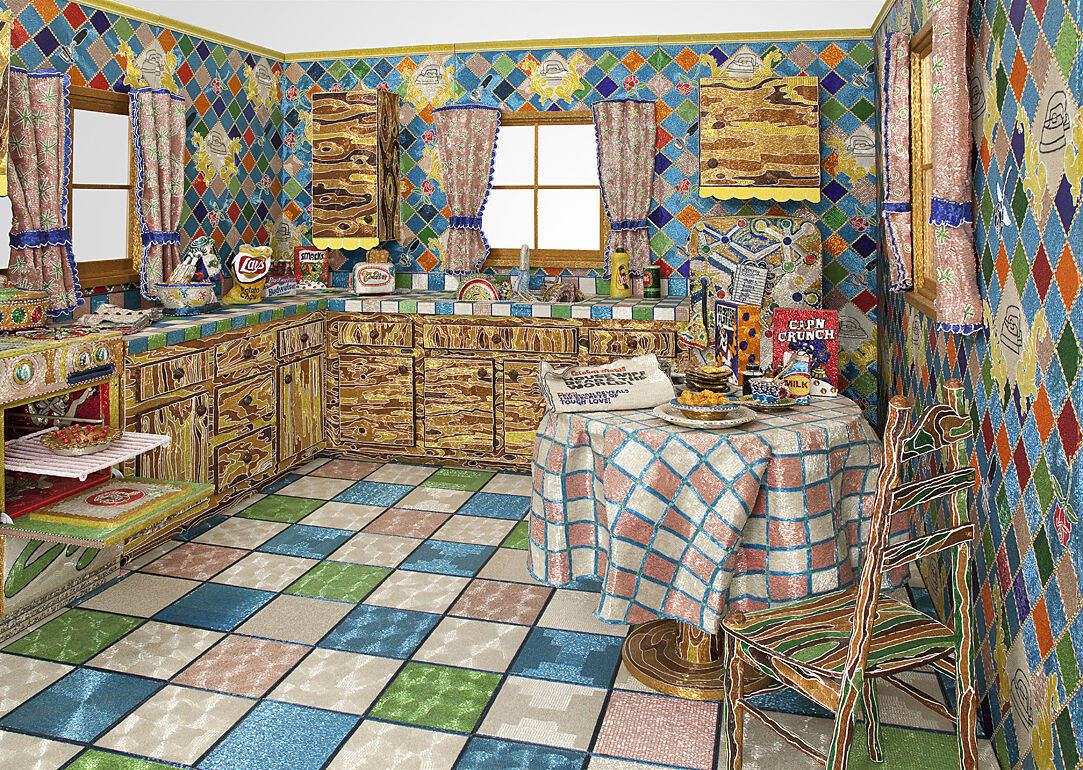
Liza Lou's Kitchen looks at first like a pop hallucination of domestic cheer: checkered floor, wooden cabinets, breakfast on the table, sink, stove, branded boxes, and the light-catching brightness of a room that seems too clean and too busy at the same time. Then the material fact catches up. The room is not painted to look glittery. It is encrusted with glass beads. The kitchen is full-scale, exacting, and almost absurdly patient.[1][3]
That is why the work should be read as a medium invention, not only as a feminist image of household labor. Lou did not add beads to a kitchen after the meaning had already been decided. She made beading the operating system of the piece. Every surface turns into evidence of handling. Every familiar object becomes a time deposit. The room's argument is not hidden behind the sparkle. The sparkle is the argument: domestic work becomes visible only when its repetitive, finishing, cleaning, arranging, wiping, and polishing motions are made impossible to ignore.[1][2]
Image context: this post uses one real photographic image of the artwork from Whitney Museum of American Art, not a diagram, generated visual, or decorative stock image. The image-work match is direct: it shows Lou's Kitchen, the installation discussed throughout the article, with enough spatial context to see the beadwork as a room-sized method rather than as a single object detail.[1]
Beads Turn Surface Into Time
Whitney's collection record gives the basic scale: Kitchen was made between 1991 and 1996, measures 96 by 132 by 168 inches, and uses glass beads, plaster, wood, and found objects.[1] Those dimensions matter because the work does not operate as a jewel box or tabletop craft object. It surrounds the viewer as an environment. A bead is tiny; the room is large. The tension between those two facts is where the technique begins.
A single bead is almost nothing. It is a dot of color, a point of light, a small hard unit that can be held between fingers. Repeated across a table, a cereal box, a faucet, a floor, and a pie, it becomes a different kind of mark. Paint can spread quickly. A printed image can reproduce instantly. A bead has to be placed. That difference changes the viewer's relation to the room. You do not simply see a kitchen; you infer the number of touches required to make the kitchen appear.
Whitney's label notes that Lou researched kitchen design manuals and historical writing about nineteenth-century women's lives, made drawings and models, fashioned the objects, painted them, and then applied beads as mosaic surface.[1] The sequence matters. The beads are not a late flourish. They arrive after planning, modeling, object-building, and painting, meaning the finished surface carries several layers of labor before it begins to glitter.
The result is a strange reversal of domestic invisibility. Household labor usually disappears when it succeeds: the clean dish, the wiped counter, the stocked pantry, the prepared breakfast. Lou makes that disappearance fail. The kitchen is so finished that finishing becomes the subject. Shine no longer means effort has been erased. Shine means effort has accumulated past the point of denial.
The Room Is Both Satire and Devotion
The easiest weak reading of Kitchen is that it mocks the suburban dream by making it garish. The stronger reading is that it does not let mockery have the room to itself. CBS's 2003 profile framed the work as both satire and celebration of women's work, and that double register still feels exact.[5] The kitchen is excessive, funny, lush, obsessive, and a little punishing. It loves the material too much to be simple parody, but it knows too much about domestic expectation to be simple homage.
That doubleness begins with recognition. The viewer knows the scene before the art history arrives: the sink, the table, the breakfast foods, the cabinets, the cleaning supplies, the promise that a good kitchen should be bright, stocked, and under control. The New Museum archive account of Lou's 1996 presentation in "A Labor of Love" stresses the work's familiar suburban inventory: appliances, a toaster, tiled surfaces, lacy curtains, cereal, dish soap, detergent, beer, chips, and the fictional newspaper headline "HOUSEWIFE BEADS THE WORLD!"[3] The inventory is comic because it is so specific. It is also sharp because it shows how domestic gender roles pass through commodities.
Brand detail is not incidental. It keeps the kitchen from becoming timeless. This is not a mythic hearth or a neutral room for abstract care. It is a consumer kitchen built from recognizable packages, advertised cleanliness, processed breakfast, and the promise that domestic order can be purchased, repeated, and displayed.[1][3] Lou's beads do not remove that commercial language. They intensify it until every package looks both desirable and trapped inside its own sparkle.
The work's feminism sits there, in the collision between pleasure and pressure. The room is beautiful because the beads make color active. It is troubling because the same beauty records a workload with no natural endpoint. CBS preserves Lou's point that the task "never ends," but the installation's best proof is visual rather than verbal: even dust, dishes, breakfast, and cleaning products have become sites of meticulous application.[5]
Craft Stops Being a Category Problem
Lou's choice of beads also pressures the old hierarchy between fine art and craft. MacArthur's 2002 profile describes her as creating large works that merge fine art and craft, and notes her use of materials such as papier-mache, fiberglass resin, wood, found materials, acrylic paint, and glass beads.[4] That mixture is important because Kitchen does not ask beads to imitate marble, bronze, or oil paint. It lets beads remain beads: small, decorative, tactile, luminous, and historically easy to dismiss.
CBS's profile gives the social edge of that dismissal. Lou recalled that teachers saw beadwork as the wrong category, closer to jewelry or craft than fine art.[5] Kitchen answers by scaling the supposedly minor material until the category problem becomes ridiculous. If beads are "only" decorative, why can they hold a room, a politics of labor, a consumer critique, and a five-year record of attention?
The Whitney's 2020 media note on the making of Kitchen calls the installation a tribute to the unsung labor of women over time, while also emphasizing the glittering pop vision of suburban happiness created through cereal boxes, Emily Dickinson, and everyday drudgery.[2] That phrasing helps because it refuses to split craft from concept. The work is about labor partly because the viewer can feel labor in the medium. The beads do not illustrate the idea of work. They are work arranged into image.
This is also why Kitchen should not be filed too neatly under "craft revival." The work is not valuable because it rescues a humble material and lifts it into art-world legitimacy. That would leave the hierarchy intact. Lou does something more disruptive: she makes the hierarchy look incapable of describing what is in front of it. The same bead can be ornament, pixel, mosaic unit, evidence of touch, feminist marker, pop surface, and sculptural skin.
Scale Changes the Ethics of Looking
The full-scale room matters because it makes looking bodily. A small beaded object can be admired at a distance as virtuosity. Kitchen is harder to keep at that distance. It asks the viewer to imagine entering a room whose every available surface has already been touched by someone else's concentrated time. That can feel wondrous, but it can also feel claustrophobic. A kitchen is supposed to support movement; Lou's kitchen makes every movement accountable to labor already performed.
MacArthur's profile identifies the work as a 168-square-foot replica of a typical American kitchen of the 1950s, including a sink, a pie cooling on an oven rack, and dust balls under the refrigerator.[4] Those dust balls are the perfect detail. They prevent the piece from becoming an idealized showroom. Lou does not bead only the surfaces that domestic display wants seen. She beads the residue too.
That decision changes the ethics of the installation. A spotless kitchen often implies that labor has been successfully hidden. Lou makes even hidden dirt precious, ridiculous, and visible. The viewer cannot consume cleanliness as a smooth image. The room keeps redirecting attention to the kind of care, boredom, repetition, and surveillance that domestic cleanliness historically demanded from women.
The New Museum archive's labor framing strengthens this reading. "A Labor of Love" asked how labor relates to the perceived value difference between high art and craft, and placed Lou's work inside a broader argument about media historically categorized as marginal, domestic, or feminine.[3] Kitchen does not simply represent that debate. It stages it in a form that makes evasion difficult. If the viewer likes the spectacle, the viewer is already valuing the labor that made it.
The Later Work Makes the Early Method Clearer
Lou's later career helps clarify what Kitchen was already doing. In a 2026 interview with The Art Newspaper, Lou describes materiality and beads as a conceptual project for questioning what counts as a valid art material and who gets included in the canon.[6] That later formulation is useful retroactively. In Kitchen, beads do what paint cannot by turning surface into accumulated duration.
The later work also shows that the early installation was not a novelty stunt. Lou has kept returning to beads as units of color, light, touch, and labor.[6] The medium is not a gimmick that happened to produce one spectacular room. It is an inquiry into how small repeated actions become form, how a material associated with ornament can carry seriousness without ceasing to be ornamental, and how making itself can remain visible inside the finished object.
Seen that way, Kitchen is less a frozen 1990s pop environment than a durable test of artistic value. It asks whether viewers can take a surface seriously when it sparkles. It asks whether domestic objects become more or less legible when they are overworked. It asks whether the labor of making can answer the labor represented by the subject. Most of all, it asks what happens when a material long treated as peripheral refuses to stay small.
The answer is not that beads redeem the kitchen by making it beautiful. The sharper answer is that beads make the kitchen answer back. They make every appliance, box, dish, crumb, and patch of floor insist on the time buried inside ordinary order. Lou's achievement is that the room does not choose between delight and critique. It makes delight do critique's work.
In Kitchen, domestic labor is not pictured from outside. It is built into the surface, one glittering unit at a time.
Sources
- Whitney Museum of American Art, "Liza Lou, Kitchen" - official collection page and API record for date, medium, dimensions, accession data, object description, image, and collection context.
- Whitney Museum of American Art, "The Making of Liza Lou's Kitchen" - museum media note on the five-year making process, tribute to women's labor, and the installation's glittering pop vision of domestic life.
- New Museum Digital Archive, "Bodies, Commodities: Labor, Circulation, and Gender in the New Museum Archives" - archive essay with 1996 Kitchen installation context, "A Labor of Love" framing, and detailed inventory of the beaded kitchen.
- John D. and Catherine T. MacArthur Foundation, "Liza Lou" - 2002 MacArthur Fellows profile on Lou's materials, first major work Kitchen, 168-square-foot scale, and broader bead environments.
- Rome Neal, "Creating Art, One Bead At A Time," CBS News, February 7, 2003 - profile covering Lou's art-school category conflict, the making of Kitchen, Marcia Tucker's response, and the work's relation to women's domestic labor.
- Caroline Roux, "'It was my job to create the view': US artist Liza Lou on making colourful works in her windowless warehouse," The Art Newspaper, April 15, 2026 - interview on Lou's bead practice, color, solitude, and beads as a conceptual test of valid art materials and canon inclusion.