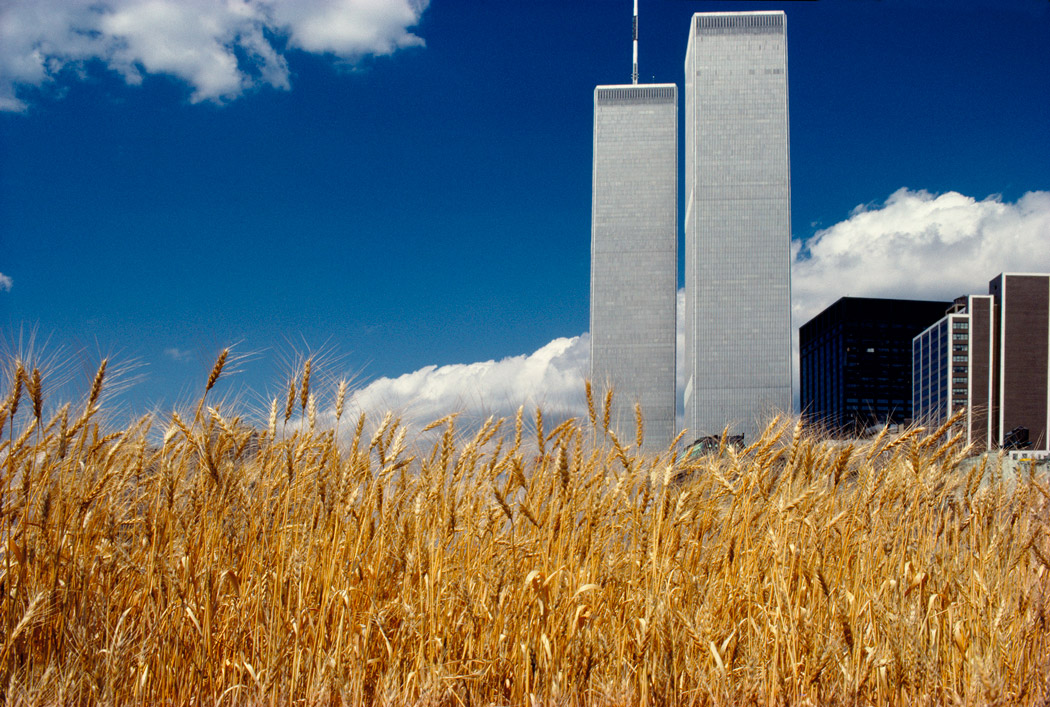
Agnes Denes's Wheatfield-A Confrontation is strongest when it is read as a working field, not only as an unforgettable photograph. The image is startling: wheat in lower Manhattan, the World Trade Center rising behind it, the harbor nearby, the future Battery Park City still loose enough to be planted. But the photograph matters because it records a real season of labor. Denes and her assistants did not merely stage an agrarian symbol in front of finance. They turned rubble-strewn landfill into a temporary crop system, then let the city watch land value behave like soil.[1]
That distinction keeps the work from becoming a simple visual joke. Public Art Fund's exhibition record says the 1982 project involved planting and harvesting wheat at the Battery Park City landfill from May through September, with furrows dug by hand, rocks and garbage cleared away, irrigation set up, the crop maintained for months, and nearly a thousand pounds of wheat harvested in August.[1] The artist's own project statement, preserved on the same page, frames the field as a confrontation with food, energy, commerce, trade, economics, waste, hunger, and ecological concern.[1] Those are large abstractions. The brilliance of the work is that Denes made them grow by inches.
Image context: the cover photograph comes from Public Art Fund's archival gallery for the 1982 project.[1] It is not a diagram, a rendering, or a generated illustration. Its force comes from documentary specificity: a bright field in the foreground, towers in the background, and a site whose future development pressure is already visible in the skyline.
The field was a temporary accounting system
The first thing Wheatfield counts is not money, but time. A speculative parcel can be valued instantly; a crop cannot. It has to be seeded, watered, weeded, protected, and harvested. Denes's field therefore inserted an agricultural clock into a city trained to read the same ground through finance, development, and circulation. The work did not deny that the land was valuable. It asked what kind of value becomes visible when an urban site is forced to feed a living process for four months.[1][4]
That is why the labor details matter so much. Two hundred truckloads of dirt, hand-dug furrows, rock removal, mildew control, irrigation, and harvest are not backstage logistics. They are the artwork's grammar.[1] The field made a proposition that could not be completed by concept alone. Wheat had to germinate. Weather had to cooperate. People had to keep returning. Maintenance, not spectacle, made the confrontation credible.
Seen this way, the work belongs to Denes's larger role as a pioneer of environmental and conceptual art. Public Art Fund describes her practice as linking ecological degradation, sustainability, food scarcity, land use, and resource mismanagement; Whitney similarly identifies Wheatfield-A Confrontation as one of the iconic works in a career spanning ecological art, philosophical systems, drawings, and large public projects.[2][3] The field therefore was not a one-off stunt. It was a temporary instrument for making systems visible.
Manhattan was not a backdrop
It is tempting to treat the skyscrapers as scenery, as if Denes placed nature in front of capitalism and let the contrast explain itself. The better reading is sharper. Manhattan was part of the medium. The field worked because the site was so compressed with incompatible claims: landfill, future real estate, harbor edge, financial district, public art commission, crop land, post-industrial rubble, and civic image.[1][4]
The Guardian's later account of the project emphasizes the same paradox: a wheat field on a multibillion-dollar patch of New York land became newly prophetic as urban land grew more expensive and ecological questions became harder to ignore.[4] That retrospective framing is useful, but it should not make the 1982 work look merely ahead of its time. It was also exact about its own moment. Battery Park City was not yet the polished district it would become. The field occupied a transitional site, a place where development had not fully converted ground into property image.
That transition is what the wheat interrupts. A normal development narrative treats empty land as waiting for its highest use. Denes made the emptiness productive in another register. The wheat did not compete with towers on financial terms. It exposed the narrowness of those terms. For one season, the land could be valued by germination, yield, public attention, and the awkward fact that food systems are usually kept far from the places where capital is concentrated.
The beauty is not innocent
The work's beauty is part of its difficulty. Golden wheat under a blue sky can feel pastoral, even soothing. That is dangerous if it turns the project into nostalgia for a pure countryside. The field was never pure. It was planted on landfill, maintained through imported soil and urban infrastructure, and framed by the towers of global commerce.[1][5] Its beauty came from friction, not escape.
Recent criticism has rightly pressed on this point. ArtReview's essay on the revived interest in Wheatfield warns against missing the work's harder political and ecological stakes by sentimentalizing it as a lovely rural apparition inside the city.[5] That warning improves the work rather than diminishing it. Denes's field is not valuable because wheat is morally cleaner than finance. It is valuable because it forces the two into the same frame and refuses to let either remain abstract.
The crop also complicates the usual land-art story. Many canonical earthworks are remembered through scale, remoteness, excavation, or command over terrain. Denes used a city site and a living material that had to be tended. The result is not mastery over land but dependency on land processes. The artwork succeeds only if the nonhuman part of the work does something. Wheat is not a passive symbol attached to a site; it is a collaborator with a schedule.
The harvest made the image accountable
The August harvest is the article's key. Without it, Wheatfield would risk becoming a photogenic contradiction: skyscrapers plus crop, city plus country. With it, the contradiction becomes accountable. Public Art Fund records that the crop yielded almost a thousand pounds of wheat, and Denes's project statement says the grain later traveled through The International Art Show for the End of World Hunger.[1] The field therefore did not end as a photograph alone. It ended as material that left the site.
That does not mean the work solved hunger or land misuse. It did something more modest and more durable: it changed the terms under which those problems could be seen. Hunger, ecology, and commerce are often discussed at scales so large that no single viewer can feel implicated. Denes compressed them into a field small enough to walk beside and large enough to look impossible in its setting.[1][2][4]
This is why Wheatfield-A Confrontation still feels fresh. It does not ask viewers to choose between image and system. The image is the system made briefly visible. The field is beautiful because it is temporary; political because it is cultivated; ecological because it depends on care; conceptual because it makes value argue with itself. Denes did not decorate Manhattan with wheat. She made Manhattan answer, for one growing season, to the slower intelligence of a crop.
Sources
- Public Art Fund, "Wheatfields for Manhattan" - exhibition record, archival photo gallery, project dates, labor details, artist statement, harvest, and commissioning context.
- Public Art Fund, "Agnes Denes" - artist biography describing Denes's ecological, land-art, and public-action practice.
- Whitney Museum of American Art, "Agnes Denes" - artist record identifying Wheatfield-A Confrontation within Denes's broader ecological and conceptual practice.
- Katy Hessel, "A field of wheat on a $4.5bn patch of New York: the prophetic eco art of Agnes Denes," The Guardian, July 18, 2022 - retrospective account of the project's land-value and ecological stakes.
- Amber Husain, "You're Missing the Point of Agnes Denes's 'Wheatfield'," ArtReview, March 26, 2025 - critical essay on the risks of sentimentalizing the work's pastoral image.