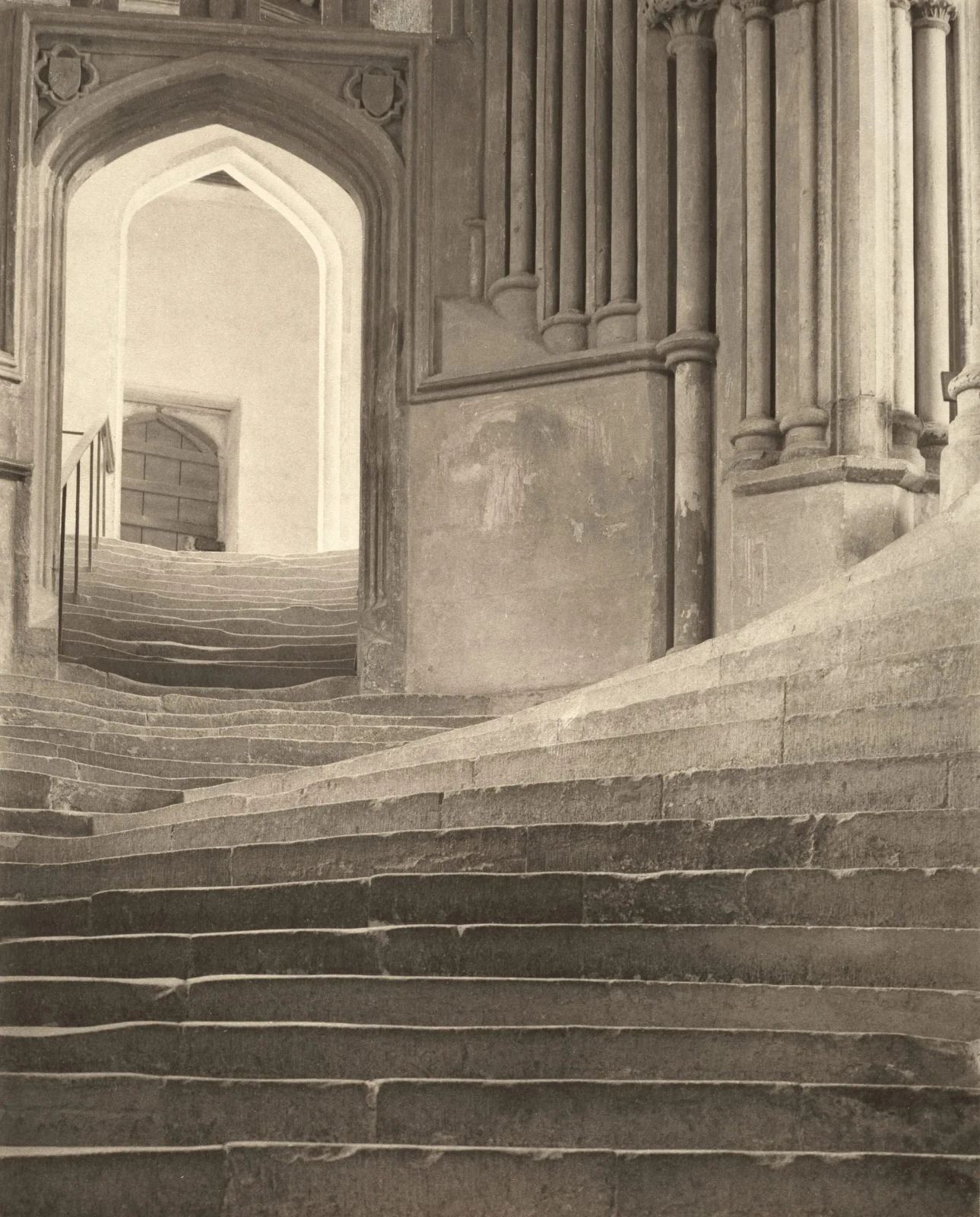
The steps are stone, but their edges seem to move. In Frederick H. Evans’s A Sea of Steps — Wells Cathedral, shallow hollows run across the staircase like overlapping waves. Beyond them, pointed arches draw the eye upward. The columns at the right hold their vertical lines while the stairway appears to billow around their feet. Nobody occupies the scene; the worn treads supply the absent bodies.
LACMA dates this photograph to 1903 and identifies its print as platinum. The image measures only about 23 by 18 centimeters: an architectural ascent held on a modest sheet.[1] Its drama depends on distinctions within the middle tones. The hollows remain separate from the risers; pale stone keeps its weight; the dark doorway recedes without swallowing the whole picture.
That makes it a useful place to begin thinking about photographic printing. The camera established the view, but the finished photograph also required a material capable of carrying those relationships. Platinum offered photographers a particularly expressive range of possibilities between the negative and the sheet they would exhibit.
Light leaves a metal image
In the developing-out platinum process described by MoMA, paper is sensitized with iron oxalate and a platinum salt. After exposure, a potassium oxalate developer brings out the image. Clearing and washing remove residual chemicals, leaving tiny particles of metallic platinum.[2]
Contact printing places the negative directly against the sensitized sheet. Its dimensions therefore determine the image size at this stage; an enlarged negative can be prepared when a larger print is wanted.[2] The relationship is physical and close: negative, paper, and light meet without an enlarger projecting the final image onto the sheet.
The National Gallery of Art describes platinum particles lodged among the paper’s upper fibers. The support consequently participates in the photograph’s appearance. Platinum surfaces can range from matte to a noticeable sheen, and their tones extend through pale highlights, grays, browns, and deep blacks.[4] A museum label saying “platinum print” identifies a family of objects, not one compulsory finish.
In Evans’s staircase, that distinction encourages a slower look. Follow the bright edge of a tread into its shaded hollow. The passage between them gives the stone its contour. Calling the photograph simply “soft” misses how much precise spatial information those intermediate tones can carry.
One negative, several interpretations
Platinum printing allowed decisions that a digital reproduction can conceal. Sensitizer and developer chemistry, the temperature of development, and the moisture in the paper could all affect the result. The National Gallery’s study of Alfred Stieglitz also distinguishes Willis’s developing-out process from Pizzighelli’s direct process, in which moisture enables image formation without a separate chemical developer.[3] The sequence described above was an important method, rather than a universal recipe.
The Gallery’s examination of three Stieglitz prints from the same negative, Sunlight Effect, Gutach, makes the differences tangible. X-ray fluorescence detected platinum in all three. One strongly sepia print also contained mercury, an additive used to produce that hue. Another warm version lacked mercury; the researchers identified it with the direct process, in which drying the sensitized paper before exposure could produce warmth.[3]
The subject had stayed put while the print changed. A viewer choosing among such versions would be choosing among different organizations of the same recorded light. Warmth could make a scene feel enveloping; a cooler rendering could make its divisions feel more severe. Those are interpretive possibilities, not a formula for every viewer’s response.
They also set a useful limit on what we can infer from Evans’s reproduction. Its warm appearance is visible, but neither a screen image nor the word “platinum” tells us his exact chemistry. LACMA’s record establishes the medium; it does not provide a printing recipe.[1] The pleasure of looking survives that uncertainty. We can describe the relationships in front of us without inventing the decisions behind them.
A fine-art surface with an industrial dependency
Platinum’s tonal range helped it find an audience among the pictorialists, who argued for photography as artistic expression. As the National Gallery’s exhibition account explains, some favored an unmanipulated platinum photograph, while others combined platinum with other processes to build more elaborate surfaces.[4] The medium could support different ideas of what photographic authorship should look like.
Its availability also depended on the world beyond the studio. Getty dates the process’s introduction to 1873 and notes that restrictions on platinum during the First World War pushed manufacturers toward alternatives.[6] MoMA records the introduction of commercial palladium paper during that war as a less expensive substitute for scarce platinum paper.[2]
A change of paper could therefore begin with supply and end as an aesthetic decision. The history complicates any account in which photographers simply selected their ideal materials from an unlimited shelf. What they could buy helped determine what they could make—and which qualities they learned to value.
Permanent metal, vulnerable photograph
Platinum acquired a reputation for permanence because its image metal is stable. That reputation needs a second sentence. In his conservation study, Adam Gottlieb distinguishes the durability of the metal from the condition of the paper supporting it. Platinum’s catalytic activity can accelerate paper embrittlement and contribute to image transfer onto adjacent material.[5] A surviving metal image does not guarantee a sound photographic object.
This matters aesthetically as well as physically. When the paper changes, the light passages against which we read the darker image can change too. Conservation therefore concerns the tonal relationships that make the photograph legible, as well as the sheet’s ability to remain intact.[5]
Return to the cathedral steps. Their strongest effect lies in the interval between the tread and its hollow, the lit stone and the dark opening. A digital reproduction lets us follow those intervals while offering only limited evidence of the original surface. The platinum print asks us to hold both kinds of attention together: to the space Evans photographed and to the small, worked sheet that makes that space available.
Sources
- Los Angeles County Museum of Art, “A Sea Of Steps — Wells Cathedral,” Frederick H. Evans, 1903 — object metadata and source of the reproduced platinum print, M.2008.40.736.
- The Museum of Modern Art, Object:Photo, “Materials: Glossary” — contact printing, enlargement, platinum processing, and palladium paper.
- National Gallery of Art, “Stieglitz’s Practices and Processes,” 2020 — platinum processes, tonal controls, and analysis of the Gutach prints.
- National Gallery of Art, “A Subtle Beauty: Platinum Photographs from the Collection” — paper fibers, surface variation, tonal range, and pictorialist uses.
- Adam Gottlieb, “Chemistry and Conservation of Platinum and Palladium Photographs,” Journal of the American Institute for Conservation 34, no. 1, 1995, section 2 — process history and the distinction between stable metals and vulnerable paper.
- J. Paul Getty Museum, “In Focus: Platinum Photographs” — introduction of the process and restrictions on platinum during the First World War.