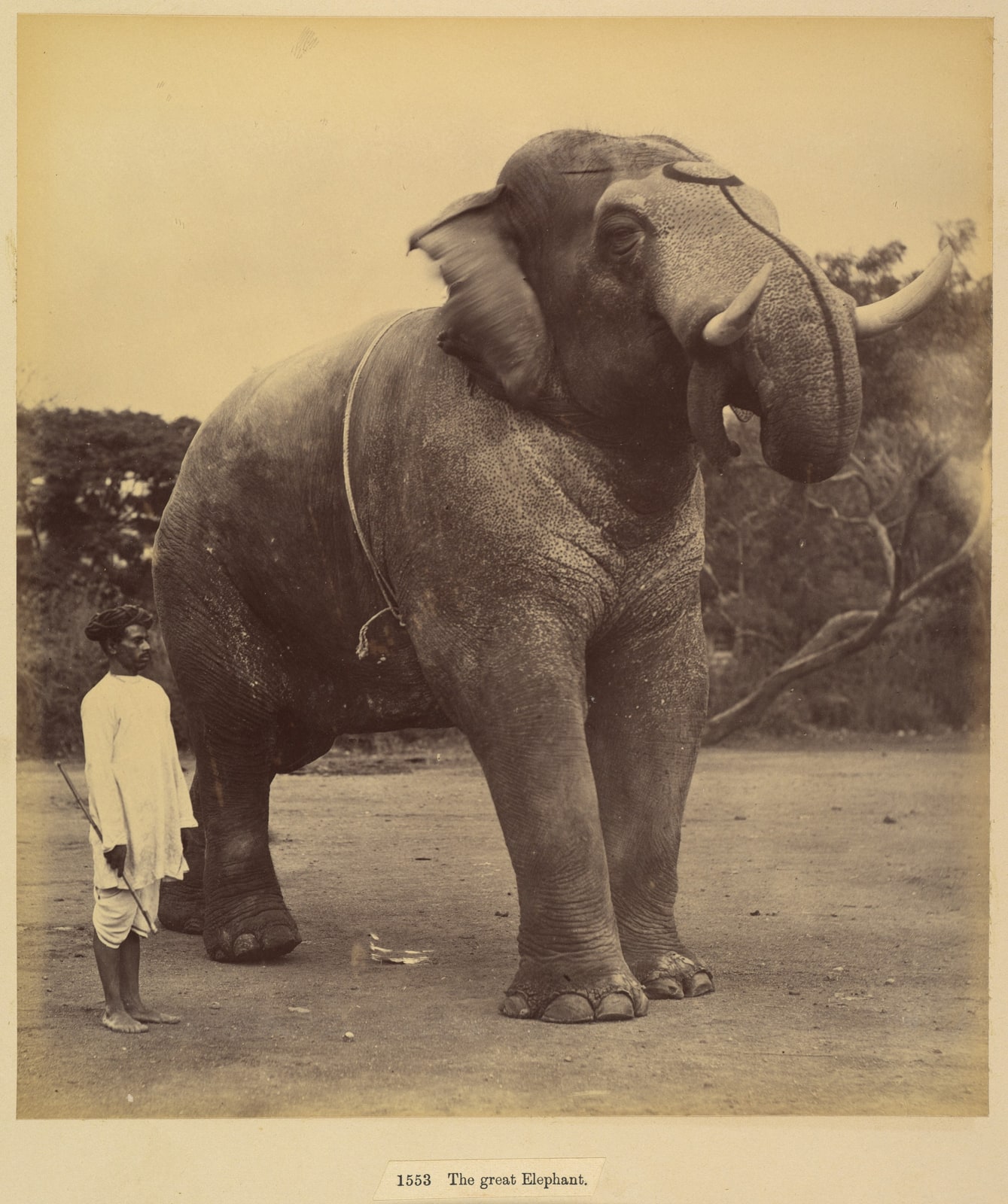
The elephant almost fills the photograph. Its trunk curls between long tusks; a man in white stands beside its immense flank, his head well below its shoulder. The low viewpoint gives the animal a commanding presence, while the man's full-length figure makes its scale immediately legible. Lala Deen Dayal's The Great Elephant gives an animal the attention usually reserved for a distinguished sitter.[1]
The Met dates the photograph broadly, to 1885–1900, and identifies its material precisely: an albumen silver print made from a glass negative. Its paper border and small title label survive in the museum reproduction. We encounter both an animal and a photographic object prepared for someone to look at.[1]
Dayal became one of nineteenth-century India's most successful photographers by moving among public works, princely households, and commercial portrait studios. His career makes access part of the history of photographic art: where the camera could go, who wanted a picture, and how an image would travel all helped determine what could be made. Technical judgment and social relationships developed together.[2]
Learning to make a place legible
Born in Sardhana in 1844, Dayal trained at Roorkee's civil engineering college and worked as an estimator and draughtsman in Indore. The Indira Gandhi National Centre for the Arts traces his early patronage through Maharaja Tukoji Rao II to the British official Henry Daly.[3]
The route matters. A draughtsman learns to organize space so that another person can understand it. Photography offered a different means of describing buildings, terrain, and distances, with the additional power of light and texture. It would be too neat to explain every later composition through his training, but his early employment gives architectural clarity a practical history.
In their 2013 exhibition, the Royal Ontario Museum and the Alkazi Collection placed his early photographs within colonial public works. That setting changes how we encounter a handsome view. The pleasure of looking coexisted with administrative interests in making places visible and knowable. Dayal's authorship developed inside those institutions, with opportunities and expectations attached.[2][4]
He eventually tested whether photography could support him independently. According to the ROM's account, he took a two-year furlough in 1885 before leaving government employment. The decision was a professional gamble with a gradual transition: he could try the market before surrendering his salaried position.[2]
The court beyond the portrait chair
Hyderabad gave Dayal sustained contact with a different kind of institution. The IGNCA records his work for Mahbub Ali Khan, the sixth Nizam: palace interiors, hunting, visiting dignitaries, processions, and famine relief. Pleasure and public responsibility both entered the court's photographic record.[3]
Such pictures could do several jobs. They preserved an occasion for its participants, displayed wealth or authority, and supplied images that could circulate beyond the people present. Those functions help explain why a court needed a photographer repeatedly. A reign generated a succession of appearances, each with a different audience.
The Met's album The Royal Visit to Hyderabad (Deccan) January 1889 preserves that connection between an event and a photographic product. Its title fixes an occasion; its albumen prints gather views into a substantial bound object. The museum emphasizes Dayal's unusual access to court festivals, people, and events.[5]
Access, however, is a condition of knowledge rather than a guarantee of completeness. A photographer welcomed by a ruler sees things an outsider cannot, while also working within the ruler's world. I read the court pictures with that double possibility in mind: they offer proximity to people and ceremonies, and evidence of how a household wished to appear. Neither possibility cancels the other.
That is also a reason to resist making the elephant photograph illustrate a particular royal occasion. Its collection record does not identify one. The broader career supplies context; it cannot supply a missing caption.[1]
When a name becomes a firm
By the height of his career, Dayal's name belonged to an enterprise as well as an individual. The Alkazi Foundation describes studios in Indore, Secunderabad, and Bombay, with more than fifty photographers and assistants and an output exceeding 30,000 images. Those totals concern a working organization. They should make us curious about the people behind a studio attribution.[4]
The IGNCA catalogue identifies a family group from about 1901 as a photograph by Adam Khan, Dayal's assistant, and attributes other images to Dayal's son Gyan Chand. The archive itself makes multiple hands visible.[3]
Consider what an album required beyond the initial exposure: a usable negative, a print, a choice of images, an order, and a finished object for a client. The surviving albums invite attention to that chain of decisions. A successful photographic business had to make good pictures and deliver them in forms people wanted to keep.
The 2013 exhibition made this business visible through commissions and prices, alongside architecture and portraiture. That curatorial choice is valuable because it lets commerce enter the account of artistic achievement. A photograph's address to its purchaser is part of its form: the grand view, the flattering likeness, and the commemorative sequence all anticipate someone looking.[4]
Looking back through the glass
Dayal died in 1905.[2] The IGNCA later acquired glass negatives and equipment from his descendants, preserving the physical tools behind the apparent ease of the image.[3]
His legacy becomes more interesting when we allow those different objects to remain different. A negative records an exposure. A print has a surface and scale. An album establishes a sequence. A studio name records a reputation, but may leave particular workers unnamed. Together, they give us a richer artist profile than a parade of famous patrons.
Return to The Great Elephant with that career in mind. The photograph can still arrest the eye as a single image. Around it, however, another field becomes visible: training, equipment, permission, skilled labor, and the prospect of a viewer. Dayal's achievement was to make pictures compelling enough to travel through that field and survive beyond it.
Sources
- The Metropolitan Museum of Art, Lala Deen Dayal, The Great Elephant, 1885–1900, accession 2011.599.1b — artwork metadata and the archival photograph reproduced here.
- Royal Ontario Museum, “Between Princely India & the British Raj: The Photography of Raja Deen Dayal,” April 2, 2013 — exhibition research, public-works employment, commercial transition, and biographical dates.
- Indira Gandhi National Centre for the Arts, The Legacy of Raja Deen Dayal, exhibition catalogue, 1993–1994, PDF pp. 1–4 — training, early patronage, court subjects, and the surviving negatives and equipment.
- Alkazi Foundation for the Arts, “Between Princely India & the British Raj: The Photography of Raja Deen Dayal,” 2013 exhibition account — studio locations, collective production, commissions, and the exhibition's interpretive framework.
- The Metropolitan Museum of Art, The Royal Visit to Hyderabad (Deccan) January 1889, accession 2021.381.4 — album metadata and Dayal's access to the courtly world.