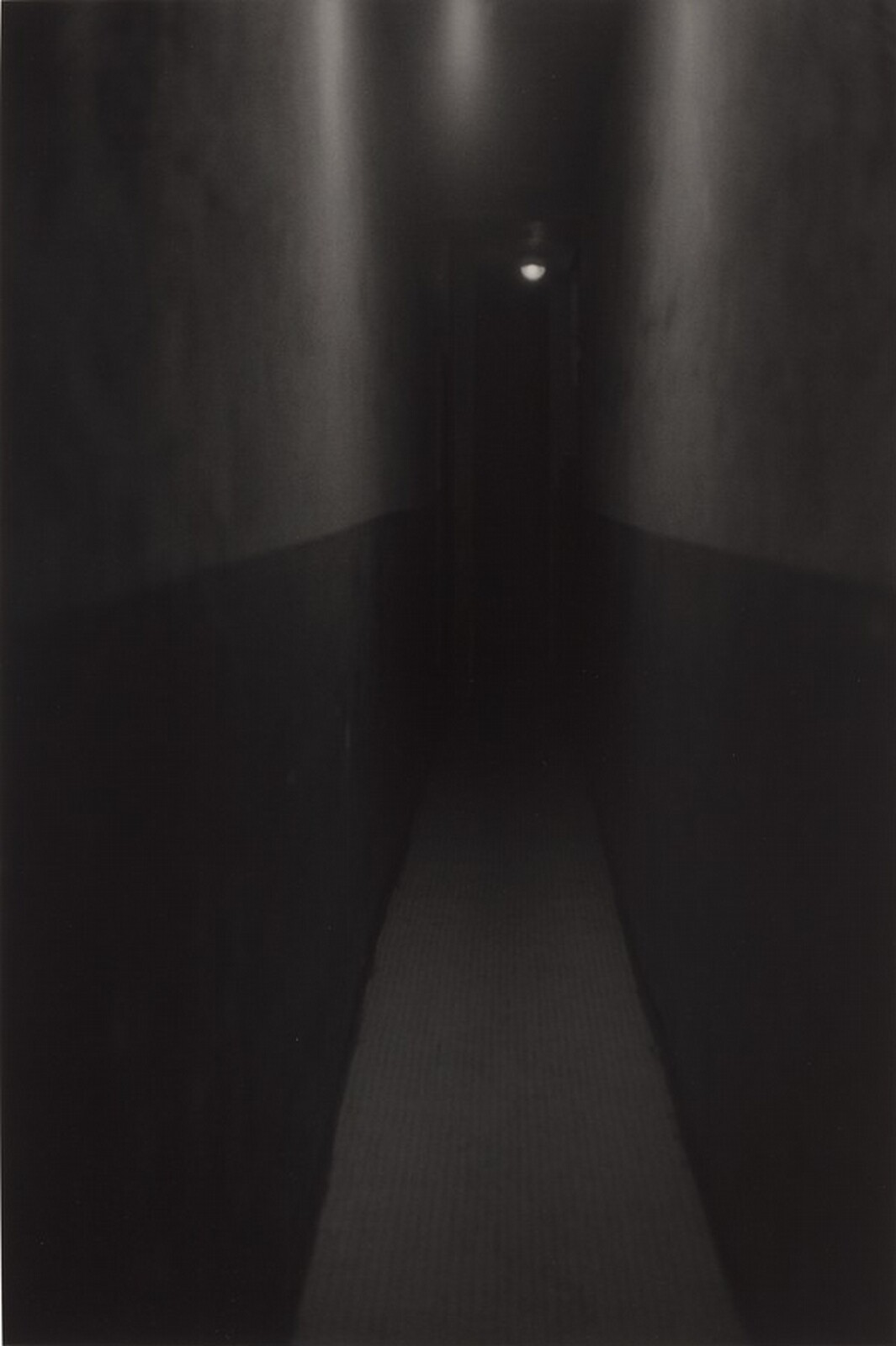
A ceiling light hangs over a narrow corridor. The walls recede; the doorways thicken into black. In Roy DeCarava’s Hallway (1953), an everyday passage becomes a place where looking takes time. There is no person to identify and no incident to explain. The small differences between one shadow and another have to carry the picture.[1]
That demand for attention runs through DeCarava’s career. He photographed Harlem families, workers, children, and jazz musicians, but his ambition exceeded collecting recognizable subjects. He wanted room for an individual artistic vision within the representation of Black life. Darkness was one of his means: a way of keeping the atmosphere of a place while asking viewers to meet it on its own terms.[2][3]
A painter learns to stay with the light
Born in Harlem in 1919, DeCarava trained in painting and lithography at Cooper Union from 1938 to 1940, then studied at the Harlem Art Center and the George Washington Carver School. His early camera work supplied material for paintings and prints. By the end of the 1940s, photography had become his principal medium.[3]
The change matters because his photographs retain the sense that a picture must be made, even when its subject is found. A wall, a shoulder, or a pool of shadow has a place within the whole. Recording what stood before the lens is the beginning of that work.
In 1952, he became the first African American photographer awarded a Guggenheim Fellowship. The grant gave him time to pursue Harlem’s daily life. The National Gallery emphasizes his commitment to available light, without flash or artificial illumination.[2]
Look again at Hallway. Brightening every recess would make the architecture easier to inventory. It would also alter the experience that gives the photograph its force. Here, distance emerges unevenly: the eye advances where light permits, then slows at a dark opening. The corridor is legible without becoming fully exposed. That is my reading of the image, rather than a claim about what happened in this particular building.[1]
Available light also makes a practical artistic commitment. The photographer accepts that the world will offer unequal visibility. DeCarava turned that condition into a vocabulary of subtle distinctions, rather than treating it simply as an obstacle to a usable photograph.[2]
Harlem speaks in more than one voice
DeCarava’s photographs reached a wider readership through The Sweet Flypaper of Life, published in 1955 with text by Langston Hughes. Hughes selected 141 images from a group DeCarava assembled and wrote a fictional narrative around them. Its speaker, Sister Mary Bradley, is an older Harlem woman whose attachments to family and neighborhood keep her entangled in living.[4]
The fiction is essential to understanding the book. Sister Mary’s account is a literary construction, not a transcript of the photographed people’s testimony. The pictures and the voice operate together, but they have different kinds of authority. A camera records a person’s appearance at a moment; a narrator supplies relationships, memories, and an unfolding story.[4]
That arrangement makes the book richer than an illustrated report. It also asks readers to be careful. Knowing the narrator’s account does not mean knowing everything about a face. The photographed person retains an existence beyond the page.
The Whitney’s discussion of Shirley looking down stairwell (1952), included in the book, identifies its sitter as part of the Murphy family, whom DeCarava photographed at home. The museum places his work against earlier documentary projects that surveyed Harlem, emphasizing the interior lives of individuals within the community.[3]
The difference is visible in the attention granted to a pause. A family member looking down a stairwell can matter without illustrating an emergency or standing for an entire neighborhood. DeCarava’s intimacy gives ordinary experience enough weight to sustain a photograph.
Hearing through a still image
Jazz supplied another sustained field of attention. MoMA’s account of his career dates the beginning of his major series of jazz musicians to 1956 and names Billie Holiday, Milt Jackson, and John Coltrane among its subjects. A selection appeared at the Studio Museum in Harlem in 1983 as The Sound I Saw.[5]
The title offers a useful challenge. A photograph cannot preserve the notes. It can attend to the people making them, to their concentration and physical presence, and to the space in which listening happens. Seen within DeCarava’s wider practice, a musician belongs to the same world of felt experience as a child or worker.
It is tempting to call every off-center composition an improvisation and every dark interval a musical rest. Those analogies can become shortcuts. The more useful connection is attention: music unfolds through distinctions that disappear if a listener stops following; DeCarava’s photographs reward an equally sustained encounter with tone and form. This is an interpretive parallel, not a formula he applied to every picture.
Making a place for other eyes
A personal vision also needs somewhere to develop. In 1963, two groups of Black photographers joined to form the Kamoinge Workshop. An account drawn from Louis Draper’s archive records that the group invited DeCarava to become its director because of his experience. His presence connected younger photographers with someone who had already pursued artistic autonomy through the camera.[6]
The workshop made that pursuit collective. Members met to discuss photographs, exchange technical and professional knowledge, and support one another. As the Whitney’s exhibition history stresses, they retained distinct sensibilities while sharing a commitment to photography as an independent art form and to depicting communities they knew from within.[7]
That distinction keeps DeCarava’s influence from becoming a recipe for dark prints. A workshop devoted to individual vision could not fulfill its purpose by making everyone see alike. His example helped establish that a Black photographer could claim authorship over the shape and feeling of an image, as well as its subject.
MoMA mounted a major retrospective in 1996, bringing fifty years of work into view.[5] Yet Hallway offers a more immediate introduction than a career’s worth of milestones. Stay with its doorways for a moment. Notice how much the photograph gives through small changes in visibility. DeCarava made an ordinary space worth that time; his larger achievement was to extend the same seriousness to lives too often pictured through someone else’s expectations.
Sources
- National Gallery of Art, Hallway, 1953 — collection record, medium, credit, accession number, and the museum reproduction used here.
- National Gallery of Art, “Roy DeCarava” — Harlem background, Guggenheim Fellowship, and the commitment to available light.
- Whitney Museum of American Art, “Roy DeCarava” — training, transition to photography, and discussion of Shirley looking down stairwell.
- David Zwirner, The Sweet Flypaper of Life, First Print Press edition, 2018 — the original 1955 publication, image selection, and Hughes’s fictional narrator.
- Museum of Modern Art, “Major Publication Accompanies Roy DeCarava: A Retrospective,” January 1996 — career survey, jazz series, and 1983 exhibition history.
- The Louis Draper Project, “Kamoinge, Part I: Origins,” February 7, 2013 — account based on Draper’s archival texts, including the invitation to DeCarava to direct the workshop.
- Whitney Museum of American Art, Working Together: The Photographers of the Kamoinge Workshop, 2020–2021 — collective critique, mutual support, and members’ independent artistic practices.