Pierre Bonnard is often filed under comfort: patterned tablecloths, cats, gardens, warm rooms, Marthe in the bath. The surfaces are seductive enough to invite that shortcut. But the real engine of his art lies somewhere less restful. Bonnard painted after looking, not during it. He rebuilt rooms, windows, meals, and bodies from memory until the scene stopped behaving like immediate observation and started to feel like consciousness sorting itself out.[1][2][3]
That is why his pictures stay unstable even when nothing overtly dramatic happens. A corner slides forward, a door opens onto a garden too suddenly, a figure dissolves into wallpaper, a tabletop glows harder than a face. Bonnard's domestic world is intimate, but intimacy in his work does not settle into ease. It becomes a testing ground for how vision lingers, distorts, and returns.[1][3][4]
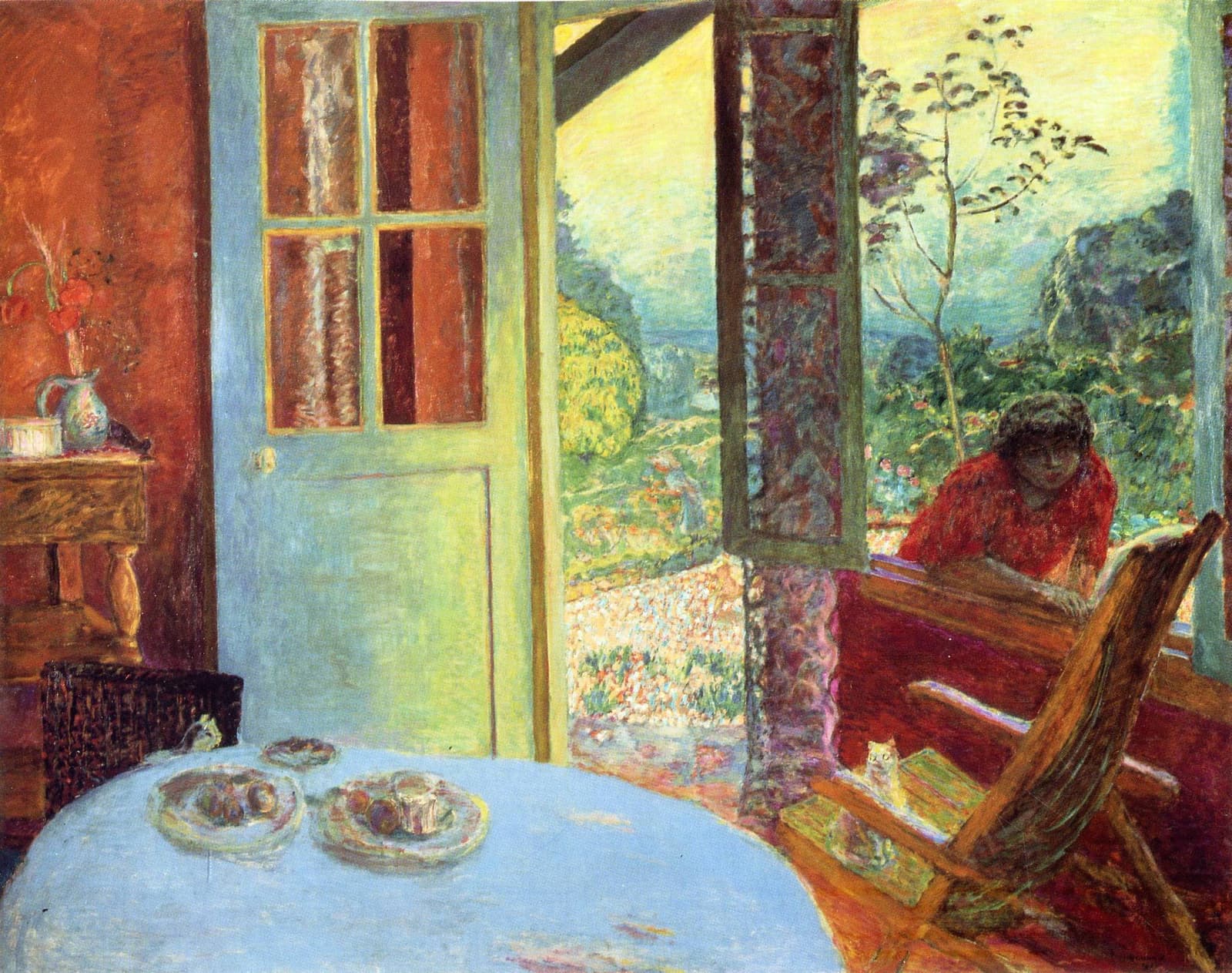
Image context: the hero image uses Dining Room in the Country (1913), because the painting condenses the profile's whole argument: interior pattern, exterior air, and Marthe's off-center body all arrive through a window threshold rather than a stable viewpoint.[4][8]
1) A decorative beginning that never stayed merely decorative
Born in 1867, Bonnard came of age in the Paris of posters, print culture, Japonisme, and the Nabi circle.[5][7] He is often described as the most intimate of the Nabis, but that can make him sound smaller than he was. What he took from the group was not only decorative flatness. He learned to let pattern move the eye laterally, to cut figures with the frame, and to treat the painted surface as an active field rather than a neutral container.[2][7]
The Guggenheim's overview of his career helps clarify that breadth: Bonnard moved through painting, printmaking, posters, illustration, and decorative projects rather than staying inside one protected medium lane.[7] He never fully abandoned that lesson. Even his later interiors keep some of the Nabi logic. They do not simply depict rooms; they spread across them.
2) He painted memory, not an instant
The Phillips Collection states the central fact plainly on its page for The Open Window: Bonnard painted from memory rather than from life.[1] That sentence explains far more than a biographical habit. It explains why his color feels both exact and belated. He is not chasing a fresh optical impression in the Impressionist sense. He is repainting what remains after sensation has already settled.
The Phillips's Bonnard's Worlds framing pushes the point further. The exhibition describes a painter whose quiet, private life fed a long practice of return, and whose compositions often place people and objects on the edge of the frame while activating the whole surface with color and what Bonnard called the "first sensation."[2] That phrase matters. "First sensation" sounds immediate, but in Bonnard the first sensation is usually reached through delay. He would revisit pictures for years, carrying old perceptions back into new work.
The Met's study Pierre Bonnard: The Late Still Lifes and Interiors describes him reworking canvases over long periods and sometimes adding new memories to pictures already underway.[3] That method turns ordinary domestic life into something stranger. A table can hold breakfast, noon light, a remembered gesture, and a later mood at once. Time accumulates inside the paint instead of moving cleanly forward.
3) The window is Bonnard's operating system
If one motif organizes Bonnard's art more clearly than any other, it is the window. The Minneapolis Institute of Art's Bonnard at the Window talk description says he was fascinated by windows because they unite interior and exterior, and it singles out Dining Room in the Country as the motif's especially rich expression.[4] That is exactly right. The window in Bonnard is never just an opening in architecture. It is a machine for merging two states of attention.
In Dining Room in the Country, Marthe de Meligny leans from outside and peers into the room rather than occupying it as a stable center.[4][8] The dining table, blue framing bars, patterned cloth, and garden light refuse to sort themselves into foreground and background cleanly. The painting feels breathable and compressed at the same time. You are inside and outside in one look.
This is a recurring Bonnard effect. Thresholds matter more than centers. Doors, mirrors, balcony rails, bathtub rims, and window casements tell the eye where to hesitate. He paints the room as a set of passages, not as a box with stable coordinates.
4) Domestic space becomes psychological space
That hesitation is why Bonnard's domestic subjects never reduce to anecdote. The Phillips press release for Bonnard's Worlds describes the exhibition moving from landscapes and terraces to dining rooms, parlors, bedrooms, and baths, with Marthe often appearing in the most private scenes.[2] But the important word there is not "private." It is "constructed." These spaces are carefully staged realms of feeling.
The Musee d'Orsay's materials on Bonnard and the Painting Arcadia exhibition help clarify the arc.[5][6] Bonnard's southern landscapes and interiors are saturated with color, yet that saturation does not read as decorative overflow alone. It reads as an attempt to make lived space hold more than one register at once: the day's light, the body's memory of it, the emotional residue that makes a room feel inhabited even when no one commands the center.
That is why Marthe matters so much. She is not only model, partner, or repeated subject. She is the figure through whom Bonnard tests how the body can half-merge with its surroundings without disappearing. Baths, dressing tables, bedrooms, dining rooms: these are the places where a person can seem most familiar and most unstable.
5) Why Bonnard still feels modern
Bonnard is sometimes treated as the last warm painter before the harder modernisms took over. That reading misses his difficulty. His pictures are modern because they distrust immediate clarity. They understand that seeing is not a single event. It is layered, revised, and vulnerable to mood.[1][2][3]
That is also why his color still feels alive in 2026. It is not merely lush. It is structural. It carries memory across the canvas and keeps objects from locking too quickly into place. In a Bonnard interior, the eye keeps having to renegotiate what counts as wall, light, cloth, body, or air.
A fast museum drill helps make the point:
- Start with the threshold: window, doorway, mirror, rail, or bath rim.[1][4]
- Track where the figure almost disappears into pattern or color.[2][6]
- Then ask whether the room feels observed in one moment or rebuilt from several.[3]
Read that way, Bonnard stops being a painter of pleasant rooms. He becomes a painter of delayed recognition, of how ordinary life returns to us after the glance has already passed.
Sources
- The Phillips Collection, The Open Window collection entry.
- The Phillips Collection, "The Phillips Collection Presents Bonnard's Worlds" (press release, December 13, 2023).
- The Metropolitan Museum of Art, Pierre Bonnard: The Late Still Lifes and Interiors (exhibition publication PDF).
- Minneapolis Institute of Art, "Talk: Bonnard at the Window" (event page on the window motif and Dining Room in the Country).
- Musee d'Orsay, Pierre Bonnard (1867 - 1947) artist record.
- Musee d'Orsay, Pierre Bonnard. Painting Arcadia exhibition presentation.
- The Guggenheim, Pierre Bonnard artist page.
- Wikimedia Commons, file page for The dining room in the country by Pierre Bonnard (1913).