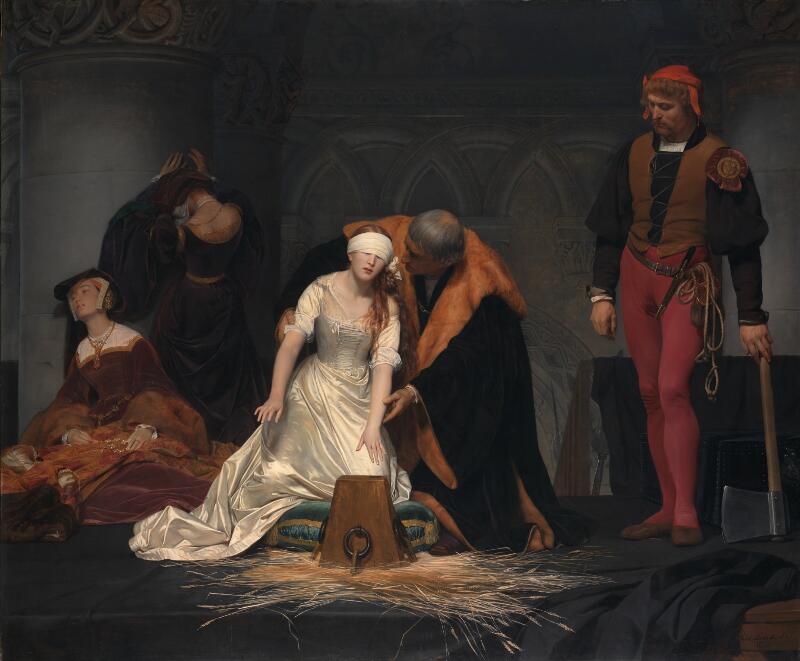
Paul Delaroche's The Execution of Lady Jane Grey (1833) still grips viewers because it does not organize itself around the fatal blow.[1][2] The picture's center is earlier and crueler: a blindfolded young woman stretching both hands into empty space, searching for the block that will steady her body for death.[1][3] Delaroche takes a Tudor execution that every history summary can compress into a line or two and re-engineers it as a prolonged interval of hesitation. Through a shallow stage-like setting, severe lighting, life-size bodies, and a carefully split pattern of witnesses, he turns historical painting into a machine for delaying impact.[1][4]
Image context: the hero image keeps the full canvas because the article's argument depends on the entire witness structure. Lady Jane's white dress matters, but so do the executioner, the two women collapsing at left, the dark architecture, and the patch of straw waiting below the block.
1) The painting begins with a missed touch
The historical outline is stark. Lady Jane Grey held the English crown for only nine days in 1553 before Mary Tudor displaced her, and she was executed at Tower Green on February 12, 1554.[1][3] Delaroche does not paint proclamation, imprisonment, or the strike itself. He chooses the moment recorded in an early Protestant martyrology: the blindfolded Jane asking, "What shall I do? Where is the block?"[1]
That choice changes the painting's emotional logic. An execution scene often pushes the eye toward weapons, authority, or blood. Delaroche makes touch do the work instead. Jane's hands move outward with caution rather than drama; they do not clutch, plead, or resist. Their uncertainty is what makes the scene hard to shake. She has already been condemned, already dressed for ritual humiliation, already led forward. Yet the picture suspends all finality inside one searching gesture.
This is where the painting becomes more precise than simple melodrama. Blindness is not only a symbol here. It is a practical condition of bodily vulnerability. Jane cannot orient herself without help. Sir John Brydges guides her, but only barely. He does not carry her. He directs her into contact with an object the viewer can already see. Delaroche makes the audience inhabit that asymmetry of knowledge: we know where the block is, and she does not.[1]
2) The room behaves like a theater built to stop time
The National Gallery's catalogue text is exact about Delaroche's method: shallow stage-like space, theatrical lighting, and life-size figures.[1] Those three choices explain most of the picture's force. The architecture recedes just enough to frame the action, but not enough to release it into breathable depth. This is an indoor chamber of compression. The dark Romanesque backdrop flattens the scene forward, as if the figures had been pushed to the lip of a stage and held there.
At the center of that compression is the white satin petticoat. The catalogue notes the radiant whiteness of the dress and ties it to innocence.[1] The fabric does something more structural as well. It catches and holds the light so completely that Jane becomes less a body in space than the light-source around which the rest of the picture arranges itself. The executioner, Sir John, the grieving attendants, even the black cloth over the platform all read in relation to that whiteness.
Delaroche's smooth, painstaking finish matters here.[4] Visible brushwork would have given viewers a reminder of paint as paint. Instead the surface aims for seamless illusion. That technical polish aligns with what the National Gallery identifies as nineteenth-century spectacle culture: panoramas, dioramas, and the tableau vivant, where costumed performers held fixed poses under dramatic lighting.[1] The picture borrows that logic without ceasing to be a painting. It asks the viewer to feel the chill of frozen theater.
3) The composition divides the labor of witness
The five figures surrounding Jane are not arranged as general atmosphere. Each one models a different relation to what is happening.[1] One lady-in-waiting has collapsed onto the floor with Jane's removed garments gathered in her lap. Another turns toward the wall and cannot watch. Sir John remains close, guiding but unable to alter the outcome. The executioner waits at the right edge with the axe lowered, his body ready yet momentarily stalled. Jane herself cannot see. Out of the whole group, nobody occupies the easy position of complete witness.
That distribution is one reason the painting still feels psychologically active. Delaroche does not simply show suffering; he stages competing forms of proximity to suffering. The attendants register grief. Sir John registers duty. The executioner, whom Delaroche revised from a more brutal early conception into a more burdened one, registers the human weight of state violence.[1] Jane, deprived of sight, registers the event through touch alone.
The viewer is drawn into that system. The National Gallery's essay puts the problem plainly: the painting forces us to choose between looking and looking away.[1] That claim is persuasive because the dilemma is already being acted out inside the picture. The women turn away or collapse; the men remain visibly functional; Jane searches in blindness. Looking becomes ethically unstable. The canvas offers no detached place from which to consume the scene as mere history.
4) Historical inaccuracy is part of the method, not a flaw to subtract
One of the most useful facts about the work is also one of the most clarifying: the execution did not happen indoors as Delaroche shows it.[1] Historically, Jane was executed outside at Tower Green.[1][3] Delaroche moves the event inside because documentary exactness is not his governing aim. He wants enclosure, darkness, and control. He wants architecture that can behave like a curtain and lighting that can isolate innocence against shadow.
That move tells you what kind of painter he is. Britannica describes Delaroche as one of the most successful academic painters of mid-nineteenth-century France, known for painstaking realism and highly finished historical subjects.[4] The realism here is therefore selective. Delaroche makes cloth, skin, stone, straw, and metal feel tangible, while reorganizing the historical scene into a morally legible spectacle. He paints history with the authority of realism and the timing of theater.
This is also why the British subject mattered in Paris. The National Gallery notes French fascination with English history in the 1820s and 1830s and the way Tudor catastrophe could echo the nearer memory of revolutionary violence in France.[1] Lady Jane becomes more than an English queen-for-nine-days. She becomes a transportable image of innocence delivered into state ritual. The painting historicizes and universalizes at once.
5) Why the picture keeps surviving its own theatrics
The work was an immediate sensation at the Salon of 1834, drew crowds, later fell from view, was long thought destroyed in the Thames flood of 1928, and was rediscovered at Tate in 1973 before returning to public prominence.[1] That history matters because it proves the painting's appeal has outlived the exact culture of spectacle that first made it famous.
It survives because its real subject is not simply martyrdom. Its real subject is the interval in which action has become irreversible but has not yet arrived. Delaroche stretches that interval across the whole composition. Jane's searching hands, the waiting axe, the turned-back attendants, the straw beneath the block, and the chamber's sealed darkness all say the same thing: knowledge has outrun touch, and the body is a second behind the fact of its fate.
If you are standing before the canvas, one viewing sequence works especially well:
- Start with Jane's hands and the block, not with her face.[1]
- Move outward to the witnesses and sort who can look, who cannot, and who must act.[1]
- Finish with the room itself and notice how little air Delaroche allows around the event.[1][4]
Read in that order, The Execution of Lady Jane Grey stops being only a famous historical tearjerker. It becomes something sharper: a painting about how power works on the body through choreography, delay, and the terrible gap between seeing and finding.
Sources
- The National Gallery, London, Paul Delaroche | The Execution of Lady Jane Grey | NG1909 (collection entry, catalogue text, historical context, and exhibition history).
- The National Gallery, London, IIIF manifest for The Execution of Lady Jane Grey (image record and object metadata).
- Encyclopaedia Britannica, Lady Jane Grey (biographical timeline for the 1553 succession crisis and 1554 execution).
- Encyclopaedia Britannica, Paul Delaroche (biographical context on Delaroche's finished historical style and academic success).