
Robert Smithson's Spiral Jetty is often reduced to one unforgettable image: a dark coil set against pale water, seen from above as if the work were a perfect emblem waiting to be recognized.[2][3][6] That image is real, and it helped make the sculpture one of the central works of Land art. But it can also flatten the piece into a logo. The actual encounter at Rozel Point is slower, harsher, and more unstable than the iconic aerial view suggests. You drive through a remote basin, walk over salt-crusted ground, and arrive at an earthwork whose visibility has never been permanent.[2][3][4]
Dia Art Foundation's 2024 film "Robert Smithson at Dia: Spiral Jetty" is valuable because it corrects that flattening without demystifying the work into mere site management.[1] The video keeps the spiral's beauty intact, yet it also insists on weather, changing waterline, black basalt, lakebed crust, and the practical labor of stewardship. Instead of presenting Spiral Jetty as a fixed monument from 1970, it shows a work that keeps happening in time.[1][2][4]
That is the right frame before pressing play. Smithson's own language around entropy made the piece sound geological and conceptual from the beginning, but the video's contribution is to make entropy visible as an experience of approach, exposure, and repeated return.[3][5] The sculpture does not sit outside change and symbolize it from a safe distance. Change is the condition under which the work becomes legible at all.
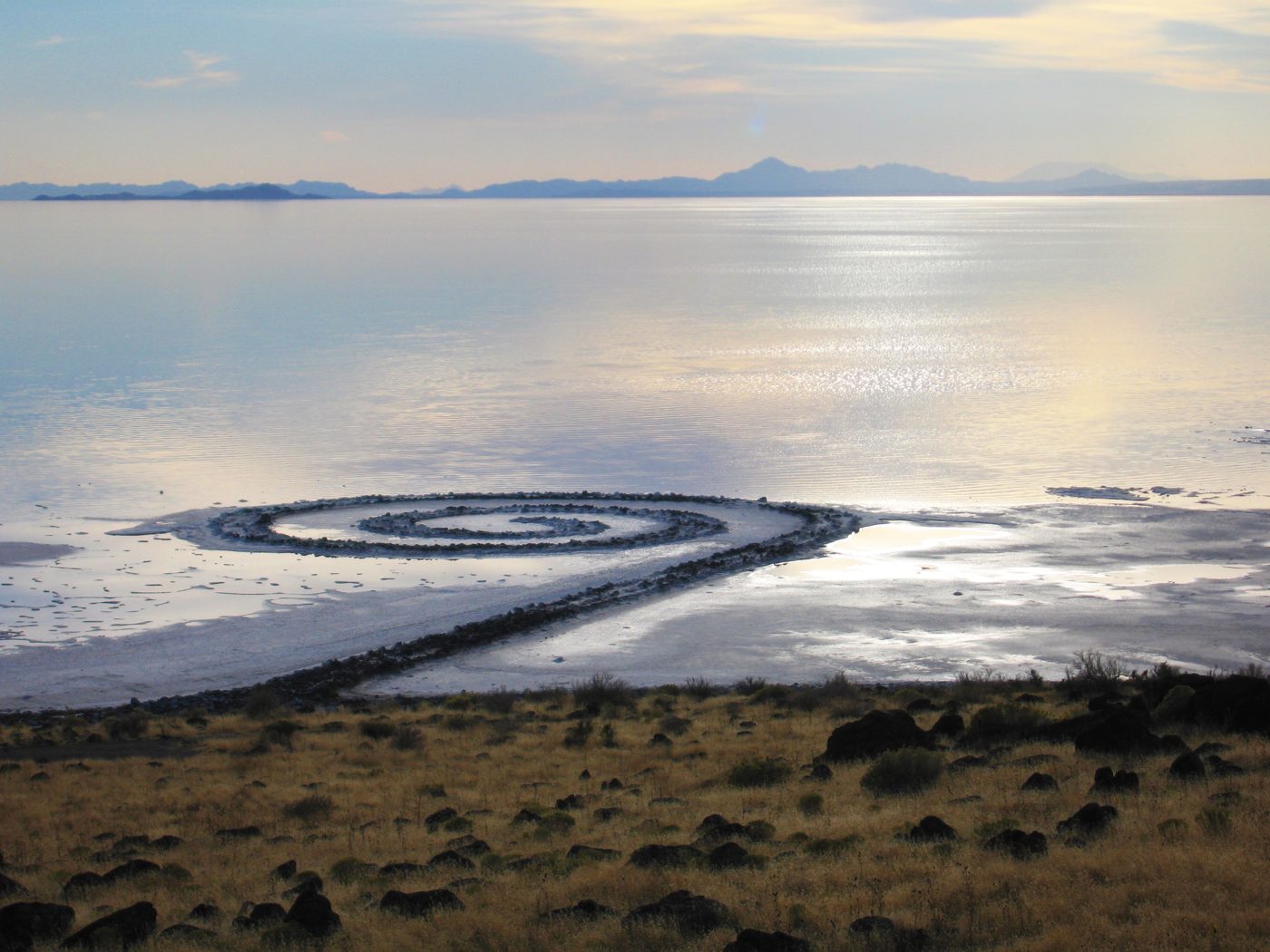
Image context: the cover uses a photographic view of Spiral Jetty from Wikimedia Commons. A real site photograph is the right image here because this article is about the artwork as a place in light, distance, and salt, not as a cleanly isolated diagram on a white page.[6]
The film begins by breaking the poster-image habit
One of the best things the Dia film does in its opening movement is refuse to let the sculpture remain a pure overhead sign.[1] The video gives the viewer road, slope, shore, and changing distance before it settles into the classic view. That sequence matters. Spiral Jetty is famous enough that many readers arrive with a preloaded image already in mind. By delaying the total reveal, the film restores the work's dependence on movement through space.[1][2]
That correction aligns with the factual description on the Utah Museum of Fine Arts page: the work is a fifteen-foot-wide coil extending more than 1,500 feet into Great Salt Lake, built from black basalt rock and earth gathered on site.[2] Those numbers are useful, but they do not tell you how scale is actually felt. The sculpture is too large to read in one glance when you stand near it and too entangled with the ground to detach cleanly from the basin around it. The film understands that problem and turns it into a virtue. It lets the work emerge through walking, not only through recognition.[1][2]
This is also where the video sharpens Smithson's achievement. In photographs, the spiral can seem like a single formal gesture placed on the landscape. In the film, it reads more like a negotiation with the landscape's edge. The curve is exact, but the shore around it is not. Salt flats, mud, rocks, and reflected sky keep softening the boundary between sculpture and setting.[1][3] The piece holds because its geometry is strong enough to survive that softness without eliminating it.
Entropy here is not a slogan. It is a waterline.
Smithson's reputation can tempt writers into treating entropy as a glamorous idea word. The film is better than that. It shows entropy as something the site does visibly through exposure, retreat, crystallization, and seasonal difference.[1] Dia's video description notes that the foundation has kept annual photographic documentation since 2012 and that the work, once submerged, has remained visible since 2002 while the lake's edge has retreated dramatically.[1] That single fact changes how the piece should be read in 2026. The jetty is not simply persisting in an untouched natural frame. Its relationship to the lake is being rewritten.
The official site pages help anchor this without turning the article into climate abstraction. UMFA's description stresses the reddish water, remote peninsula, and the work's construction from material taken from the site itself.[2] Holt/Smithson Foundation's page presents the piece with its materials stated bluntly: mud, precipitated salt crystals, rocks, water.[3] That list is almost the article's thesis. Spiral Jetty is not a sculpture placed next to environmental processes. Those processes are the medium's continuing life.
Around the middle of the film, the camera lingers on the crusted surface and the texture of the coil rather than rushing toward the most spectacular panoramic angle.[1] That choice is intelligent. The work has always had two scales at once. From afar it is a sign, almost calligraphic. Up close it is rubble, salt, labor, and uneven footing. The video's great strength is that it keeps moving between those scales so the viewer can feel how the sculpture slides between concept and ground condition.[1][3]
Stewardship is part of the artwork's present tense
The most contemporary layer in the Dia film is not a new interpretation but a new emphasis: stewardship as an active part of how the work now exists.[1] Dia received Spiral Jetty in 1999 through the generosity of Nancy Holt and the Estate of Robert Smithson, and the institution's present role is not to freeze the sculpture into one preferred historical state.[1][4] It is to maintain access, document change, and care for a work whose meaning depends on not being stabilized too completely.
That distinction matters because Land art is often narrated as heroic artistic intervention followed by romantic weathering. The National Register documentation points to something more complicated: significance at once artistic, historical, and environmental, bound to the site's remoteness and to the persistence of the work's material identity even as conditions around it shift.[5] In other words, the piece does not become truer by being abandoned to mythology. It becomes truer when viewers understand that durability here is inseparable from monitoring, custodianship, and a refusal to confuse neglect with authenticity.[4][5]
The film handles this without becoming managerial. It stays attentive to Smithson's scale and ambition while making room for the afterlife of the work: annual documentation, collaboration with Utah partners, and the plain fact that reaching the sculpture is part of understanding it.[1][2][4] That is why the video is worth embedding rather than merely citing. It does not just tell us that Spiral Jetty changes. It gives the viewer enough shore, light, and physical texture to register how that change becomes meaning.
What to watch for after the video ends
If you return to still photographs after watching the film, the images start behaving differently. The famous spiral no longer looks self-contained. You begin to notice how much of its force depends on what lies around it: the shallow mirror of the lake, the mineral crust, the dry grass, the long approach, the possibility that another decade of hydrological change will alter the relation again.[1][2][3] The artwork starts to read less like a frozen masterpiece and more like a durable sentence rewritten by its setting.
That is why Spiral Jetty remains so strong. It does not ask the landscape to behave as a backdrop for modernist will. It lets the shoreline answer back. Smithson gave the basin a form sharp enough to be remembered, and the basin keeps giving that form back under new conditions of light, salt, and visibility. Dia's film makes that reciprocity legible. The result is not a monument with documentary support. It is an artwork whose real medium, by now, includes time, access, and care.[1][4][5]
Sources
- Dia Art Foundation, "Robert Smithson at Dia: Spiral Jetty," YouTube video, 2024.
- Utah Museum of Fine Arts, "Spiral Jetty."
- Holt/Smithson Foundation, "Spiral Jetty."
- Dia Art Foundation, "Spiral Jetty" site page.
- United States Department of the Interior, National Register of Historic Places Registration Form: Spiral Jetty.
- Wikimedia Commons, "File: Spiral Jetty Smithson Laramee.jpg."