Photo-Secession began as a campaign for photography's dignity and ended by helping photography stop pleading. Alfred Stieglitz and his circle first argued that the camera could belong with painting, sculpture, and printmaking because a photograph could be composed, printed, toned, and handled as a made thing rather than a mechanical receipt. That was already a serious claim in the early twentieth century. Yet the movement's deeper importance lies in the turn that followed: once photography had won a language of artistic seriousness, Stieglitz's best work began to trust the camera's own blunt gifts - frame, instant, tonal pressure, urban fact, and the hard geometry of modern life.[2]
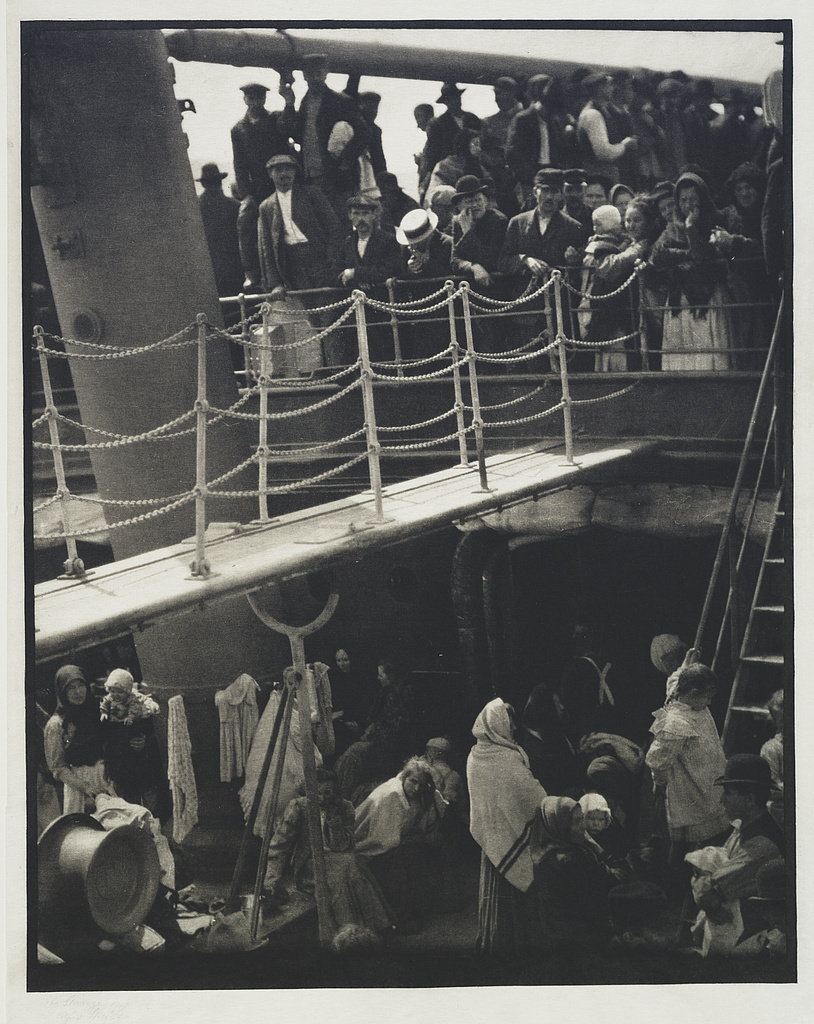
The Steerage is the hinge. Stieglitz took the photograph in 1907 while traveling to Europe, and museum records consistently treat it as one of the decisive images of his career.[1][3][4] The subject is not elevated in the old pictorial manner. Passengers occupy the lower deck and upper railing of a ship; a gangway cuts diagonally through the scene; a white hat, a round straw form, pipes, ropes, shadows, faces, and metal edges hold the image in a tense architecture. The picture does not ask to look like a painting. It asks the viewer to see how photographic seeing itself can organize modern experience.
That is why a movement/style context around Photo-Secession has to end inside this image rather than at the movement's manifesto. The style did not mature by applying a fixed look. It matured by discovering when to abandon its own earlier comforts.
The campaign began with craft
The Metropolitan Museum of Art's account of Stieglitz's career places the first move in 1902, when he and like-minded photographers broke away from the Camera Club of New York to form the Photo-Secession.[2] The break was partly institutional, but it was also aesthetic. Photography needed a public case, and Photo-Secession made that case through prints, exhibitions, and editorial control. Stieglitz had edited Camera Notes; from 1903 to 1917 he edited Camera Work, the ambitious journal that gave photography luxury-paper seriousness and critical company.[2]
The early argument leaned heavily on craftsmanship. Many Photo-Secession photographers used labor-intensive processes and painterly effects to show that a photograph could bear the trace of selection and hand.[2] This was not merely vanity. In a culture that could dismiss the camera as a machine, visible craft became a defense. Soft focus, tonal delicacy, platinum surfaces, and carefully staged atmospheric effects helped photographs enter the same room as drawings and prints.
Stieglitz understood that room literally. In 1905, Edward Steichen's donated studio space became the Little Galleries of the Photo-Secession, known as 291 after its Fifth Avenue address.[2] The gallery did more than display photographs. It put American photography into contact with new European modernism, including work associated with Rodin, Picasso, Brancusi, and Picabia.[2] The point was not that photography should imitate each of them. The point was that photography had to survive in the same argument about form.
291 changed the pressure on the photograph
Once 291 became a site for modern art, the old defense of photography as painterly craft started to feel too narrow. If painting itself was breaking the illusion of seamless space, then photography no longer needed to prove itself by borrowing a misty finish. It could become modern by attending harder to what the camera saw: cropping, structure, interrupted bodies, urban machinery, and the accidental alignment of shapes.
That shift is visible in the way the Met describes The Steerage. The essay notes Stieglitz's familiarity with European modernism and connects the photograph's arrangement of shapes and tones to the lessons of Cubism.[2] The important word is arrangement. The picture's force does not come from exotic subject matter alone. It comes from the way the ship divides the field into planes and routes. Human figures are present as travelers, workers, families, and social evidence, but they are also visual weights held inside a structure.
The Whitney Museum's collection text captures the same double charge. It describes the photograph as an image of steerage, the ship's lowest-priced quarters, and notes both its political force and its formal emphasis on the ship's divided architecture and the interplay of machinery and passengers.[1] That balance is the picture's modernity. Social meaning and formal construction do not compete. They are locked together.
The photograph refuses a clean moral distance
It is tempting to read The Steerage as a straightforward immigration image, and the photograph has often been reproduced that way. The Library of Congress record complicates that habit. It notes that Stieglitz made the image while traveling as a first-class passenger on the SS Kaiser Wilhelm II from New York to Bremen in June 1907; the passengers shown may have included skilled workers and families returning to Europe after temporary labor in the United States.[4] The picture therefore carries social charge without offering a simple documentary label.
That complication matters. The camera looks across class distance, and the deck itself makes that distance visible. Upper and lower zones divide the image before any caption can explain them. The white gangway becomes an optical bridge and a social barrier at once. The round hat at the lower center glows like a target, while faces gather at the rail in a compressed band of attention. Stieglitz is not outside the system he photographs. His first-class position belongs to the picture's ethical pressure.
The result is a photograph that does not settle into pity or pure design. It keeps both. The people matter as people, and the structure matters as structure. If Photo-Secession's early rhetoric tried to lift photography into art by emphasizing craft, The Steerage shows another route: the photograph becomes art by making the conditions of seeing inseparable from the conditions of social life.[1][4]
Publication made the image move
The print history also belongs to the style story. The Met's object record identifies one version as a 1907 photograph printed in 1915 as a photogravure, while the Library of Congress record notes publication in Camera Work in 1911.[3][4] The dates remind us that The Steerage was never only an exposed negative from one shipboard moment. It became an artwork through print, sequence, journal circulation, and retrospective framing.
This is central to Photo-Secession. The movement was not just a group of makers with shared taste. It was an apparatus: Camera Work, 291, exhibitions, collectors, critical writing, and later museum deposits. Stieglitz's authority came from arranging contexts as much as from making pictures. A photograph's meaning could change when placed beside European modernism, printed in a lavish journal, shown in a gallery, or donated as part of a collection.[2][3]
For The Steerage, that apparatus clarified the image's tension. Printed as photogravure, the photograph retained a material link to older fine-print culture.[3] Yet its composition pushed away from pictorial softness. It used the page not to disguise the camera, but to sharpen the camera's claim: modern life arrives as a cut field of bodies, decks, ropes, metal, shadow, and unequal passage.
What the movement learned from its own limits
By 1917, according to the Met, Stieglitz's thinking had shifted away from the idea that photography needed to appropriate the appearance of drawing, prints, or watercolor to prove itself as creative art.[2] That sentence marks the deeper arc of Photo-Secession. The movement's early tactics were historically necessary, but they were not the final style. They cleared a path for photography to claim its own grammar.
That grammar is visible in The Steerage because the photograph keeps refusing translation. It does not become a painting of shipboard poverty. It does not become a sociological chart. It does not become a decorative pattern emptied of bodies. It remains a photograph: made from a particular vantage point, bound to a fraction of time, alert to facts the photographer could not fully stage, and yet composed with extreme pictorial intelligence.[1][2][4]
Photo-Secession's legacy is therefore more interesting than a simple victory story about photography becoming accepted as art. Acceptance was only the threshold. The larger achievement was discovering that photography's artistic future did not require escape from the camera. It required deeper confidence in the camera's ability to turn modern pressure into form.
That is why The Steerage still feels alive. Its decks divide, its gangway slices, its passengers wait, and its surfaces hold together without resolving the social distance they expose. The image lets photography become modern by staying photographic.
Sources
- Whitney Museum of American Art, "Alfred Stieglitz, The Steerage" - collection page with date, medium, formal description, and interpretive context.
- Lisa Hostetler, "Alfred Stieglitz (1864-1946) and American Photography," The Metropolitan Museum of Art, October 2004 - essay on Photo-Secession, Camera Work, 291, and Stieglitz's shift toward modern photography.
- The Metropolitan Museum of Art, "Alfred Stieglitz, The Steerage" - object record for the 1907 photograph printed in 1915 as photogravure.
- Library of Congress Prints & Photographs Online Catalog, "The steerage / Alfred Stieglitz" - catalog record and source for the article image, with ship, date, publication, and rights notes.