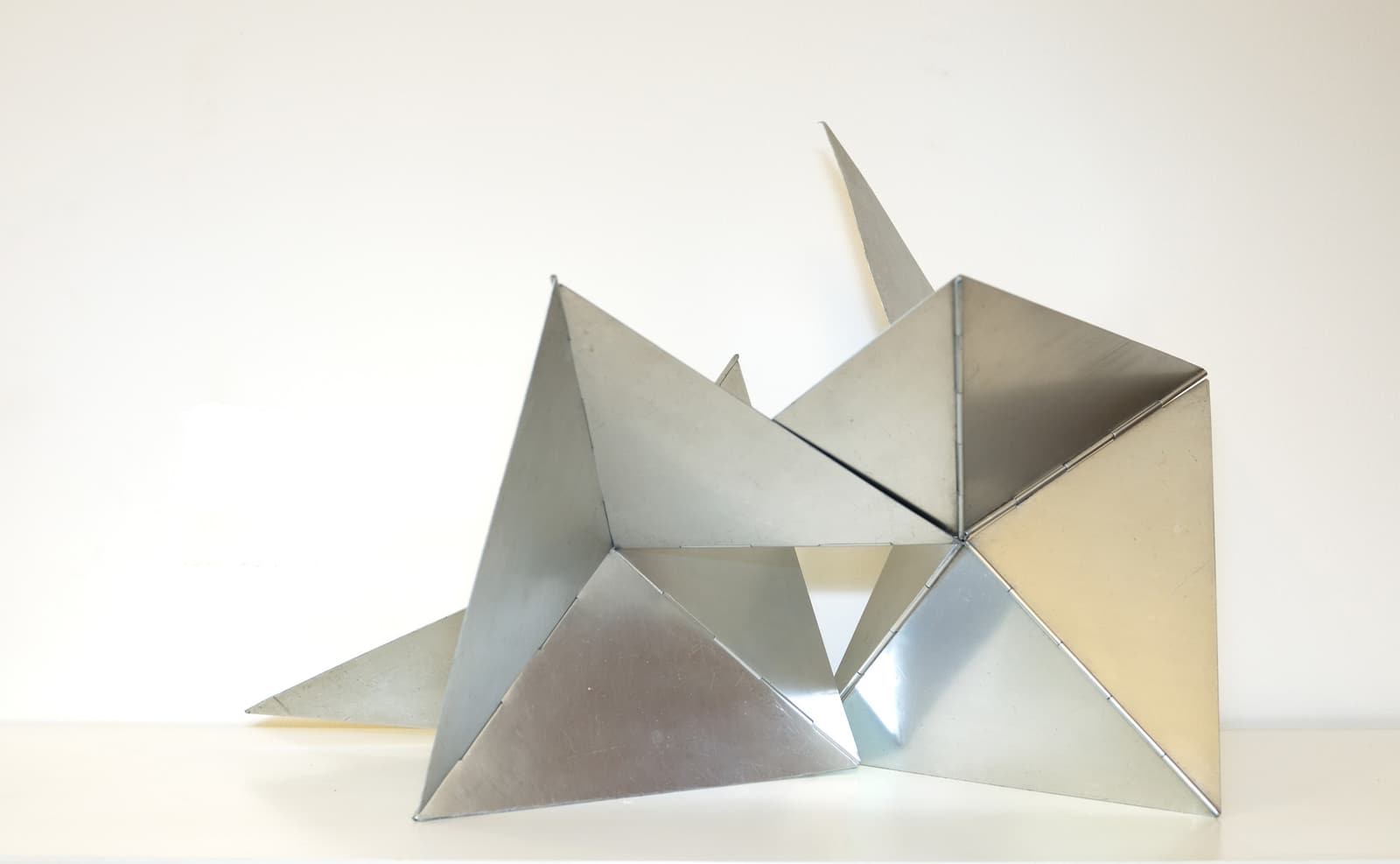
Lygia Clark's Bichos look simple until the viewer imagines them staying still. A few aluminum planes, cut into strict geometric shapes, meet along hinges. The sculpture can lie almost flat, open into a shallow animal-like posture, fold inward, or tilt into a form that seems to have found balance for only a second. That is the whole technical drama. Clark did not add interactivity after finishing a sculpture; she made articulation the sculpture's grammar. The hinge is where the work thinks.[1][2][5]
That point matters because the Bichos are often introduced through a broad art-historical label: Neo-Concretism, participation, the move beyond the static object. All of that is true, yet the label can make the work sound like an idea wrapped around metal. The reverse is more precise. Clark's idea enters through the metal's behavior. The sheet, the cut edge, the joint, the weight of each plate, and the user's uncertain hand are the argument. The object does not illustrate participation; it manufactures a situation in which participation has consequences.[1][2][5]
The image attached to this article is a Wikimedia Commons photograph of O Bicho Linear - Lygia Clark.jpg, with the file page identifying the work as a 1960 Bicho linear and linking its source to MoMA.[6] Its documentary value is practical. The photograph shows a real artwork rather than a diagram: polished planes, hard folds, visible seams, and a silhouette that cannot be reduced to either painting or freestanding sculpture. That accuracy is essential for a technique essay, because the Bichos are not understood by naming their interactivity alone. They have to be read through how a hinge reorganizes surface, volume, and responsibility.
From plane to joint
Clark came to the Bichos after a long argument with the picture plane. The 2025 Neue Nationalgalerie retrospective gives that arc a useful physical sequence: geometric-abstract paintings, ruptured canvas, relief-like wood panels connected to space, then three-dimensional participatory objects.[3] MASP describes the Bichos as a radical rupture with modern sculpture because they question the distance between art and real life, as well as the untouchability usually assigned to museum objects.[1] The hinge arrives after the plane has already been restless.
That sequence is important. Clark was not simply switching from painting to sculpture as a change of category. She was asking what happens when the surface refuses to remain a viewing front. In the earlier reliefs and modular surfaces, the edge of the work already begins to matter. With the Bichos, the edge becomes a joint. A painting's boundary becomes a fold line. The viewer's route around an object becomes a hand's pressure on an object.
SFMOMA's collection page for Bicho Passaro do Espaco (Critter Bird in Space) identifies that 1960 Bicho as aluminum and gives its shallow physical dimensions, while the museum's acquisition note describes the related works as planes articulated through hinges and capable of configuration and reconfiguration.[4][5] Those details carry more force than they first suggest. Aluminum gives the work a light industrial exactness: thin enough to move, hard enough to resist softness, reflective enough to catch the room. Reconfiguration means the work's measurements are not settled once and for all by fabrication. The sculpture's dimensions are partly an event of handling. A closed position, an open position, and an awkward in-between position all belong to the piece.
The hinge as a spine
The Museo Reina Sofia's entry for Bicho desfolhado (Husked Creature) is especially sharp on the mechanics. It describes the Bichos as metal plates joined by hinges that formed a "spine," allowing articulation; the same entry notes that Clark presented the series at the 6th Sao Paulo Biennial in 1961 after signing the Brazilian Grupo Neoconcreto manifesto in 1959.[2] The word spine matters. A hinge in ordinary engineering is a convenience. In Clark, it becomes anatomy.
The spine metaphor keeps the work from being mistaken for a puzzle. A puzzle has a solution; a Bicho has positions. A puzzle rewards the user for resolving instability; a Bicho makes instability the experience. MASP's collection text notes the machine-like aspect produced by industrial materials such as hinges and aluminum sheet, while also stressing that the Portuguese title points toward critters or creatures rather than machines.[1] That tension matches what the hinge makes possible. No single side wins. No single pose becomes the final state.
The technique is therefore not neutral. Hinges usually make an object serve a function: a door opens, a box closes, a tool deploys. Clark's hinge withholds that functional closure. It lets the object move, but it does not tell the participant what the correct movement should be. The hand has to negotiate with metal. Push too little and the sculpture stays inert; push too far and a plane collapses into another relation. The work's intelligence sits in that live feedback.
Touch changes authorship
The Bichos also change what authorship feels like without pretending that the participant replaces the artist. Clark cuts the planes, chooses the material, determines the joints, and sets the range of possible motion. The participant enters a field of constraints, not an empty invitation. This is why the works remain rigorous rather than merely playful. The viewer's agency is real, but it is conditioned by the object's structure.[1][5]
SFMOMA's 2019 acquisition note for Bicho Passaro do Espaco (Critter Bird in Space) and its related study describes the works as sculptures built from planes and articulated through hinges, able to be manipulated, configured, and reconfigured in a range of forms.[5] That phrase "range of forms" is the key boundary. Clark is not outsourcing composition to any random gesture. She builds a finite but elastic system. Each configuration belongs to the work because the hinge system authorizes it; each configuration also belongs to the participant because the work appears through a decision made in time.
This creates a subtle ethical shift in looking. Traditional sculpture often lets the viewer move while the object remains sovereign. Clark lets the object move and makes the viewer accountable for that movement. The participant cannot claim pure spectatorship after touching the piece. A fold has been chosen. A balance has been risked. The artwork has become a record of encounter even when it returns to another position a moment later.
Why the object still resists the screen
The Bichos are notoriously hard to translate into flat images. A photograph can document one configuration, but it cannot carry the work's whole premise. The Neue Nationalgalerie's 2025 exhibition emphasized interaction with specially created replicas and activated works through regular performances.[3] Institutions keep returning to replicas because Clark's technique defeats the sufficiency of the display case.
This does not make photographs useless. It makes them partial in a productive way. The cover image of Bicho linear shows enough to register the problem: every plane looks like both surface and potential movement. The reflective aluminum catches light, but the joints interrupt any smooth visual reading. The sculpture looks complete and incomplete at once. That tension is exactly why the image works for this essay. It gives the eye a single position while making the hand imagine another.
In that sense, the Bichos remain contemporary even when the museum touch protocol changes. Many current interactive works depend on sensors, screens, cameras, or code. Clark's system uses older mechanics: plates, hinges, gravity, hand pressure. Yet it reaches a question that digital interactivity still faces. Does participation alter the work's structure, or does it only trigger a prepackaged response? With the Bichos, participation alters the visible body of the object. The response is not simulated. It is mechanical, spatial, and immediate.[2][5]
The organic without imitation
Clark's title invites the animal reading, but the Bichos do not imitate animals. Reina Sofia's note draws the distinction carefully: Clark located the organic quality not in the shape, since the pieces remain geometric concepts, but in the way the work presents itself as a living, active organism with which the spectator can interact completely.[2] That is the stronger reading. Organic here means responsive, not biomorphic decoration.
The difference can be felt in the sculpture's awkwardness. A Bicho does not glide like a perfected machine. It changes with hinge friction, plate weight, table angle, and the pressure of a hand. Its liveliness comes from limited motion rather than unlimited freedom. It can behave, but only inside a structure. That is why the series still matters inside the history of participatory art. Clark found a form where collaboration does not dissolve form; it activates form.
Neue Nationalgalerie's retrospective positions Clark's later practice as moving from the Bichos toward sensorial objects, collective-body actions, and body-related therapeutic methods.[3] The Bichos sit near the hinge of that larger career, both technically and historically. They still look like sculptures. They still use hard geometric materials. Yet they already require a viewer who is no longer only a viewer. The later abandonment of the fixed art object begins inside the precise metal joint.
What Clark made, then, was not a clever foldable object. She made a sculptural contract. The artist builds the grammar, the hinge keeps the sentence open, and the participant completes one temporary reading without exhausting the next one. The Bichos endure because their technique and their philosophy are the same thing: a plane learns to move, and the viewer learns that seeing has become a physical responsibility.[1][2][3][5]
Sources
- MASP, "Lygia Clark, Critter" - collection entry on a 1960s aluminum Bicho, viewer touch, rearrangement, authorship, conservation limits, and handling replicas.
- Museo Reina Sofia, "Bicho desfolhado (Husked Creature)" - collection entry on the Bichos series, aluminum sheets and hinges, the 1959 Neo-Concrete manifesto, and the 1961 Sao Paulo Biennial presentation.
- Staatliche Museen zu Berlin / Neue Nationalgalerie, "Lygia Clark: Retrospective" - 2025 exhibition page on Clark's move from geometric abstraction to participatory sculptures, replicas, and performances.
- San Francisco Museum of Modern Art, "Lygia Clark, Bicho Passaro do Espaco (Critter Bird in Space), 1960" - collection page with title, date, aluminum medium, dimensions, and acquisition details.
- San Francisco Museum of Modern Art, "SFMOMA Announces 11 New Acquisitions..." - 2019 acquisition note on Bicho Passaro do Espaco, hinges, reconfiguration, Grupo Frente, and Movimento Neoconcreto.
- Wikimedia Commons, "File:O Bicho Linear - Lygia Clark.jpg" - photographic source page for the article image, identifying Bicho linear and linking its source to MoMA.