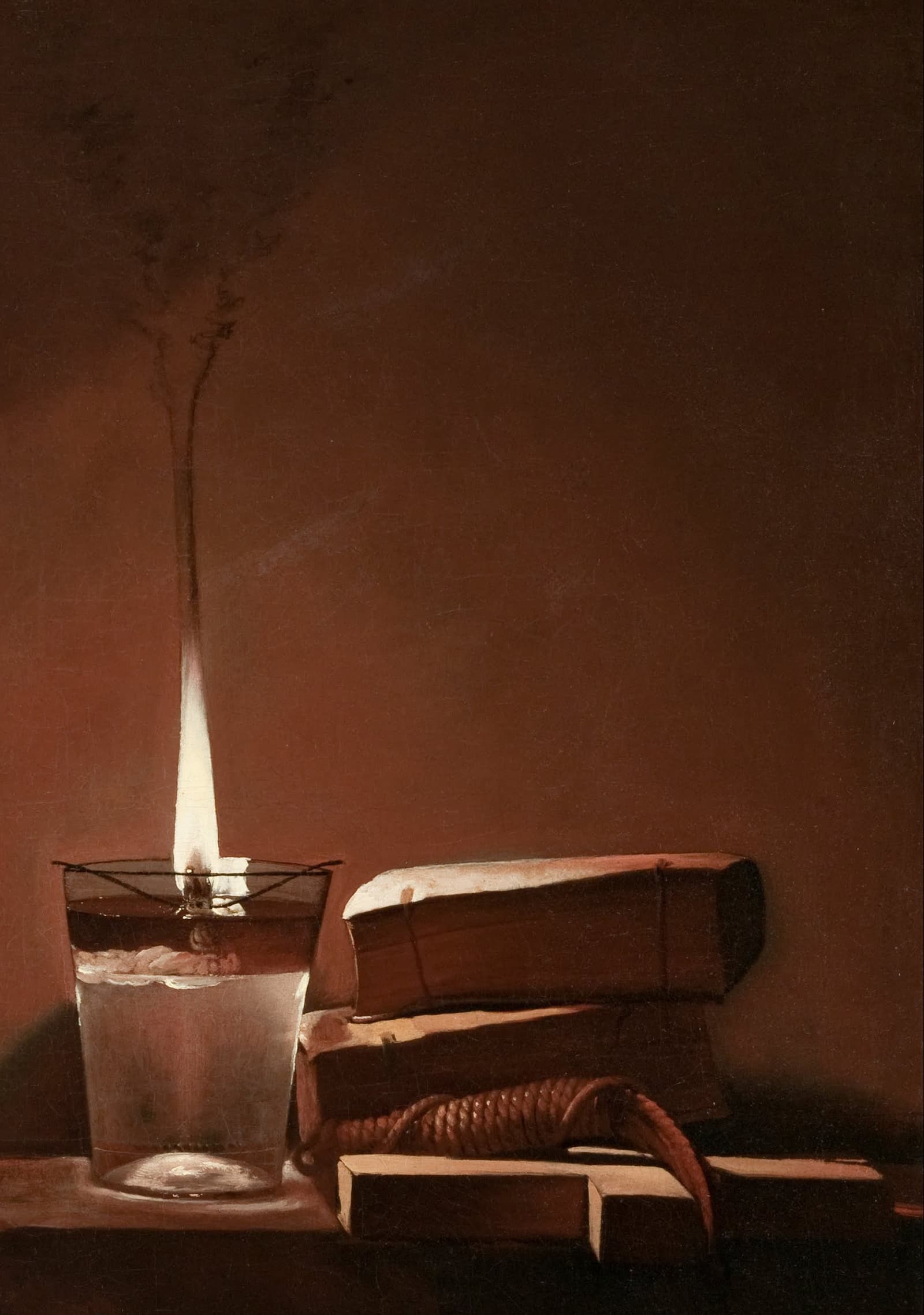
Georges de La Tour's The Magdalen with the Smoking Flame can look, at first, almost too simple to sustain much reading. A woman sits in profile. A skull rests in her lap. Books sit on the table. A candle burns behind them, and the room gives itself almost entirely to darkness.[1] Yet the painting's austerity is exactly where its force begins. La Tour does not make penitence dramatic by multiplying gestures. He makes it difficult to avoid by reducing the scene until every remaining object has to carry moral, physical, and temporal weight.
The LACMA record identifies the work as The Magdalen with the Smoking Flame, dated circa 1635-37, and places it within La Tour's lifelong career in Lorraine, away from the largest cosmopolitan centers.[1] That distance matters less as biography than as tone. This is not a painting eager to perform sophistication. It has almost no anecdotal machinery. The body is still, the table is plain, the props are few, and the light source is partly blocked. Instead of narrating conversion as event, La Tour turns conversion into a condition of sustained looking.
Image context: the cover image is the artwork itself, sourced through the Wikimedia Commons file record for the LACMA painting. It fits this article because the whole close reading depends on the specific visual contract made by the flame hidden behind the books, the skull held against the body, and the fragile smoke that makes time visible.[1][2]
The candle is present, but not offered
The painting's most important decision is easy to miss: the candle is not fully displayed.[1] In many candlelit paintings, the flame becomes a spectacle. It models flesh, throws shadows, and announces painterly control. Here the flame is partly shielded by the stacked books, so the light does not arrive as a theatrical center. It leaks. It touches the side of Magdalene's face, the white cloth, the edge of the table, and the round skull, but it never becomes a little sun around which the room can comfortably organize itself.
That restraint changes the meaning of illumination. La Tour is often linked to Caravaggesque painting, and Britannica notes his debt to that larger world of dramatic light and dark.[4] But the difference is decisive. Caravaggio's darkness often heightens collision: bodies confront one another, revelation cuts into action, and the viewer feels pulled into an event already underway. La Tour's darkness slows the event almost to immobility. The light does not expose a crime, miracle, or argument. It keeps a mind awake.
The smoke sharpens that effect. A flame can symbolize spiritual attention, divine presence, or inward concentration, but smoke is more literal and more severe. It is the residue of burning. It marks consumption while it is happening. The painting therefore makes time visible without inserting a clock. Magdalene does not need to point toward mortality because the room is already measuring it in flame, smoke, wax, and breath.
The skull is not a prop; it is a second body
The skull in Magdalene's lap can be read quickly as a memento mori, the familiar reminder that earthly life ends.[1] La Tour lets that symbolism stand, but he also makes the object physically intimate. The skull is not parked on the table like a label in a still life. It is held against the body, near the red skirt, close enough to feel less like an emblem than a weight.
That placement matters because it prevents the painting from becoming a detached lesson about vanity. Magdalene's repentance is not staged as a public confession. It is an inward pressure registered through contact. Her hand rests near the skull, and the roundness of bone echoes the curve of her forearm and knee. Life and death share the same compositional circuit. The dead object is not opposite the living figure. It has been drawn into her posture.
The comparison with the Met's Penitent Magdalen helps clarify La Tour's serial intelligence.[3] In that version, another Magdalene sits by candlelight with a skull and mirror, and the Met describes La Tour's simplified forms and quiet atmosphere around the subject of penance and contemplation.[3] The LACMA painting pushes that simplification into a still narrower register. The mirror disappears from prominence, the candle is obstructed, and the skull becomes almost unavoidable in the lap. Where a mirror might tempt the viewer toward reflection and appearance, this version insists on weight, extinguishing, and duration.
The books make thought look heavy
The books are not incidental furniture. They are the objects that hide the flame and therefore control the entire room's access to light.[1] That is a brilliant, unsentimental move. Learning, scripture, memory, doctrine, and written authority are all present, but they do not solve the scene by explanation. They create a partial screen. Magdalene's attention has to live with what books can clarify and what they cannot.
Their stacked form also matters. The books sit horizontally, like slabs. They answer the horizontal table edge and the heavy quiet of the seated body. The whole left side of the composition feels compressed by things laid down: books, tabletop, shadow. Against that compression, the smoke rises in one of the few vertical gestures in the painting. La Tour turns the smallest upward movement into the most unstable fact in the room.
This is why the painting does not feel merely pious. Its religious subject is handled through structure rather than sentimental appeal. The viewer is asked to notice how little changes, and then to understand that little change as the content. A flame burns down. Smoke thins. Thought continues. The skull remains. Repentance, in this picture, is not emotional overflow. It is the discipline of staying with consequences after the visible drama has passed.
La Tour removes the crowd so attention has nowhere to hide
La Tour could handle social tension when he wanted to. The Met's The Fortune-Teller is crowded with hands, fabrics, glances, theft, and performance; its whole intelligence lies in the distribution of attention among figures who are looking, touching, and deceiving at once.[5] The Magdalen with the Smoking Flame feels like the opposite experiment. It removes the crowd, removes exchange, removes narrative interruption, and leaves one body alone with light and objects.
That subtraction is not emptiness. It is pressure. A crowded picture lets the eye escape from one incident to another. This painting closes those exits. If you look away from Magdalene's profile, you meet the skull. If you look away from the skull, you meet the books. If you look beyond the books, you meet the flame and the smoke. If you look into the darkness, it gives back almost nothing. The whole room is a small machine for returning attention to finitude.
The severity also explains why La Tour's Magdalene still feels contemporary. The painting does not depend on a viewer sharing every theological premise of seventeenth-century penitence. Its structure is more portable than that. It understands the moment after distraction, when a person has run out of spectacle and has to sit with what remains. The skull is an ending, the smoke is a process, the books are accumulated knowledge, and the blocked flame is the partial light by which any reckoning has to happen.[1][3][4]
Read in that order, The Magdalen with the Smoking Flame is not quiet because nothing is happening. It is quiet because La Tour has placed happening at a scale almost too small for ordinary drama. The painting asks the viewer to stay long enough for a single thread of smoke to become a sentence about time.
Sources
- Los Angeles County Museum of Art, The Magdalen with the Smoking Flame - collection entry for Georges de La Tour's circa 1635-37 painting, with object context and artist note.
- Wikimedia Commons, "File:Georges de La Tour - The Magdalen with the Smoking Flame - Google Art Project-cropped.jpg" - image file record used for the article artwork.
- The Metropolitan Museum of Art, The Penitent Magdalen - collection entry for La Tour's related candlelit Magdalene and its simplified contemplative setting.
- Encyclopaedia Britannica, "Georges de La Tour" - biography and context on La Tour's Lorraine career, candlelit scenes, and relation to Caravaggesque painting.
- The Metropolitan Museum of Art, The Fortune-Teller - collection entry for La Tour's crowded secular scene, useful as a contrast to the solitary Magdalene.