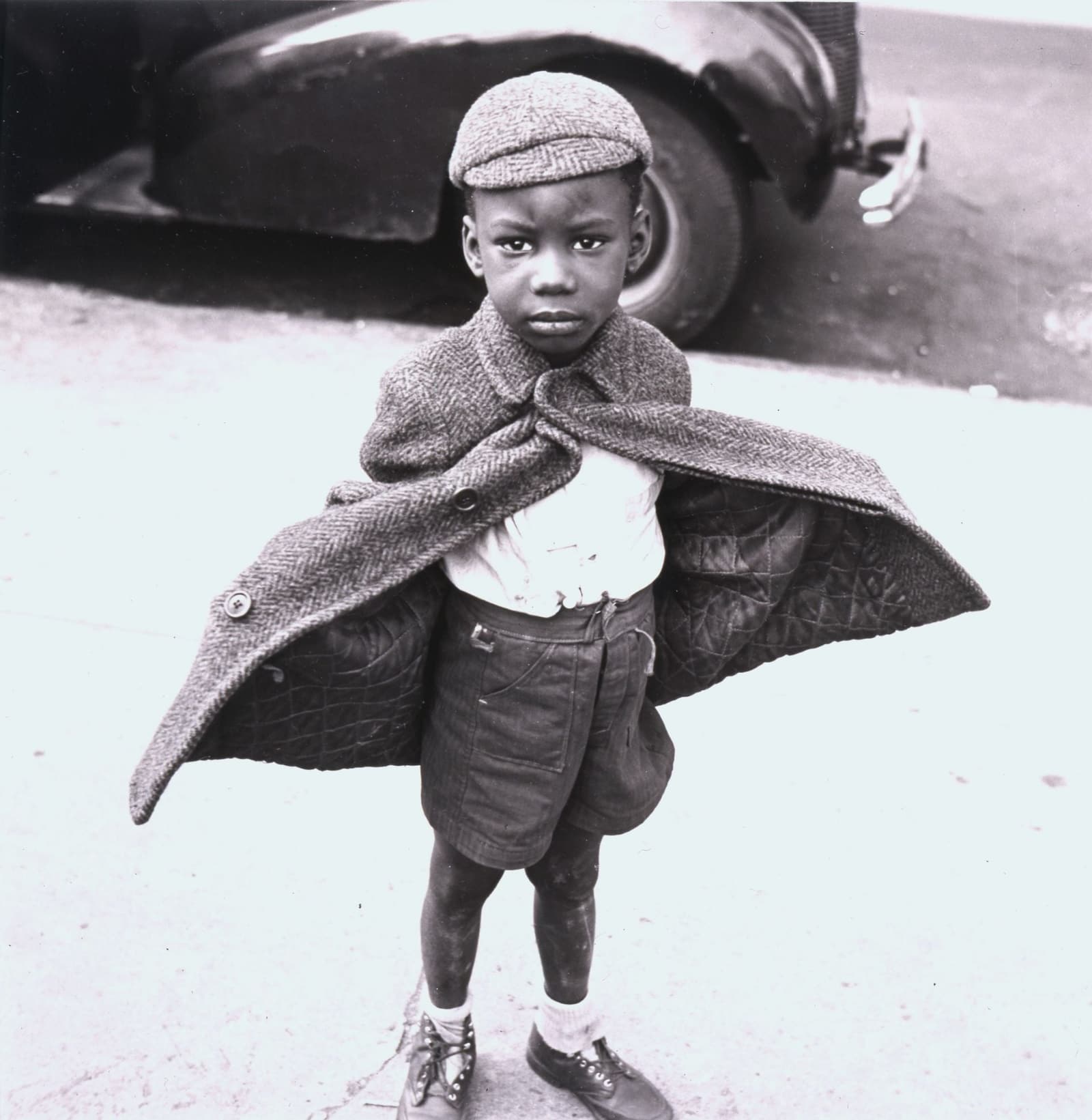
A parked car crowds the top of the frame. Beneath it, a boy stands on the pavement with his overcoat spread into wings, its dark lining opened toward the camera. Jerome Liebling's Butterfly Boy, New York, made in 1949, turns a stretch of sidewalk into a small stage.[1] The child looks up toward the lens; his steady gaze holds us while the coat seems ready to lift.
That order of attention helps explain the Photo League. Active in New York from 1936 to 1951, the organization brought photography into sustained contact with everyday urban life. It also gave photographers somewhere to learn, develop prints, exhibit, and argue about what those prints meant.[1] Its collective purpose could accommodate a picture as singular as this one.
Calling the League a movement requires a little care. It had premises, dues, classes, and projects. Its coherence came partly from those arrangements: people shared the means of making photographs while discovering different ways to see. The most useful question is how that common setting encouraged individual vision.
The city begins in a workroom
Sid Grossman and Sol Libsohn founded the League in 1936 after a split from the Film and Photo League. Its program joined photographic education to the ambition of exposing social problems and encouraging change.[2] For a young photographer, that ambition had a practical address.
The Columbus Museum of Art records annual membership dues of seven dollars, alongside access to lectures, exhibitions, courses, and darkroom facilities.[1] A darkroom matters to this story as much as a camera. It is where a negative becomes a print that other people can examine. Providing one collectively makes the passage from taking a picture to discussing it part of a shared activity.
Historian Deborah Dash Moore, discussing the League in connection with her book Walkers in the City, emphasizes its largely working-class, Jewish milieu and the importance of walking among fellow New Yorkers. Many participants were immigrants or children of immigrants. Their interest in the street grew from a social world they inhabited.[6]
That proximity did not make every encounter transparent. Knowing a city still leaves choices about where to stand, whom to photograph, and what a frame excludes. It does, however, complicate the familiar image of a solitary photographer arriving from elsewhere to discover an anonymous population.
Morris Engel's entry was wonderfully ordinary: he saw a newspaper advertisement and joined in 1936. His archive describes how Aaron Siskind became his mentor and how he worked with fellow photographers on neighborhood projects. Engel subsequently taught and exhibited at the League himself.[4] The student could become part of the institution that had admitted him.
A neighborhood takes more than one picture
The International Center of Photography describes the League's neighborhood-based reporter groups, which photographed multiple aspects of their chosen areas.[3] A project could extend beyond an arresting encounter. Different photographs could supply context, vary the pace, and complicate one another.
Engel participated in Park Avenue North and South, The Bowery, and Harlem Document. The last, led by Siskind, was especially important to him.[4] Even those titles reveal different organizing ideas. One establishes a comparison along an avenue; another identifies a district; the third announces an undertaking whose subject exceeds any single photographer's frame.
I read this group method as a useful restraint on the spectacular image. A striking photograph can make us feel that we have understood a place at once. A sequence asks us to keep looking. It can put a public occasion beside ordinary work or make a familiar street seem different from another position. Those are possibilities of the method, rather than guarantees of fairness.
Collective authorship also leaves a question open: who gets to explain whom? Sympathy does not settle it. A documentary photograph offers visible particulars, but its caption and its neighbors on a wall help determine what those particulars are taken to mean. The League's social ambition makes that responsibility more pressing.
Room for an individual eye
The membership extended beyond the men who usually organize its historical outline. The Jewish Museum's educator guide records more than a hundred women participating between 1938 and 1951, with responsibilities that included editing, administration, advice, and guest lectures.[2] The institution's work depended on more than the names printed beneath its best-known pictures.
Grossman's teaching encouraged photographers to recognize an emotional and personal dimension in documentary work. The same guide describes an increasing openness to experiment during and after the war.[2] A social subject could sustain uncertainty, atmosphere, or an unusual viewpoint.
His own itinerary widened. The Howard Greenberg Gallery records wartime work in Panama, photographs at Coney Island in 1947 and 1948, and the San Gennaro festival on Mulberry Street in 1948. After 1949 he spent summers in Provincetown, studied painting with Hans Hofmann, and taught photography there while continuing private winter teaching in New York.[5] The League's central teacher kept changing the circumstances of his own looking.
Return to Butterfly Boy. The coat gives the photograph an instantly legible shape, but the child remains a particular person standing before a camera. I find the picture strongest when that particularity stays intact. The wing-like gesture invites metaphor; the photograph gives us no warrant to invent the boy's thoughts or future.
When association became a liability
In 1947 the U.S. attorney general blacklisted the League as an alleged communist front. The organization rejected the accusation. Political affiliations within its membership varied, but fear of association made retaining and attracting members increasingly difficult. It ceased operating in 1951.[2]
For an organization sustained by participation, this was a material injury as well as a reputational one. The relationships that supported teaching, exhibitions, and shared facilities became harder to maintain. Its closing belongs inside the history of the pictures because it removed a setting in which pictures could be made and debated.
The surviving photographs let us encounter distinct eyes: a gesture noticed, a neighborhood revisited, a crowd approached from a particular angle. Behind them stands the less visible achievement of the League's workrooms and classes. A common place to learn could help a photographer see something that belonged to them alone.
Sources
- Columbus Museum of Art, “We Cover New York: The Photo League” — membership, facilities, and the museum's reproduction of Jerome Liebling's Butterfly Boy, New York, 1949.
- Lisa Libicki, The Radical Camera: New York's Photo League, 1936–1951: An Educator's Resource, The Jewish Museum — pp. 3–4 on founding, teaching, blacklisting, and closure; p. 7 on women's participation.
- International Center of Photography, “The Photo League: Harlem Document and Related Works,” 2003 — neighborhood reporter groups and documentary practice.
- Morris Engel Archive, “The Photo League” — Engel's arrival, mentorship, group projects, teaching, and exhibitions.
- Howard Greenberg Gallery, “Sid Grossman” — wartime and postwar photographic work, Provincetown, and continued teaching.
- Julia Gergely, “The radical Jewish photographers who fought injustice with their cameras,” New York Jewish Week, September 27, 2023 — Deborah Dash Moore on the League's Jewish, working-class, and urban context.