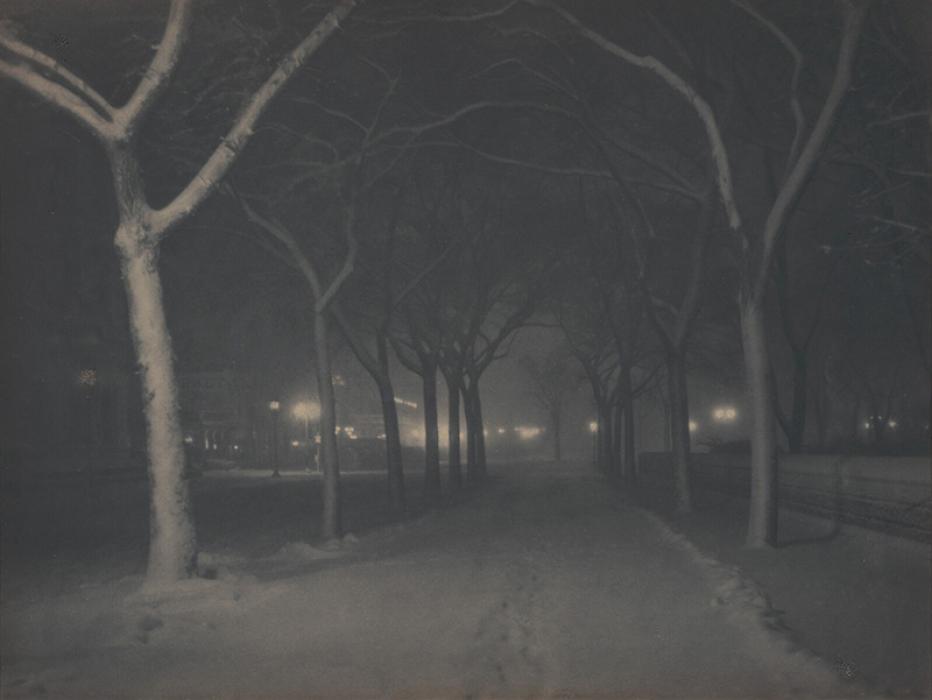
Snow and lamplight make a city feel briefly less solid. In Alfred Stieglitz’s An Icy Night, the branches remain dark while the ground and distant lights loosen the street’s edges. The National Gallery of Art dates its print to 1898 and identifies its medium as carbon.[1] That small word on the label opens a surprisingly physical explanation for the picture’s atmosphere.
The image is carried by pigment suspended in gelatin. Its dark and light passages depend on how much of that material survives processing. To hold those passages together, the printer moves the image from one support to another.[2][3] The winter night reaches us through a delicate act of handling: a photograph has to change its footing before it can safely become a finished object.
Light decides what will stay
Carbon printing belongs to the nineteenth century’s search for lasting photographic images. Poitevin introduced the process in 1855; Joseph Swan improved it in 1864. By the later nineteenth century, commercially manufactured carbon tissues gave photographers a prepared material with which to work.[2] “Tissue” here means a carrier coated with pigmented gelatin, rather than a sheet of the translucent wrapping paper the word might suggest.
In the historical process, a dichromate makes the gelatin sensitive to light. The printer places the sensitized sheet against a photographic negative and exposes it. Light passing through the negative hardens the gelatin; the less exposed material remains soluble. Development in warm water removes that soluble material and the pigment it carries.[4]
This accounts for a small reversal that can initially be confusing. A dark part of the photographed scene corresponds to a relatively transparent part of the negative. More light passes through there during printing, so more pigmented gelatin survives. A light part of the scene requires less pigment on the finished sheet. The negative’s pattern of transmitted light becomes a distribution of material.
Darker passages are therefore thicker; paler passages are thinner. That variation can leave a shallow relief, with differences in surface gloss as well as tone.[7] What looks like the depth of a winter street also depends on a much smaller depth at the surface of the print.
Why the picture needs another sheet
The difficulty lies underneath the exposed surface. Light may harden an upper portion of the coating without hardening all the gelatin between it and the original paper. Put that arrangement straight into warm water, and the soluble layer beneath the image can wash away. The very process meant to reveal the picture can detach it.[3]
Transfer solves the problem by giving the hardened face a new support. The printer brings the exposed coating into firm contact with a receiving sheet. After the sheets have bonded, warm water permits removal of the original backing and washes away the gelatin that has remained soluble. The image-bearing layer stays attached to its new paper.[3]
The sequence matters. It would be misleading to imagine a completed, dry photograph being peeled off and pasted elsewhere. The new support helps the image survive development. Transfer is part of making the tones, because it allows the unwanted material to leave while the delicate image remains anchored.
There is a further consequence: a single transfer reverses the image laterally. A second transfer can restore its orientation.[4] Even the question of which way a street runs across the page belongs partly to the printer’s work.
A color chosen in the workshop
The name can make carbon printing sound restricted to black. In practice, the pigment supplies the hue, so the process can produce monochrome images in different colors.[3] The V&A describes a range from warm sepia to cooler gray and blue. It also connects carbon’s resistance to fading with its use in commercial photographic editions and book illustration during the 1870s and 1880s.[5]
Those applications put beauty and durability in the same workshop. A publisher needed images that could keep their appearance; a photographer could choose a color that changed the emotional temperature of a scene. A warm print and a cool one need not describe different weather to make the viewer experience the weather differently.
That is an interpretive possibility, rather than a claim about a particular pigment in this Stieglitz print. A digital reproduction lets us discuss the composition, but it cannot reliably convey every change in gloss or the height of the gelatin. The material explanation comes from examination of the objects.
What a bubble remembers
The National Gallery’s conservators found a revealing accident in its copy of An Icy Night. A bubble had been trapped between the carbon tissue and the receiving paper. It burst under the squeegee, and the resulting flaw was retouched.[2] A tiny interruption in the surface preserves evidence of the moment when the image acquired its new support.
The Art Institute of Chicago owns a separate carbon print of the same photograph. Its technical report records pigment particles within the binder, slight relief, and differences in gloss visible under angled light.[7] These findings support the process explanation; they do not establish that Chicago’s print has the same bubble. Each physical print has its own history.
Chicago’s account also offers a useful distinction between making the negative and making the print. Stieglitz valued some halation—the glow around bright lights—for its pictorial effect in night photography.[6] That glow should not be attributed to carbon transfer. The camera record supplies one set of possibilities; pigment, paper, and processing give those possibilities their final surface.
I read the resulting street as a meeting of two kinds of attention. One belongs to the photographer watching light gather in winter darkness. The other belongs to the printer watching a vulnerable layer adhere, release, and remain. Knowing about the transfer does not dispel the cold or dim the lamps. It gives the apparent ease of the view a human weight: someone had to carry this night across to another sheet.
Sources
- National Gallery of Art, Alfred Stieglitz, An Icy Night, 1898 — object record, medium, dimensions, collection identification, and exhibition history.
- Courtney Helion, Joan M. Walker, and Constance McCabe, “Carbon Prints,” in Stieglitz’s Practices and Processes, National Gallery of Art, 2020 — historical development, materials, and the burst transfer bubble in the Gallery’s print; source of the reproduced image.
- Richard Benson, “Non-Silver Processes,” The Printed Picture, Yale University Art Gallery — written sections on carbon printing, transfer, pigment choice, and the unsupported gelatin beneath the hardened image.
- Library and Archives Canada, Lingua franca, Chapter 1, “Processes” — carbon-print chemistry, development, and the purpose of double transfer.
- Victoria and Albert Museum, “An A to Z of Photographic Processes,” carbon-print section — available hues, resistance to fading, and use in photographic editions and book illustration.
- Art Institute of Chicago, An Icy Night, New York, 1898, Alfred Stieglitz Collection — the separate Chicago print and Stieglitz’s published appreciation of halation in night photography.
- Art Institute of Chicago, An Icy Night, New York: Object Research, June 2016 — technical examination of accession 1949.689, especially page 2 on pigment, gelatin thickness, relief, and differential gloss.