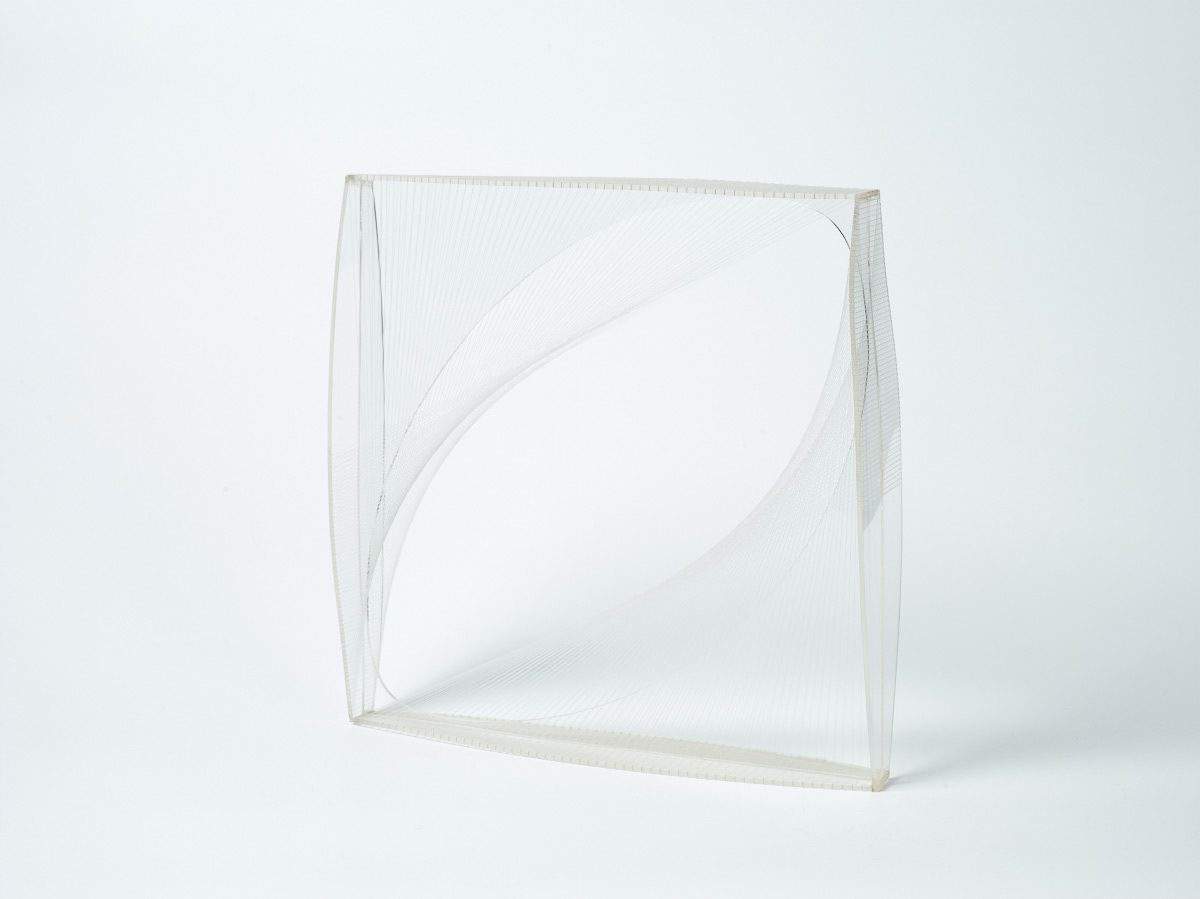
A curve appears where there is no continuous curved skin. Follow one of the fine threads in Naum Gabo's Linear Construction in Space No.1: it runs straight between its supports. Follow the neighboring threads together, and they seem to gather into a surface that turns around an opening. The eye joins what the hand has kept separate.[1][2]
The version photographed here belongs to Kettle's Yard in Cambridge. Made in 1944–45 from Perspex and nylon thread, it measures roughly thirty-one centimeters high and wide, with a depth of just over six centimeters.[1] Those dimensions matter. This is an object one can imagine sharing a table with, yet its small span produces an unexpectedly spacious interior.
What holds my attention is the effort of seeing both things at once: the individual strands and the surface they suggest. Recognizing the construction does not exhaust the pleasure. It gives the apparent curve something to push against.
A surface the eye completes
Kettle's Yard describes a frame assembled from five Perspex pieces, with nylon stretched across it. The frame establishes one form; the threads create another. Gabo's move into actual stringing developed beyond his earlier practice of incising lines into plastic.[1] A line could now cross open space, with light passing between it and its neighbors.
The Barber Institute owns a separate, smaller version, dated 1942/43, and describes the result as the illusion of a continuous parabolic form.[3] That is a useful phrase to keep beside the photograph. It directs attention to the difference between the material parts and the larger shape we perceive. No specialist mathematics is needed to see the relation: a succession of straight lines can establish a curving boundary.
Look first at an outer edge, where the support is easiest to recognize. Then follow the threads inward. Their changing angles make the transition from frame to opening feel gradual, almost poured. Yet the strands remain legible. The sculpture continually offers evidence of how its effect is made.
There is also a difference between transparency and disappearance. Clear plastic has edges; fine filament catches light. In the Sotheby's catalogue for another version, an excerpt from art historian Steven A. Nash emphasizes how reflections animate the stringing and the plastic ends.[4] The materials have to become visible for the form to emerge. Their delicacy lets that visibility fluctuate.
A photograph fixes one arrangement of highlights. It can show the openness of the construction, but it cannot supply the successive views of someone moving around the object. That limit is useful to remember: the picture records one encounter between sculpture, illumination, and camera.
The factory inside the miniature
The work's origins give its fine threads a social setting. Kettle's Yard identifies Linear Construction in Space No.1 as a prototype for a public sculpture near an unidentified textile factory, intended to honor its workers' skills. The larger commission was never completed.[1][4]
That proposal changes how I read the repeated lines. They suggest patient, cumulative work: one connection followed by another, an overall form dependent on many small acts. The connection to textile labor is especially suggestive because the sculpture makes its stringing visible. This is an interpretation of its method, rather than a claim that it depicts a particular machine or weaving process.
Gabo's choice of materials also belonged to a contemporary industrial world. Kettle's Yard's Space resource explains his interest in plastic's transparency, affordability, and workability; Perspex was then used for purposes including aircraft windows.[2] The material could carry an association with modern manufacture while admitting light into the object.
The proposed monument thus survives at a scale suited to close attention. Its public ambition remains part of its history, but the little construction asks for a remarkably intimate kind of looking. A viewer can trace a thread, lose it among the others, and begin again.
One title, several objects
The title identifies a family of constructions, so dates and dimensions need to stay attached to the individual object. Kettle's Yard dates its sculpture to 1944–45 and cautiously identifies it as probably the fifth in the series.[1] The Barber's version is twenty-one centimeters high; the Cambridge example is nearly thirty-one.[3][1] Their shared name does not make their physical presence interchangeable.
Sotheby's catalogue quotes a 1946 letter in which Gabo explained that making each version required doing the work afresh, rather than mechanically repeating or casting it.[4] This helps explain why serial production here remains a sequence of acts of construction. A design can recur while each realization requires another engagement with its materials.
For a reader encountering the sculpture through reproductions, this distinction has a practical consequence. An image caption is part of the looking. It tells us which object has supplied the photograph and gives back something the screen removes: scale, date, and a particular history. The photograph above shows the Kettle's Yard work, not a generic illustration assembled from the series.
A rhythm beside the piano
Jim Ede gave the sculpture an especially fitting domestic setting. Kettle's Yard records that he placed it on the piano in the lower extension, beside Ben Nicholson's 1933 (musical instruments), bringing their rhythms into conversation.[2] The threads could participate in a room already organized around looking and listening.
I find that placement more illuminating than an isolated appeal to the work's geometry. A repeated interval can be measured, but it can also be felt. The eye travels along the strands, encounters the opening, and follows another group outward. The sculpture supplies an order without forcing attention to remain still.
Return to the center. Its emptiness has acquired a contour through everything stretched around it. Gabo has made a small opening worth lingering over: an interval in the room that the threads let us see.
Sources
- Kettle's Yard, University of Cambridge, “Linear Construction in Space No.1, 1944–45” — object KY00988.E, dimensions, five-part frame, factory proposal, series, provenance, and the photograph reproduced here.
- Kettle's Yard, Space: A Learning Resource for Kettle's Yard — printed pp. 21–24 on straight threads and apparent curves, industrial materials, and Jim Ede's placement of the sculpture on the piano beside Nicholson's painting.
- The Barber Institute of Fine Arts, “Naum Gabo: Linear Construction in Space No.1” — the distinct 1942/43 version, its dimensions, materials, and description of the apparent parabolic form.
- Sotheby's, Modern & Post-War British Art, 2017, lot 11, “Naum Gabo: Linear Construction in Space No.1” — catalogue for a circa-1950 version, citing Steven A. Nash on reflected light and Gabo's 1946 letter on making successive versions.