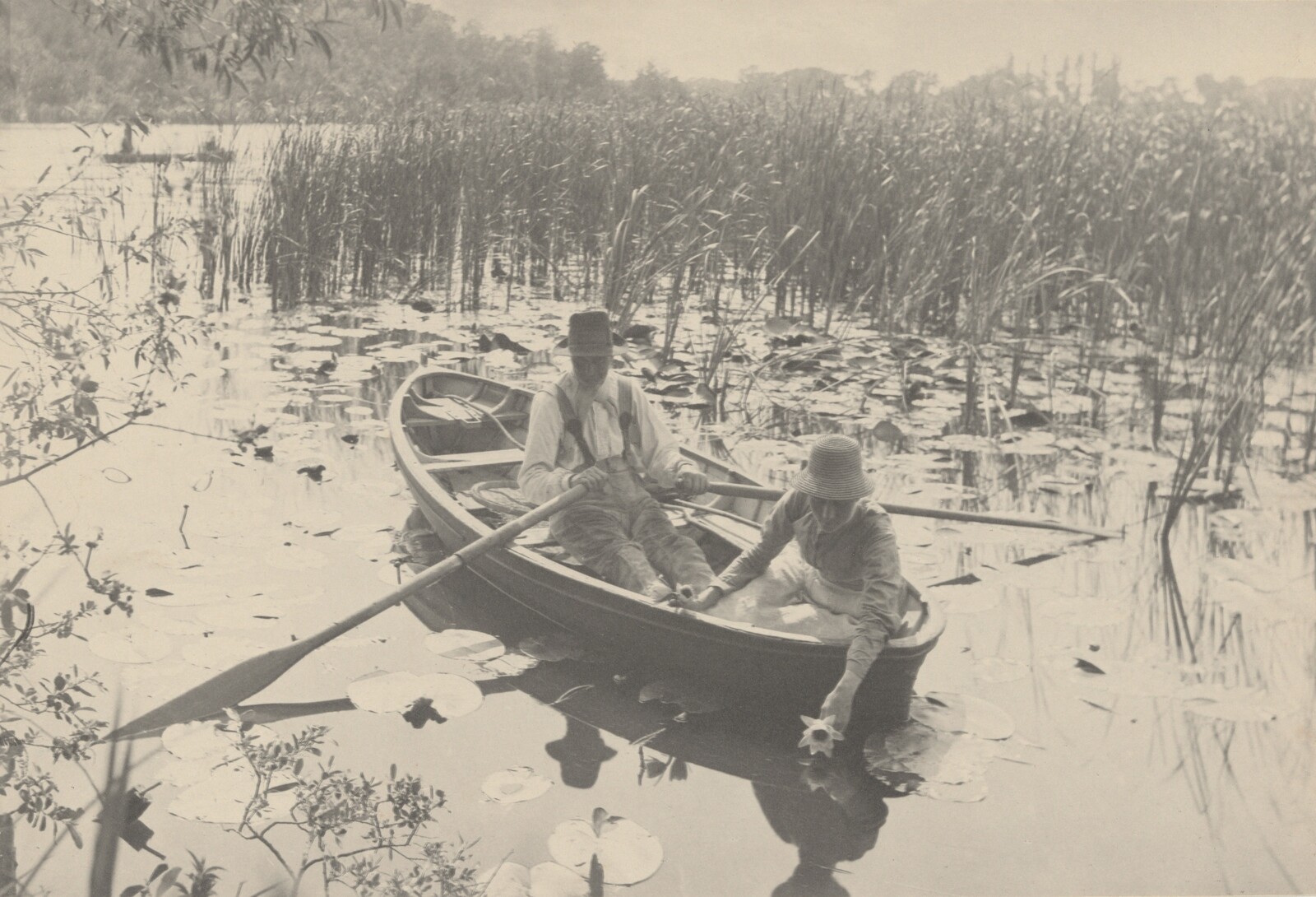
A hand reaches over the side of a boat. Pale water-lily leaves interrupt the dark water; beyond them, reeds and trees close off the distance. In Peter Henry Emerson's Gathering Water-Lilies, the action is small enough to miss if you are looking for a spectacular landscape. The photograph asks you to settle into a particular patch of water, at the pace of the people working there.
The pictured platinum print dates to 1886.[1] Its title can suggest an idle excursion, but the Getty's account identifies the flowers as fishing bait.[3] That detail changes the scene's temperature. The reaching figure is doing something useful. Beauty has arrived in the middle of a task, and the photographer has made that task available to sustained attention.
Emerson built a career around such acts of looking, then became dissatisfied with his own explanation of what they achieved. His photographs offer a particularly absorbing encounter with an artist whose pictures are quieter than his pronouncements. He wanted to establish how a camera could be faithful to sight. His work keeps revealing how much choice that fidelity required.
Born in Cuba in 1856, Emerson trained in medicine before turning toward photography and writing in the mid-1880s. Inherited wealth helped make that change possible. The National Galleries of Scotland describes his aspiration to the life of an English country gentleman and his belief that rural life offered a remedy for industrial society.[2] He approached the countryside with scientific interests, money and an idea of what ought to survive there.
Those circumstances matter when looking at his laboring subjects. Emerson could choose the marshes as an artistic commitment; the people he photographed inhabited them under other conditions. His attention gives their activities visual importance, but it does not erase that difference. The calm of an image tells us something about the photographer's arrangement of the encounter, without necessarily telling us how calm the working day felt.
In 1885 he traveled around the Norfolk Broads with the painter Thomas Frederick Goodall. Their collaboration led to Life and Landscape on the Norfolk Broads, published the following year, in which Gathering Water-Lilies appeared.[3] The project brought observation, writing and picture-making together. Its audience would encounter these waterways through a carefully prepared book, turning pages at a considerable distance from the boat.
The pictured scene holds that distance in balance. The boat gives the eye a firm shape to follow, while the water breaks into small floating interruptions. The reach of the arm connects the human figure to the plants. Nothing needs to dominate the whole rectangle for the action to become legible. You can find the people and then let your attention spread back into their surroundings.
Emerson gave this sort of visual hierarchy an argumentative foundation in Naturalistic Photography for Students of the Art, first published in 1889. In the revised 1890 edition, he argued that a photograph should approximate the uneven clarity of human vision. Even the main subject might need to be very slightly out of focus. Yet he warned against softness that destroyed structure: blur could become as distracting as excessive sharpness.[4][6]
This was a theory about the experience of seeing, and it should be read as Emerson's artistic prescription. It makes an exacting demand on the photographer. Someone must decide which forms hold attention, how far the surrounding detail recedes and when softness starts to announce itself as an effect. An apparently effortless view can depend on unusually careful judgment.
The print mattered as much as the view. The New Orleans Museum of Art's discussion of Emerson's Towing the Reed, also from 1886, emphasizes his use of platinum printing to sustain delicate tones and soft background edges. Platinum's matte surface and rich intermediate grays offered a particular way of carrying light onto paper.[5] These are material qualities of an object; a screen reproduction gives only a translated impression of them.
Emerson could sound severe about photographic purity. In his manual he attacked retouching that changed texture and tone. But he also compared developing a photograph to a sculptor's modeling, and welcomed a printing development that allowed selected areas to be intensified or held back.[4] His prescriptions gave the photographer substantial responsibility. The desired naturalness had to be worked toward through the medium.
His countryside was selective too. The Getty exhibition's account observes that he often passed over tourist crowds and agricultural decline while seeking forms of rural life he feared were disappearing.[3] That choice lends the pictures their concentration. It also sets a limit on what they can document. A photographed worker can be present with extraordinary clarity while the larger economy remains outside the frame.
By 1891, Emerson had publicly retreated from his earlier claims for photography as art. The Death of Naturalistic Photography announced the reversal in a pamphlet with a black border. His complaint concerned the medium's constraints on individual expression.[6] The change of mind is striking because the earlier book had invested so much authority in the photographer's judgment. He had begun to doubt whether the available choices were enough.
Publication nevertheless continued. Marsh Leaves appeared in 1895, and the Cleveland Museum of Art describes his late style as looser and more expressive than his early naturalism. Its Marsh Weeds is dated before 1891, published 1895—a useful reminder that the dates of making, publishing and changing one's mind need not fall neatly into separate periods.[6][7] The work resists a tidy story in which an artist issues a verdict and the pictures obediently stop.
Emerson remains compelling in that unresolved space. His changing arguments register how seriously he took photography's possibilities. The prints let us assess those possibilities for ourselves. Return to the boat: the hand still reaches, the leaves still scatter across the water, and the distant bank still gathers into a softer mass. The scene feels available and unforced. The longer you look, the more you notice the artist who made it feel that way.
Sources
- National Gallery of Art, “Gathering Water-Lilies” — source photograph; 1886 platinum print, dimensions, credit line and accession 1995.63.1.i.
- National Galleries of Scotland, “P. H. Emerson” — biography, medical career, inherited wealth and outlook on the English countryside.
- J. Paul Getty Museum, “The Old Order and the New: P. H. Emerson and Photography, 1885–1895,” 2007 exhibition — Goodall collaboration, fishing-bait context, differential focus and the selectivity of Emerson's rural vision.
- P. H. Emerson, Naturalistic Photography for Students of the Art, second edition, revised, 1890 — Book I, “Art Principles,” and Book II chapters “Development,” “Retouching Negatives” and “Printing”; digitized by Project Gutenberg.
- Brian Piper, “Object Lesson: Platinum-print photography,” New Orleans Museum of Art, May 11, 2020 — platinum's surface and tonal qualities, with discussion of Emerson's Towing the Reed.
- Margaret Maclean, “‘A photographic revolutionary’,” University of Leicester Library Special Collections, November 21, 2014 — the 1889 manual, Emerson's renunciation and the continued publication of Marsh Leaves.
- Cleveland Museum of Art, “Marsh Weeds” — photograph dated before 1891 and published in 1895; collection commentary on Emerson's later style and its relationship to Pictorialism.