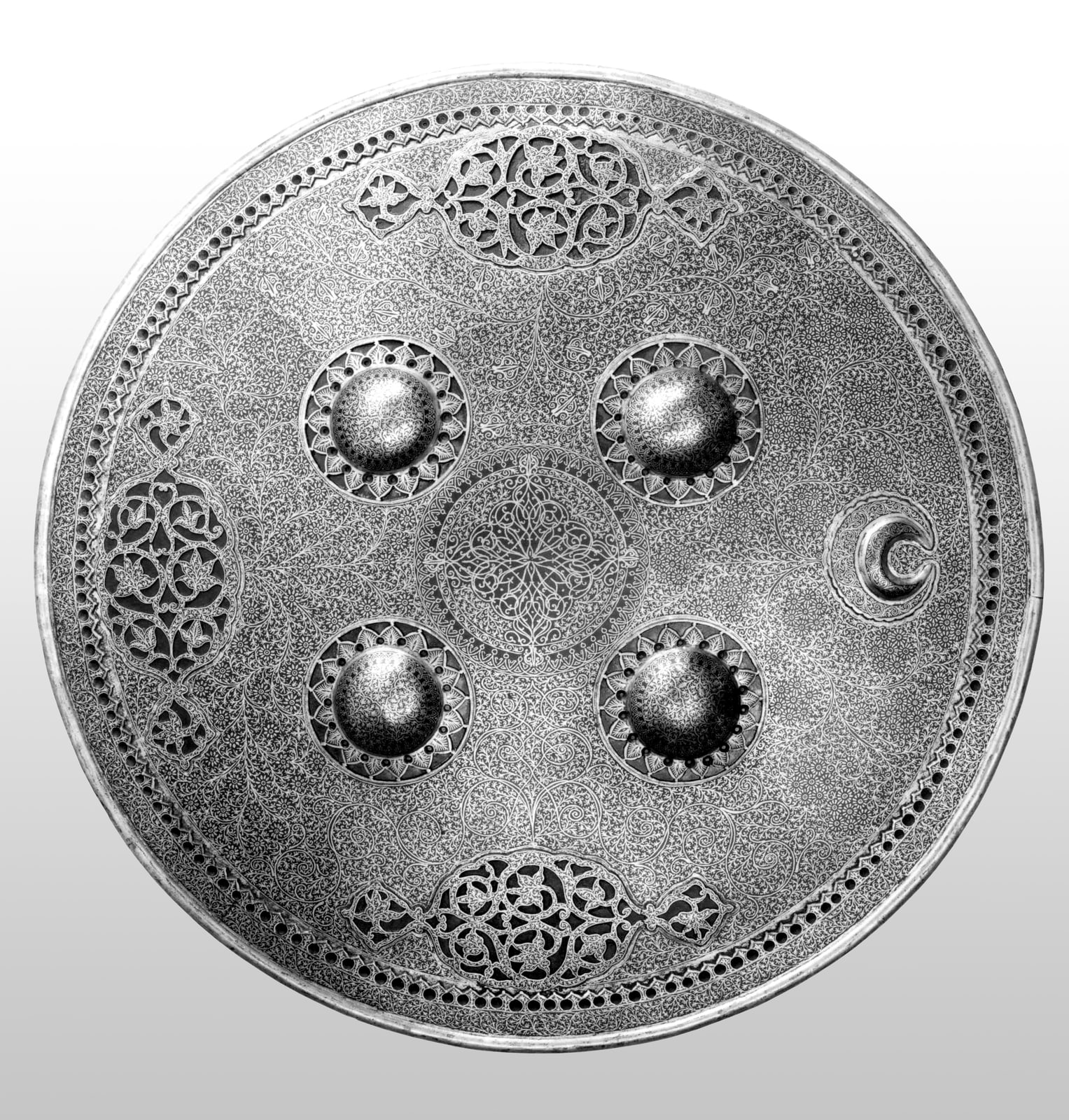
A gold ornament on a steel shield asks us to notice two kinds of value at once. The steel supplies the body of the object; the gold makes its surface worth lingering over. In the Metropolitan Museum of Art's nineteenth-century Shield (Dhál), probably made in Lahore, the two metals meet through koftgari: a method of fixing precious metal onto a roughened steel surface.[1] The richness lies partly in that unlikely attachment.
The archival photograph shown here renders the ornament in black and white. Four rounded bosses punctuate a field of fine curling lines. Larger motifs give the eye places to pause within the dense pattern. The photograph preserves those differences in scale, even as it leaves the gold's color to the museum's materials record.
Follow the same family of techniques into a small casket or a pair of candlesticks, and the relationship acquires different meanings. Gold can distinguish an object associated with defense, entice a buyer at an international exhibition, or help a manufacturer announce its artistic ambition. The materials keep their contrasting properties while the work they do in public changes.
The value of a rough surface
Damascening names more than one way of bringing metals together. In one method, a craftsperson cuts a recess with undercut sides, then hammers softer gold or silver into it. The metal spreads beneath the edges and stays mechanically secured. Another method uses shallow cross-hatching to give the harder surface a grip on wire or foil. Museum terminology sometimes calls these “true” and “false” damascening respectively.[2]
Those adjectives can mislead the eye. The second method still joins real precious metal to a carefully prepared support. Its achievement depends on making roughness useful. The Met identifies the shield specifically with this cross-hatched method, in which the applied decoration is burnished into place.[1] What appears to be a fluent line has a hidden physical explanation.
The Met's modern demonstration makes the sequence unusually clear. Gold foil is first pressed into the prepared steel with wood, then worked with copper, before a steel burnisher finishes the surrounding surface. The changing tools help seat the foil before flattening the texture that holds it.[3] The finished object's smoothness conceals a stage when smoothness would have been a disadvantage.
That is also a way of thinking about the ornament. The gold does not have to carry the shield's bulk. Its softness allows it to occupy fine marks in a harder material. Each metal supplies something the other lacks. For a viewer, knowing this changes the pleasure of the surface: a delicate pattern becomes evidence of pressure, resistance and controlled deformation.
The steel's darkness can be worked on too. The Met's account of Tiffany's practice describes deliberate black patination, which heightens the contrast with the brighter metals.[3] Dark ground is therefore part of the design. It gives each small passage of gold room to register.
A casket finds another audience
Decorative household objects were already part of this history long before nineteenth-century export markets expanded. The V&A illustrates damascening with an English iron box dated 1579, ornamented in gold and silver. Its guide describes several related methods circulating across regions, and a later revival promoted through international exhibitions.[4] A shield and a box belong to overlapping possibilities for the craft.
A particular change of audience becomes visible in LACMA's Casket, dated about 1867 and attributed to the Punjab region of present-day Pakistan. Its iron body carries gold wire and leaf; a flowering tree spreads over the lid, while bands around the sides include vines, jackfruit and lilies.[5] Ornament organizes a small container into distinct areas of attention. Opening, closing and turning it would continually change which part of the decoration came into view.
LACMA places such objects within a regional economic shift. Its catalogue links British annexation of Punjab in 1849 and restrictions on indigenous firearms production with workshops in Sialkot and Gujrat increasingly making decorative goods for Western customers and exhibitions.[5] That account concerns a particular set of workshops and markets. It cannot stand for every place where gold was worked onto iron.
Read in that context, the casket suggests that technical continuity can coexist with a major change in who pays for the work. A familiar skill meets a new commercial setting. The flowers remain beautiful, but their destination becomes part of the object's history. The surface records more than a maker's command of materials; it also belongs to the conditions under which that command could earn a living.
Craft becomes a public claim
Tiffany & Co.'s 1878 candlesticks bring another institution into the story: the international fair. Made in New York from iron, silver, gold and copper, they appeared at the Paris Exposition Universelle. The Met connects their decoration with Islamic art collected by Edward C. Moore, who directed Tiffany's silver division. A designer's surviving diary identifies the candlesticks as his first selection for the firm's Paris display.[6]
The choice of iron matters. A luxury object can advertise expertise through the difficulty of combining materials, as well as through the quantity of precious metal it contains. These candlesticks offered an occasion to recognize design and workmanship in a support associated with a very different range of uses.
The Met describes the acclaim at Paris as an important step in Tiffany's international prominence.[6] Here the elaborate surface served a company making a claim about its place in the arts. Its borrowed decorative vocabulary also asks us to look beyond the manufacturer's name, toward the collections and traditions that informed its designers.
A name cannot do all the looking
The V&A notes that nineteenth-century uses of “damascening” could describe an appearance more readily than a precise technique.[4] There is another potential confusion: the term does not identify the patterned structure of so-called Damascus or watered steel, which the Met treats separately from applied metal decoration.[2] A label provides a starting point; the actual construction still needs attention.
Return to the shield with those distinctions in mind. The gold catches the eye, but the steel participates in everything we admire: it provides the object, the darker field and the prepared surface that holds the ornament. Across shield, casket and candlestick, that material partnership remains compelling. What changes is the encounter it stages—with a bearer, a customer or the visitors to a world's fair.
Sources
- The Metropolitan Museum of Art, “Shield (Dhál),” accession 02.5.4 — nineteenth-century dating, probable Lahore attribution, koftgari technique and collection photograph.
- The Metropolitan Museum of Art, “Techniques of Decoration on Arms and Armor” — mechanical inlay, cross-hatched overlay and the distinction from patterned steel.
- The Metropolitan Museum of Art, “Damascening,” August 24, 2022 — written explanation of a modern process demonstration and Tiffany's use of patination.
- Victoria and Albert Museum, “A guide to metalworking techniques,” March 12, 2026, section “Damascening (inlaying)” — the Dudley Box, regional methods, nineteenth-century revival and changing terminology.
- Los Angeles County Museum of Art, “Casket,” about 1867, accession M.2001.93 — materials, decoration and the regional shift toward export and exhibition markets.
- The Metropolitan Museum of Art, “Candlestick,” Tiffany & Co., 1878, accession 2018.121.1a, b — materials, Edward C. Moore's collecting and the Paris Exposition Universelle.