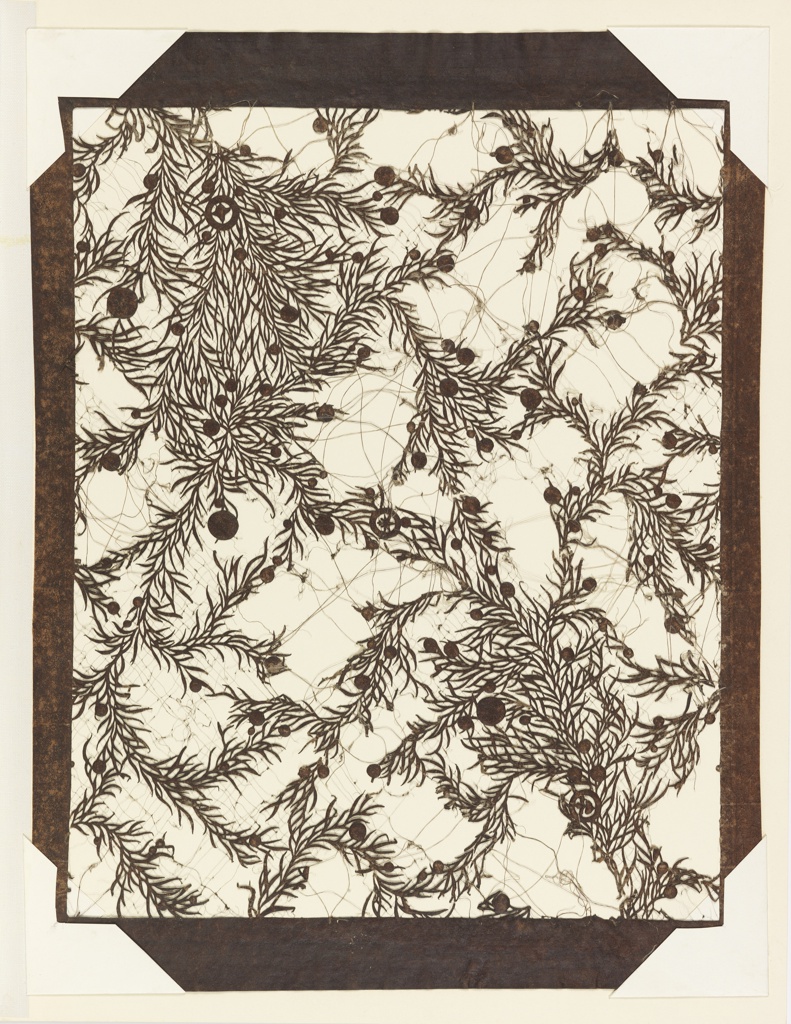
The juniper branches seem to float. Leaves and berries spread across gaps so broad that the design appears almost unable to hold together. Cooper Hewitt dates this Japanese paper stencil to 1780–1830: an object whose apparent fragility invites a closer look at how it could ever have been put to work.[1]
A katagami stencil belongs to a sequence of making. Paper must survive cutting; the cut sheet must guide a paste; the paste must hold back a dye. The resulting pattern travels onto cloth, while the stencil remains available for another application.[1][3] Understanding that sequence changes the pleasure of looking. Every empty space becomes a place where something will happen.
Before the first cut
Ordinary paper would be an unpromising tool for repeated contact with moisture. The Ise Katagami cooperative describes a specially prepared material, katajigami. In its account, three sheets of washi are laminated with persimmon tannin, their grain directions alternating. Sun drying and smoking follow, with another treatment in tannin and a further drying and smoking cycle.[2]
This preparation produces brown paper that resists stretching.[2] That property matters to the pattern: a beautiful outline is useful only if it stays where the maker and dyer expect it to be. Imagine extending a row of leaves across a length of cloth. Small changes in the stencil's dimensions would become changes in the spacing of the design.
The paper therefore has two jobs. It supplies a surface the blade can articulate, and it preserves the relationships between the shapes left behind. The craft begins before there is an image to admire. Its first achievement is a dependable sheet.
Cutting without losing the design
The blade's work is selective destruction. Each opening removes material that might otherwise help the sheet hold together. A branch can look wonderfully free while presenting a very practical problem: what keeps it in position when the rest of the paper disappears?
The cooperative describes small connections called nige, which keep parts of a design attached. Depending on the cutting method, a finished stencil may also receive reinforcement from a fine net of threads.[3] Cooper Hewitt's discussion of the juniper stencil draws attention to its almost inconspicuous supporting network.[1] The airy composition depends on something less immediately attractive than its foliage: the means of keeping the foliage still.
There are different ways to make the openings. The cooperative distinguishes ruler-guided stripe cutting from tools shaped to produce repeated motifs, and describes tiny circular holes made by rotating a semicircular cutting edge. Some examples reach around a hundred holes per square centimeter.[2] These methods give repetition a physical history. A field of similar marks can record many separate, exacting actions.
That is part of the stencil's appeal as an object. From a distance, the eye gathers the pattern. Closer attention finds how much making has been compressed into its regularity. Even a quiet stripe asks the cutter to sustain an edge.
Where the paste goes, the dye cannot
It is tempting to imagine pushing color through the holes. In the resist process described here, the material passing through is rice paste. Once dry on the cloth, it protects the covered areas during dyeing; washing the paste away reveals the reserved pattern.[1][4]
This makes the openings especially interesting. In a simple sequence using dark dye on pale cloth, an opening admits paste and thus preserves a pale area. The remaining paper prevents paste from reaching other areas, leaving those available to take the dye. The stencil organizes protection, and the color develops around that protection.
The cooperative's account adds another practical step: the stencil is soaked before use to stabilize it against stretching. Alignment marks help position successive applications, while designs with several colors can require multiple stencils and repeated operations.[3] A single sheet does not contain every decision that will determine a textile's final appearance.
For that reason, the juniper stencil should not be treated as a complete picture of a particular finished garment. It gives us a pattern and a means of carrying it. The cloth, color choices and sequence of work belong to the next stage. Its beauty is partly the beauty of an object waiting for another person's skill.
A pattern beyond the paper's edge
Cooper Hewitt's annotated view of The Stencil Dyer's Workshop, a screen detail attributed to Kano Yoshinobu and dated probably to the early seventeenth century, makes that shared work visible. One artisan applies resist with a spatula, another works with a brush, and elsewhere fabric is dyed and hung to dry. The museum explains that the stencil is used repeatedly along the cloth to create a continuous design.[4]
The sheet's edge is therefore a temporary boundary. In use, a composition has to meet its next appearance. A branch near the margin belongs both to the rectangle in front of us and to a longer rhythm that the dyer will bring into being.
A museum photograph makes it easy to enjoy the stencil as a finished arrangement. Following the technique lets us see its outward ambition. The cutter has made something that can leave an impression elsewhere without giving up its own shape. Return to those suspended juniper branches, and the gaps no longer look merely delicate. They are the working parts of the image.
Sources
- Hillary Waters Fayle, “Between Plants and People,” Cooper Hewitt, Smithsonian Design Museum, September 8, 2018 — juniper stencil, dating, paper preparation, reinforcement, resist process and source photograph.
- Ise Katagami Cooperative, “Process of creating Ise Katagami” — paper lamination, drying and smoking, and the tools and actions used to cut patterns.
- Ise Katagami Cooperative, “Ise Katagami dyeing with stencils” — connecting bridges, reinforcement, soaking, alignment marks and the relationship between stencil sets and dyeing.
- Cooper Hewitt, Smithsonian Design Museum, “Katagami: The Stencil Dyer’s Workshop” — annotated historical workshop scene, rice-paste application, repeated designs, dyeing and drying.