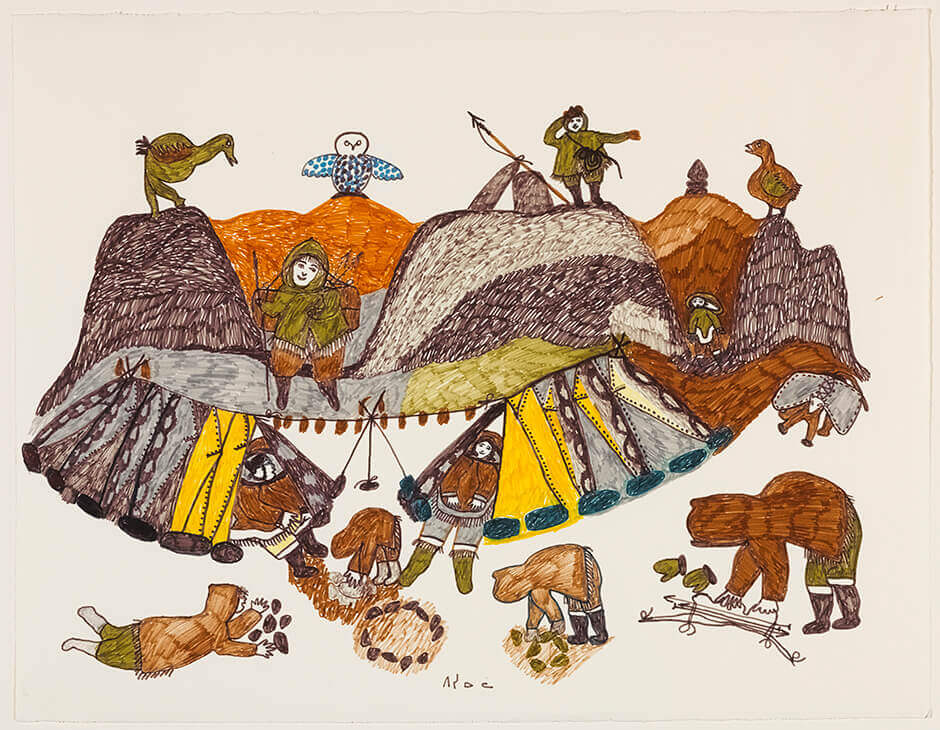
Image context: the cover reproduces the exact 1974 drawing discussed below. Its visible sheet edge, uneven felt-tip strokes, and softened colours keep the work's material history in view.[1]
Nobody in Summer Camp Scene poses for posterity. A lookout raises one hand to his brow while his harpoon tilts behind him. Travellers enter between hills. A dog carries a pack; fish hang between two tents; birds perch and fly above the camp. Near the bottom of the sheet, people bend into separate tasks while two women sit close enough to talk. The drawing holds remembered life, but it refuses the stillness that the word “memory” can imply.[1]
That refusal is the key to Pitseolak Ashoona. For years, southern audiences praised her images as records of Inuit “old ways,” a label that could make a particular woman's experience sound like anonymous cultural evidence. Her drawings do transmit knowledge of camp life. They also test line, colour, repetition, distance, and speed. They are autobiographical without requiring one central figure to declare, this is me. To see only the record is to miss the artist making it move.[1]
Art began as provision, not escape
Pitseolak was born in the first decade of the twentieth century while her family travelled through the eastern Arctic. She spent most of her life in seasonally mobile camps across southern Qikiqtaaluk (Baffin Island), then settled in Kinngait—formerly Cape Dorset—in the late 1950s. After her husband Ashoona died in the 1940s, she supported a large family first through the skills that camp life required and later through sewing goods for sale. Drawing arrived when she saw another way to provide. She bought paper, took her first sheets to the co-operative, was paid, and continued.[1][2]
That economic beginning should not be polished into a fable in which art rescues an isolated genius. The Cape Dorset arts-and-crafts program was created amid a government-driven transition from life on the land to settlement and a wage economy. It supplied materials and access to a market, but southern buyers and administrators also influenced which subjects circulated. Pitseolak worked inside that system with unmistakable purpose: she drew at home, carried finished sheets to the co-op, replenished her supplies, and returned to the problems she had set herself.[1]
Counts vary with the boundaries of the archive, but the scale is extraordinary. The Art Canada Institute places her production above 8,000 drawings, perhaps close to 9,000; York University's collection record gives a more conservative total above 7,000 and notes that 233 images entered the annual print collections. The discrepancy is useful. It reminds us that “the work” is much larger than the editioned prints through which most buyers first knew it.[1][2]
“Self-taught” was a method, not a miracle
Pitseolak had no formal drawing instructor. She began after seeing her cousin Kiakshuk's work and continued looking closely at peers' drawings when she visited the co-op; what she did not inherit was a schoolroom method for translating her experience onto paper. She did have decades of exacting visual and material intelligence. Sewing had taught her how a flat surface can be divided into registers, how a motif can be mirrored, and how an outline controls what happens inside it. On paper she proceeded by iteration: people, birds, animals, tents, and hills appear across series of sheets as she solves proportion, placement, and motion.[1]
The supplies themselves form a rough chronology. Graphite was the principal option until 1965; coloured pencils arrived in 1966; felt-tip pens became popular the following year. She established the whole composition in line before adding colour. That sequence matters: colour energizes areas already held together by contours, patterned marks, and intervals of blank paper rather than doing the main work of modelling volume.[1]
Felt-tip pens suited her speed and love of strong colour, but their ink proved unstable. By 1975 the studio was phasing them out because their colours were impermanent and faded. The olive, brown, grey, orange, yellow, and turquoise in Summer Camp Scene have consequently softened. This is not a defect to be digitally “fixed.” Material aging lets us see a historical meeting between an artist's choices and whatever happened to be available in Kinngait at a particular moment.[1]
A camp assembled from routes
Summer Camp Scene, made around 1974, is not organized around a heroic centre. Its hills overlap like broad bands of cloth. Figures occupy the bands, the gaps between them, and the lower white field. Scale follows narrative need more than optical distance: the lookout must be legible, the dog must show its pack, the people at work must keep their gestures. The picture becomes spatially convincing not through a single vanishing point but through routes—across, down, between, and toward.[1]
That structure converts recollection into simultaneity. Hunting, travel, drying food, shelter, conversation, human movement, and bird movement coexist. Practical details are present, but no activity is isolated as a museum demonstration. The figures share a terrain and, more importantly, a social world. The scene's density is its argument: camp knowledge lives between actions, because work, food, shelter, observation, and company depend on one another.[1]
The drawing is also the result of revision. An earlier Summer Camping from about 1960–65 already attempted to place figures and tents in a landscape. By 1974, Pitseolak could make the hills carry people through depth without sacrificing the directness of her line. Memory here is not the retrieval of a finished inner photograph. It is something built through years of drawing the problem again.[1]
Most prints translated drawings
The great majority of Pitseolak's surviving works are drawings, only a small subset of which became editioned prints. Studio printmakers translated selected drawings, especially into stonecuts and stencils; Pitseolak herself also worked directly on some engraving and etching plates and, to a lesser extent, lithographic stones. Those collaborations helped make Kinngait graphics internationally visible. They also changed the line. In the Art Canada Institute's comparison of the drawing and stonecut for Innukshuk Builders, the print gains graphic force while the drawing's gestural strokes become less apparent.[1]
The distinction matters even more now. The Kinngait Drawings Archive, held by the McMichael Canadian Art Collection, contains roughly 90,000 works by many artists, most of which never became prints. Its 2025 Worlds on Paper exhibition explicitly addressed how the print program's response to southern taste left bodies of work overlooked. That does not make every unprinted drawing more authentic, or every edition a compromise. It does show that the familiar print canon is a selected and transformed view of a much broader graphic culture.[3]
With Summer Camp Scene reproduced as a drawing, the eye can follow pressure and hesitation. Brown marks pile into a hill; grey strokes bend around its slope; the yellow tent is held by dotted seams. The image retains the tempo of a hand deciding. Its documentary knowledge and its formal life cannot be pried apart.
When “old ways” acquired a first-person voice
The public understanding of Pitseolak changed in 1971 with Pictures Out of My Life. Dorothy Harley Eber shaped recorded interviews, conducted with interpreters Quatsia Ottochie and Annie Manning and revised in Inuktitut transcript by Ann Meekitjuk Hanson, into an illustrated narrative published in English and Inuktitut syllabics. Pitseolak did not sentimentalize what she recalled: “The old life was a hard life but it was good. It was happy.” The book did not suddenly make the drawings personal; it made their personal basis harder for southern readers to overlook. Scenes once received as generalized tradition could now be understood as memories of actual journeys, relatives, work, danger, pleasure, and loss.[1][5]
That first-person record was itself collaborative and mediated—spoken memory passed through interpretation, transcription, editing, print, and later a revised edition. Acknowledging that chain makes the result stronger, not weaker. It identifies the people and forms that carried Pitseolak's voice instead of pretending that autobiography arrives without infrastructure.[1][5]
The National Film Board adaptation moved the chain again, combining her recollections and art in a film released in 1973. Its production generated an unexpected offshoot. During the northern filming trip, producer Wolf Koenig encountered television made in the South with little relation to Inuit life; he later described the Pitseolak portrait as the seed for the animation workshop launched in Kinngait in autumn 1972. That workshop equipped Inuit artists and musicians to make their own films, though much of their authorship remained publicly obscured for decades.[4] One artist's narrated pictures thus helped expose a larger question: who gets to turn northern experience into media, and whose name travels with it?
A shared history can still have an author
Pitseolak's profile does not fit the usual opposition between individual modern artist and collective tradition. Her camp scenes rarely promote a single protagonist. They say, in effect, this happened among us. Yet their rhythm, humour, repeated problems, selective happiness, and restless line are hers. Collective memory is not the absence of authorship; it is the material she authorizes into form.[1]
Her influence continued through an exceptional family of artists, including children and later generations whose subjects and methods are not copies of hers.[1][2] One legacy is a practice of making lived experience formally specific. Pitseolak did not preserve “the old life” by pinning it down. She drew routes through remembered camp life—again and again—until hills, birds, travellers, work, and conversation could move together in the present tense.
Sources
- Christine Lalonde, Pitseolak Ashoona: Life & Work. Art Canada Institute, 2015 — full institutional monograph covering biography, key works, critical reception, technique, print translation, and the reproduction of Summer Camp Scene.
- The Goldfarb Gallery at York University, “Pitseolak Ashoona” — institutional artist and collection record covering her move from sewing to drawing, annual print participation, exhibitions, honours, and artistic family.
- McMichael Canadian Art Collection, “Worlds on Paper: Drawings from Kinngait” (2025) — curatorial account of the 90,000-work archive, the drawing-to-print relationship, and selection for southern markets.
- Camilo Martín-Flórez, “The Forgotten Reels of Nunavut's Animation Workshop (Beginnings).” National Film Board of Canada, September 9, 2025 — production context for the 1973 Pictures Out of My Life film and the 1972 workshop it prompted.
- Jane George, “New edition of book honours Cape Dorset artist.” Nunatsiaq News, March 12, 2004 — reporting on the interviews, interpreters, bilingual text, drawings, and revised edition of Pitseolak: Pictures Out of My Life.