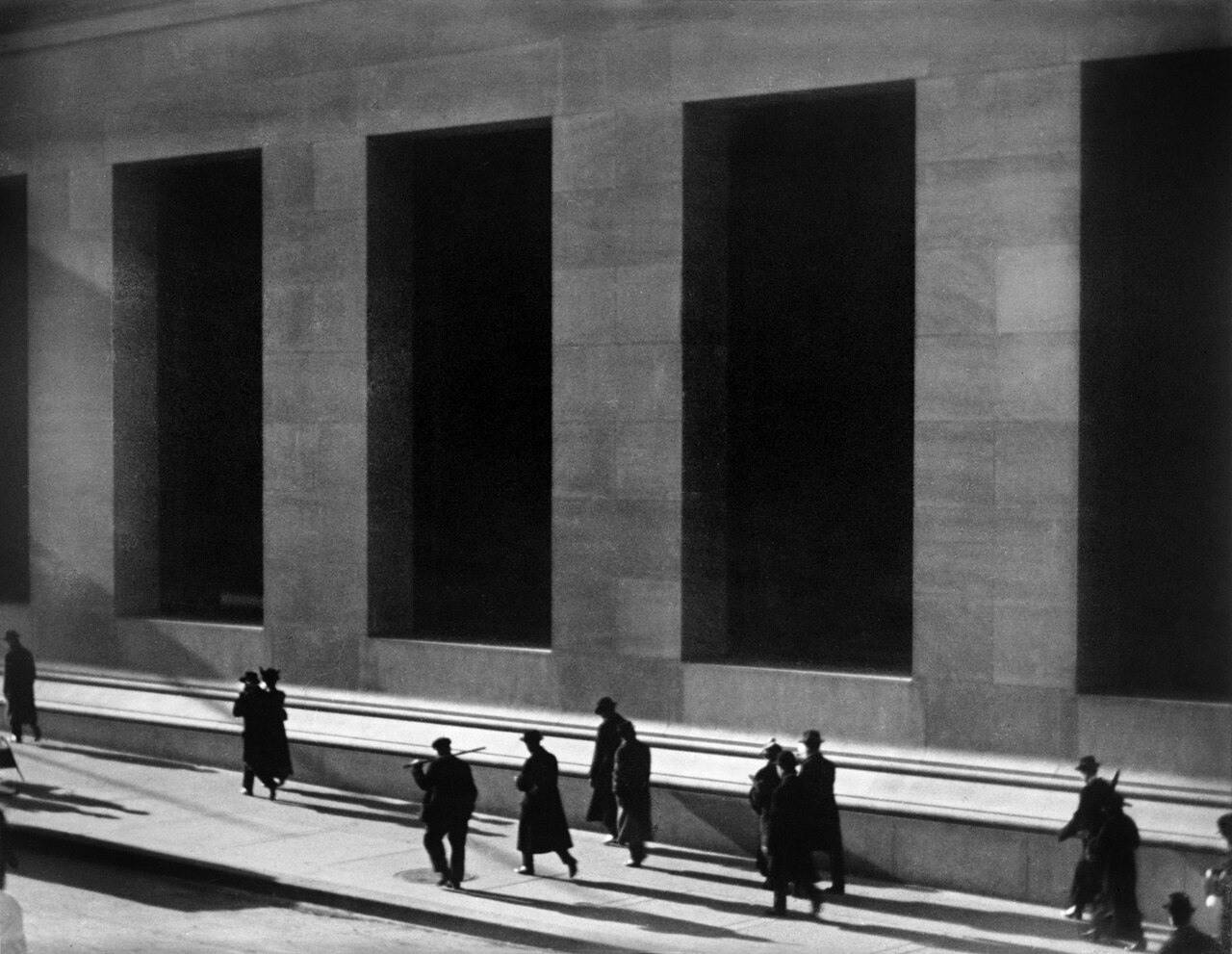
Paul Strand's Wall Street is one of the few canonical photographs that still feels physically intimidating even in reproduction.[1][2] The usual summary is easy enough: people hurry past the House of Morgan, their shadows stretching across the pavement, and modern finance looks impersonal.[1] That reading is true as far as it goes, but the photograph's real force is more exact. Strand does not show a busy street in order to celebrate urban speed. He turns lower Manhattan into a pressure system. The huge black window recesses of 23 Wall Street occupy most of the frame, while the pedestrians survive only as a narrow moving band below.[1][2] The city is not a backdrop for human action here. It is the scale that judges it.
That is why the picture still looks severe. Many city photographs ask the viewer to admire bustle. Strand does the opposite. He keeps the crowd small, strips out facial legibility, and lets the building's blank mass dominate the scene.[1][3] What remains is not anecdote but ratio: wall to body, void to light, vertical block to diagonal shadow. The image turns finance into something architectural before it becomes narrative.
Image context: the article uses the photograph itself, in a Library of Congress digital file reproduced on Wikimedia Commons, because the argument depends on the actual tonal structure of the print. A studio portrait of Strand or a contemporary view of the corner would miss the crucial fact that this picture makes the financial district look less populated than overruled.[5]
The building occupies more of the picture than the street does
The Whitney Museum's collection text supplies the central factual key. Strand took the photograph from the steps of Federal Hall during morning rush hour, looking toward the recently completed white-marble headquarters of J.P. Morgan at 23 Wall Street.[1] Yet once you look at the image, "rush hour" is not what announces itself first. The building does. Its dark window openings are so tall and so visually empty that they read almost like cuts in a stage flat.[1] They do not invite the eye inward. They absorb it.
That choice matters because it changes the meaning of the pedestrians below. If the windows were shallower, or if the frame admitted more sky, storefront detail, or neighboring traffic, the photograph might read as lively reportage. Instead Strand gives us a monumental facade that behaves almost like a cliff. The pavement becomes a ledge. Human beings appear not as protagonists but as temporary notations crossing a fixed system.[1][2]
Philadelphia's museum description gets at this well when it calls the photograph a synthesis of two Strand subjects from the 1910s: people negotiating a rapidly changing city and geometric abstraction.[2] The strength of Wall Street is that the two cannot be separated. The abstraction is not decorative overlay. It is the way power appears when architecture becomes more legible than the people moving beneath it.
The shadows make the crowd legible by taking identity away
The photograph would be far less memorable without the shadows. Whitney's text notes the long horizontal shadows as counterpoints to the vertical voids of the bank windows.[1] That formal description is precise, but it also points to the work's emotional mechanism. The shadows give the pedestrians length without giving them individuality. They extend the figures across the pavement while keeping them faceless.
This is where the image becomes colder than a simple social document. We can tell that the crowd is active, but activity does not restore personhood. The people remain dark silhouettes in hats and coats, recognizable as urban types but not as distinct characters.[1][2] Their bodies are readable chiefly through movement and projection. A person becomes a pace, a slant, a duration of shadow.
That reduction is exactly what makes the picture unsettling. Finance in Wall Street is not shown through money changing hands, office interiors, or the stock exchange floor. It is shown through the way bodies lose narrative density when placed against a facade built to outscale them. The shadows help the image register motion, but they also make motion look pre-assimilated, as if the crowd has already been translated into a pattern the building can contain.[1][2]
Strand found tempo without surrendering to blur
The Metropolitan Museum's timeline essay is useful here because it places the photograph inside Strand's technical turn in 1915. After Alfred Stieglitz criticized the graphic softness of his earlier work, Strand changed course and began making more forceful photographs around movement in the city, abstraction, and street portraiture.[3] The result was not a plunge into chaos. The Met notes that Strand was a deliberate artist and initially structured his city images around relatively slow movement before increasing their complexity with downtown crowds.[3]
That description clarifies why Wall Street feels so controlled. The image is full of motion, yet almost none of it dissolves into blur. Figures are caught in transit, but the geometry holds them firmly.[1][3] Whitney quotes Strand's own phrase for the effect, a movement that is "abstract and controlled."[1] The wording matters because it names the photograph's unusual balance. Strand does not choose between city flux and formal order. He lets order prove that flux has already been absorbed into the grammar of the street.
This is also why the vantage point from Federal Hall is so smart.[1] Strand looks down just enough to compress the sidewalk into a band, but not so much that the pedestrians flatten into dots. They still carry weight. What the angle removes is conversational intimacy. No one meets our eye. We observe circulation, not encounter.
The photograph made modernism look harder, not freer
One reason Wall Street remains central to early modernist photography is that it never confuses formal intelligence with liberation. The Met's Paul Strand: Circa 1916 publication describes Strand's breakthrough images as part of a direct modern vision expressive of twentieth-century experience.[4] In Wall Street, that experience is not bohemian excitement or machine-age glamour. It is hardness: the pressure of facades, the regularity of windows, the compression of pedestrians into shadowed units.
Philadelphia's object page adds another important point about the print itself. Strand was an exacting craftsman in platinum, and the museum notes that its 1915 platinum print is one of only two known examples, even though the image later circulated in other media and at other moments in his career.[2] That history helps explain the photograph's long afterlife. The image is reproducible, but its severity comes from a very material discipline. The picture was built to last because it was printed as carefully as it was seen.
That material history also prevents Wall Street from collapsing into a slogan about capitalism. The photograph does make financial power feel overwhelming, but it does so by organizing tones and shapes with unusual exactness.[1][2][4] The image does not merely say that modern life is anonymous. It shows how anonymity becomes visible when architecture, light, and motion begin speaking more loudly than faces.
This is why the photograph still matters. Strand found a way to make a crowd look active without making it sovereign. He made the city feel modern not by speeding everything up, but by showing how completely the street had already been arranged into power's proportions. The shadows move. The windows do not. The whole picture lives in that inequality.
Sources
- Whitney Museum of American Art, "Paul Strand, Wall Street, New York" - collection page with vantage point, 23 Wall Street context, and the photograph's formal description of horizontal shadows against vertical window voids.
- Philadelphia Museum of Art, "Wall Street, New York" - object page on geometric abstraction, the J.P. Morgan facade, platinum printing, and the rarity of Strand's large 1915 print.
- The Metropolitan Museum of Art, "Paul Strand (1890-1976)" - timeline essay on Strand's 1915 turn away from soft-focus pictorialism toward city movement, abstraction, and harder modern form.
- The Metropolitan Museum of Art, Paul Strand circa 1916 - publication page describing Strand's early photographs as a direct modern vision expressive of twentieth-century experience.
- Wikimedia Commons, "File:Paul Strand, Wall Street, New York City, 1915.jpg" - source page for the archival image used here, with Library of Congress provenance and publication-before-1931 public-domain note.