Light and Space is often flattened into a California mood: clean rooms, polished acrylic, pastel glow, and a promise of transcendence. That atmosphere is real, but it is only the doorway.[1][2] The movement's harder achievement was to push art's center of gravity away from depiction and toward conditions of seeing. Instead of asking viewers to decode image or iconography first, the artists gathered under the label made them register how light lands, rebounds, blurs edges, hollows depth, and changes with bodily movement.[1][2] The real medium was perception under pressure.
Getty's Art & Architecture Thesaurus defines Light and Space as a form of minimalism associated with Southern California artists of the 1960s and 1970s, marked by preoccupation with light, transparency, reflectivity, and color, often through glass, resin, and cast acrylic in site-specific installations.[1] LACMA's Light, Space, Surface broadens the picture in the right direction. The museum describes artists investigating how we understand form, volume, presence, and absence through light seen directly, reflected, or refracted, often using newly developed industrial materials such as sheet acrylic, fiberglass, and polyester resin.[2] That is the movement's real scale. It was never one fixed look. It was a shared wager that perception itself could become the event.
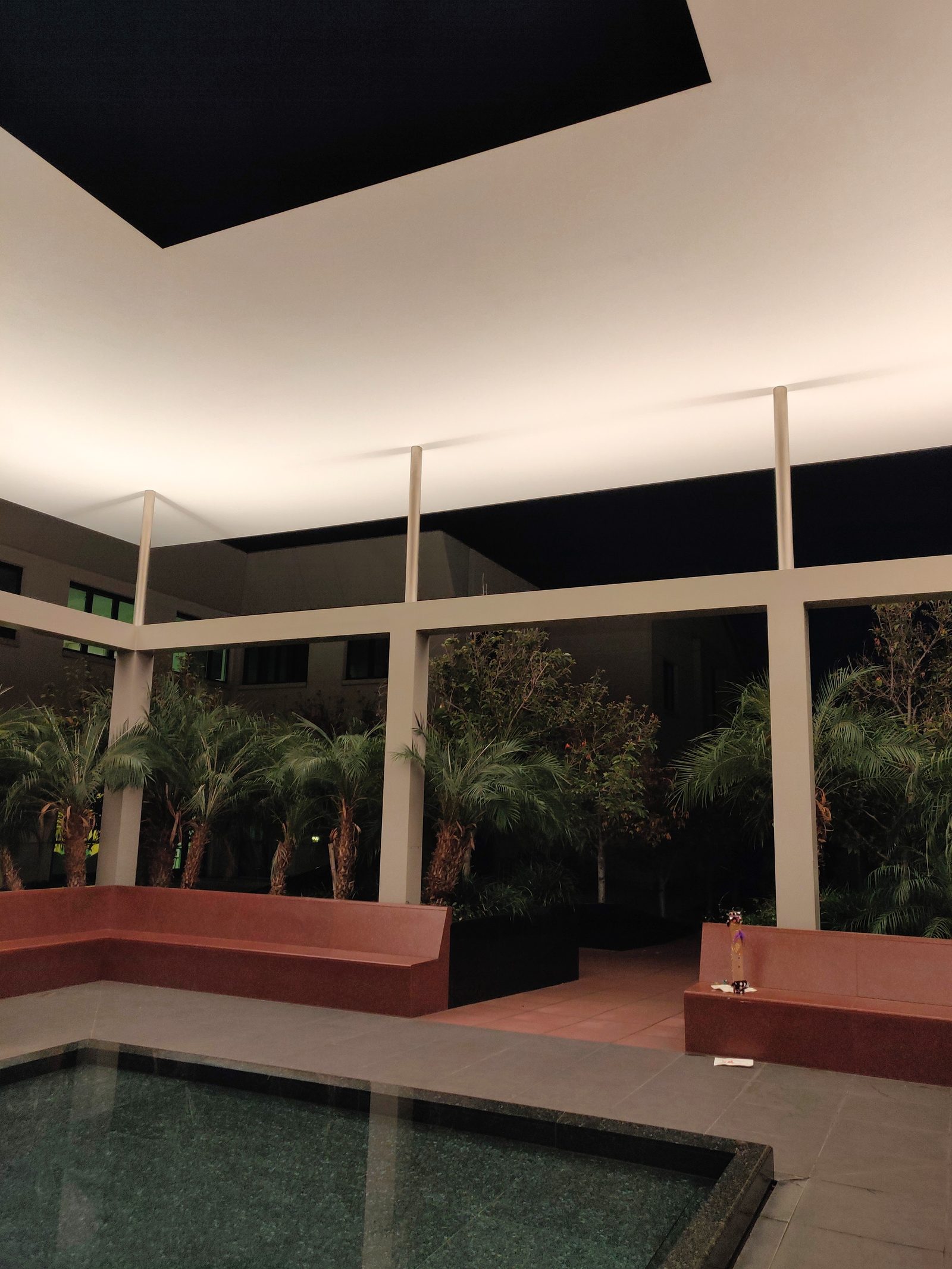
Image context: the lead image uses a faithful photographic view of Turrell's 2007 Skyspace at Pomona College rather than a poster, rendering, or abstract light study. That choice matters because the article's argument begins with a concrete artwork in which framed sky, reflected water, and changing color make the movement's central problem immediately visible.[7][10]
The point was to make looking unstable in a productive way
The quickest way to misunderstand Light and Space is to imagine that it aimed at emptiness. The forms can look spare, yet the work is full of sensory argument. Highly polished surfaces, translucent plastics, luminous paint, and room-scale installations force viewers to notice how much seeing depends on position, duration, and ambient conditions.[1][2] A piece changes when approached head-on, when glanced from the side, and when daylight gives way to artificial light. Form starts to loosen from contour. Depth can feel internal, projected, or temporarily suspended between the object and the eye.
That instability is why the movement still resists flattening into design taste. The reflective finish, the pale palette, and the clean geometry matter, yet they matter as instruments rather than signatures.[1][2] The artists were not simply making beautiful objects for calm white rooms. They were calibrating situations in which light would behave like a material and the viewer would become newly aware of how fragile visual certainty actually is.
Mary Corse kept painting inside the problem
Mary Corse is crucial because she proves that Light and Space did not require painting to disappear. Whitney's survey notes that Corse shared the movement's fascination with perception and with the possibility that light itself could serve as both subject and material, yet while many contemporaries moved toward sculptural and environmental projects, she pursued the problem through painting.[3] That difference sharpens the movement's whole history. It shows that the key issue was never medium loyalty in the old sense. The issue was whether an artwork could make light and seeing behave actively.
Corse's experiments with fluorescent light, Plexiglas, metallic flakes, and later glass microspheres gave the canvas an unstable surface condition.[3] A viewer moving across one of the White Light paintings does not encounter a fixed white rectangle that politely stays put. The painting flickers between matte and radiant, between object and atmosphere.[3] In her hands, the wall remains important, but it no longer guarantees a stable pictorial contract. Painting becomes one more apparatus for altering perception.
Helen Pashgian and James Turrell made depth feel bodily
Helen Pashgian pushed that logic into molded plastic and cast acrylic. LACMA's collection note on Untitled (Wall Sculpture) identifies her as one of the Southern California artists investigating form, volume, presence, and absence through light, and it emphasizes the work's ocean-like depth together with its mysterious partial occlusion.[4] That pairing matters. Pashgian does not offer transparent clarity as a technological virtue. She offers legibility and enigma at the same time.
LACMA's 2014 Helen Pashgian: Light Invisible makes the bodily consequence explicit. The museum describes viewers walking past, around, and between large two-part acrylic columns that create an immersive experience and invite meditation on material and light.[5] The sculpture is not content to occupy space as a finished thing. It conditions the viewer's path, measuring how perception shifts as one circles, nears, and withdraws. Depth is felt as an encounter rather than read as an illusion.
James Turrell carries the argument farther by making light appear almost free of support. The Guggenheim's retrospective frames him as one of the foremost artists associated with Light and Space, linking his installations to perceptual psychology and the Ganzfeld effect and to his formulation of "seeing yourself seeing."[6] Pomona's page on Dividing the Light offers the clearest plain-language account of how that works in practice. Opened in 2007, the Skyspace heightens awareness of light, sky, and perception through a canopy and reflecting pool; at dawn and dusk, changing color on the canopy can make the sky look lavender one moment and nearly black the next.[7] Nothing illustrative has been added to the sky. The work simply reveals that seeing is comparative, adjustable, and surprisingly easy to steer.
Robert Irwin moved the work into the site itself
If Turrell turned the sky into a medium, Robert Irwin pushed the movement toward site-conditioned experience. Getty's 2011 note on Black on White says the work, like all of Irwin's art since the 1970s, is site-conditional, organized conceptually and physically by the space in which it is installed.[8] That sentence is one of the clearest keys to the movement's later development. Once perception becomes the central problem, the surrounding architecture, circulation path, threshold, and light source stop being background. They join the work.
The Getty's Central Garden teaching guide makes the same point in a different register. Irwin's garden is described as an immersive configuration of plants, stones, and water in which smell, touch, sound, color, and texture interact, with materials chosen to accentuate light, color, and reflection.[9] The engraved phrase "Always changing, never twice the same" captures the deeper logic.[9] Light and Space, in Irwin's hands, expands beyond sculpture into a method for composing experience under changing conditions.
Why the movement still feels ahead of us
What keeps Light and Space current is that it distinguished attention from spectacle long before "immersive art" became a market category.[2][6][9] These artists asked viewers to spend time with slight shifts, uncertain edges, and materials that changed character as the body moved. The payoff was not information. It was recalibration.
That is also why the movement remains hard to reduce to photography, even when photographs of it can be beautiful. A camera records an object or a room with great efficiency; it has a harder time transmitting the exact interval in which a reflective surface wakes up, a frosted volume feels both near and unreachable, or a framed patch of sky begins to change color because the artwork has altered the conditions of comparison.[3][4][7] Light and Space still matters because it understood that perception is never neutral. Once that becomes visible, the artwork no longer ends at the object's edge.
Sources
- Getty Research Institute, "Light and Space" in the Art & Architecture Thesaurus - definition of the movement as a Southern California form of minimalism concerned with light, transparency, reflectivity, color, and site-specific installation materials.
- Los Angeles County Museum of Art, "Light, Space, Surface: Selections from LACMA's Collection" - exhibition overview describing perceptual inquiry, industrial materials, and the related finish-fetish context.
- Whitney Museum of American Art, "Mary Corse: A Survey in Light" - exhibition overview on Corse's role in Light and Space, her focus on painting, and her use of fluorescent light, Plexiglas, metallic flakes, and glass microspheres.
- Los Angeles County Museum of Art, "Untitled (Wall Sculpture)" - collection note on Helen Pashgian's acrylic sculpture, perceptual phenomena, and the work's simultaneous depth and occlusion.
- Los Angeles County Museum of Art, "Helen Pashgian: Light Invisible" - exhibition page on molded acrylic columns and the immersive viewing experience created by moving around and between them.
- Solomon R. Guggenheim Museum, The Art of James Turrell - exhibition transcript covering Turrell's place in the Light and Space movement, the Ganzfeld effect, and "seeing yourself seeing."
- Benton Museum of Art at Pomona College, "James Turrell Skyspace" - official page on Dividing the Light (2007), its dawn/dusk lighting program, and its heightened awareness of light, sky, and perception.
- Getty, "Getty Commissions New Work by Robert Irwin for Pacific Standard Time" - note describing Irwin's later work as site-conditional and organized by the space of installation.
- Getty Education, "Central Garden" - teaching guide on Robert Irwin's immersive garden, multisensory experience, and the interplay of light, color, and reflection.
- Wikimedia Commons, "File:Dividing the Light interior.jpg" - file page for the photographic image of James Turrell's Dividing the Light used as this article's cover.