Paul Klee is still too often filed under the pleasant words that make modern art sound harmless: whimsical, childlike, fanciful.[1][2] Those words catch something real about his mobility and wit, but they miss the harder achievement. Klee's lasting distinction is that he kept abstraction close to notation. His pictures rarely behave like sealed worlds. They feel written, scored, counted, tuned, or diagrammed, even when they remain sensuous and funny. That restlessness is why his work can move so quickly between fish, birds, gardens, masks, moons, arrows, grids, and blocks of color without collapsing into private ornament.[1][2]
The biographical outline helps explain the pressure behind that art. Klee was born near Bern in 1879 to a music teacher father and a singer mother, hesitated seriously between music and painting, met the artists around Der Blaue Reiter, taught at the Bauhaus, was driven out of Germany by the Nazis, and died in 1940 after years of illness.[1][2] Yet the shape of the career matters less as chronology than as method. Music, pedagogy, exile, and late frailty all left formal traces in the work. Klee remained independent not because he stood outside the twentieth-century avant-garde, but because he absorbed its languages without consenting to live inside one of them permanently.[1]
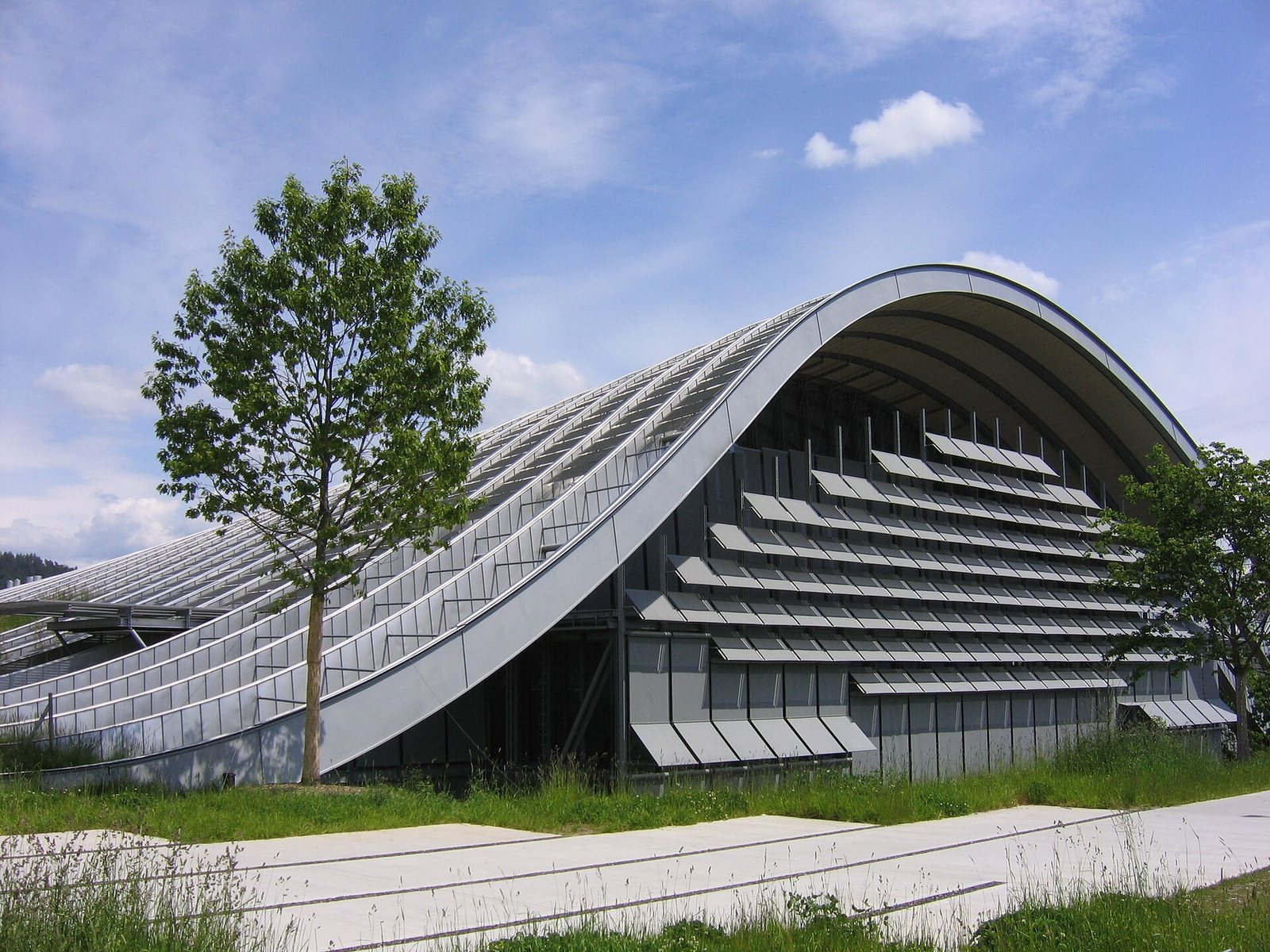
Image context: the cover now uses a real photograph of Zentrum Paul Klee in Bern. The building is not a diagram of Klee's method; it is the physical institution where his work, archive, and afterlife gather, which fits a profile about color, pedagogy, and late signs without turning the cover into an art-reproduction thumbnail.[1][7]
Tunisia made color independent, not decorative
Klee's 1914 trip to Tunisia is one of the best-known turning points in modern art, and it deserves that status if it is read carefully rather than romantically.[2][3] The Metropolitan Museum's essay says the light of North Africa awakened his sense of color and gave him the final push toward abstraction.[2] The Met's object page for Hammamet with Its Mosque makes the shift even clearer in visual terms. The upper portion still describes a town seen from outside its walls, with a mosque, towers, and gardens, while the lower area becomes a field of translucent color planes indebted to Robert Delaunay's chromatic experiments.[3]
That combination matters because it corrects a common misunderstanding about Klee. He did not discover color by abandoning structure. He discovered a way to let color operate without being chained to local appearance. The town remains legible, but it is no longer the sole authority. Color begins to organize the painting with its own rhythm. Abstraction, in Klee's case, is not an escape from the world into atmosphere. It is a re-scoring of what the world can do once line and hue are allowed to carry part of the meaning by themselves.[2][3]
This is why Klee's abstractions so often feel alive rather than doctrinal. They retain the memory of things seen, but they refuse to let seeing harden into transcription. The Hammamet watercolor still has place in it; it also has permission to become a composed field.
The Bauhaus years turned intuition into grammar
If Tunisia released color, the Bauhaus years made Klee's intuitions teachable. Zentrum Paul Klee's biography traces the institutional arc: Walter Gropius appointed Klee to the Bauhaus in 1920, he moved to Weimar in 1921, then to Dessau with the school in 1925, and remained there until 1931.[1] The Met's broader essay adds the scale of that period: nearly half of his roughly 10,000 works were produced during the ten years he taught at the Bauhaus.[2] This was not a side job attached to studio practice. Teaching became one of the engines that sharpened the work.
The Bauhaus-Archiv page on Klee's Pedagogical Sketchbook shows what that sharpening looked like.[4] It describes a book built around the relationships among line, shape, surface, and color, written in a tone that moves between diagram, science, and intuition.[4] That is a precise description of Klee's larger project. He wanted a grammar without deadness. He wanted the elementary parts of visual form to become discussable and transmissible, yet he never reduced painting to mechanical formula.
That tension is decisive. Many abstract artists can be mapped through a doctrine: purity, geometry, reduction, spiritual ascent, industrial design. Klee is harder to compress because even his most analytic work keeps a nervous pulse. The grammar stays elastic. A line can remain a line, become a path, suggest a creature, or thicken into a sign. A patch of color can sit as a plane, a temperature, or a small local event. He teaches form, but the lesson never becomes bureaucratic.
Twittering Machine shows Klee's pictures thinking in signs
MoMA's page for Twittering Machine is useful because it reveals both the work's medium and its historical route.[5] The piece is not an oil painting on canvas but an oil transfer drawing, watercolor, and ink on paper with gouache and ink borders on board.[5] Even materially, it occupies Klee's preferred in-between zone: drawing and painting, image and inscription, machine and creature. Four birdlike forms perch on a wire attached to a hand crank. The scene reads at once as comic invention, mechanical absurdity, and a tiny theory of modern life.
This is where Klee's sign language becomes most persuasive. The birds are not rendered naturalistically, but they are not merely abstract marks either. They hover between pictogram and organism. The crank implies that sound or life might be manufactured; the birds imply that machinery might have begun to sing. Klee does not choose one side and eliminate the other. He lets the image vibrate between them. That is what notation means here. The work behaves like a sentence whose syntax is clear enough to follow and open enough to keep generating tones.
The provenance on MoMA's page adds a darker twentieth-century edge.[5] The work was acquired by Berlin's Nationalgalerie in 1923, removed as "degenerate art" in 1937, and eventually entered MoMA in 1939.[5] Klee's signs may look playful, but they moved through institutions and regimes that understood very well how ungovernable such play could be.
The late works thickened the sign instead of silencing it
The final phase of Klee's career is often described through pressure: dismissal from the Düsseldorf Academy in 1933, return to Bern, the onset of scleroderma, confiscation of 102 works from German museums in 1937, and a peak of 1,253 works in 1939 despite severe illness.[1] The Met essay says the late work grows somber: lines turn into black bars, forms become broader, scale larger, colors simpler.[2] That summary is exactly right, but it should not be mistaken for collapse. Klee did not lose his language. He made it heavier.
The Met's page for Comedians' Handbill shows how.[6] The work is made on newspaper covered with caramel-colored gouache, with thick black figures and touches of white and pink; the museum notes that Klee turned his abbreviated black figures of the previous year into even thicker pictographs that leap toward the viewer like an advertisement.[6] The description is formal, but the emotional force is larger. In these late signs, Klee compresses comedy, exhaustion, public address, and private unease into the same blunt instrument. The line is no longer airy. It has become load-bearing.
That change is one reason the late work remains so moving. Klee does not pretend that inward freedom survives history untouched. The signs are burdened now. Yet they still move. Even near the end, he refuses both pomp and despair. He keeps working at the scale of marks, relations, intervals, and figures, as if the world's pressure had to be answered one sign at a time.[1][2][6]
Why Klee still matters
Paul Klee still matters because he never let modernism split into separate camps inside his work. Music and painting remain in conversation. Intuition and pedagogy reinforce rather than cancel each other. Figuration keeps passing through abstraction without surrendering its memory of things. Late gravity does not erase play; it tests it.[1][2][4]
That is why his pictures age so well. They do not ask the viewer to submit to a single creed. They ask for a more alert kind of reading. In Klee, color can think, line can hesitate, shapes can behave like words, and a tiny sign can carry more historical pressure than a monumental statement. He kept abstraction close to notation, and because of that, he kept it close to life.
Sources
- Zentrum Paul Klee, "Paul Klee" - official biography timeline covering his musical family, Der Blaue Reiter circle, Tunisia trip, Bauhaus appointment, exile, illness, and the 1,253 works produced in 1939.
- Sabine Rewald, "Paul Klee (1879-1940)," The Metropolitan Museum of Art Heilbrunn Timeline of Art History - overview of Klee's independence, Tunisia as the turning point for color, Bauhaus productivity, and the somber compression of the late works.
- The Metropolitan Museum of Art, "Hammamet with Its Mosque" - object page on the 1914 watercolor, its view from outside the city walls, and the lower field of translucent color planes influenced by Robert Delaunay.
- Das Bauhaus-Archiv / Museum fur Gestaltung, "Bauhausbucher 2 - Paul Klee: Pedagogical Sketchbook" - publication page describing Klee's Bauhaus teaching and his theory of the relations among line, shape, surface, and color.
- The Museum of Modern Art, "Twittering Machine (Die Zwitscher-Maschine)" - object page with medium details and provenance from the Nationalgalerie in 1923 through its 1937 removal as "degenerate art" and 1939 MoMA acquisition.
- The Metropolitan Museum of Art, "Comedians' Handbill" - object page on Klee's late thick-stemmed black pictographs, gouache over newsprint, and the condensed force of the 1938 image.
- Wikimedia Commons, "File:Zentrum Paul Klee Bern 10.JPG" - file page for the real photograph of Zentrum Paul Klee in Bern used as the immersive cover image.