Henry Ossawa Tanner is often introduced through a milestone sentence: the first African American painter to achieve sustained international acclaim.[1][2] The fact matters, but it can flatten the art into biography before the paintings have had time to work. Tanner's real distinction sits inside the pictures themselves. He made light carry ethical weight. Whether he was painting an older man teaching a boy to play the banjo, Mary facing the divine, or the Holy Family moving through night, illumination in Tanner is never only visual atmosphere. It is the means by which dignity becomes visible.[1][2][5]
That is why Tanner still feels unusually fresh. His paintings do not beg for admiration through noise, theatrical bravado, or allegorical overstatement. They lower the temperature. They slow the eye down. Then they ask the viewer to stay long enough for compassion, solitude, uncertainty, and spiritual pressure to rise from inside the scene. The institutions that hold his work describe different phases of that achievement, but the phases belong to one argument. Philadelphia discipline, Paris ambition, biblical subject matter, travel to the Middle East, and late moonlit compression all feed the same project: how to paint inward intensity without losing the world outside the room.[1][2][3][5]
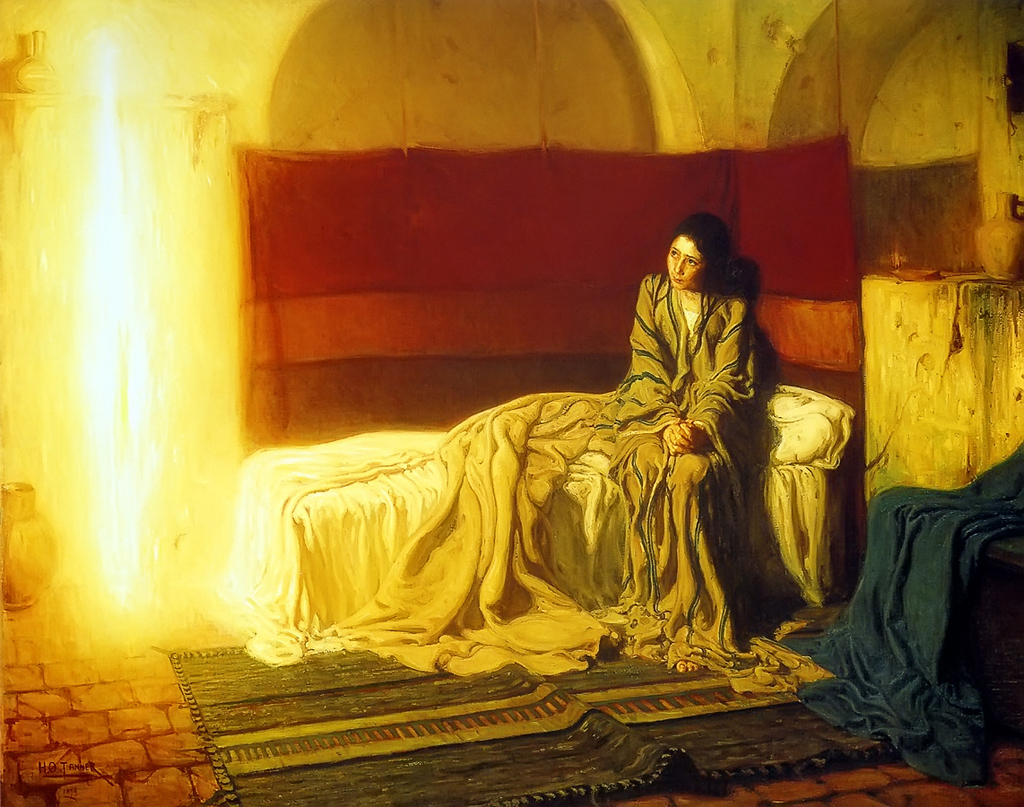
Image context: the cover image uses The Annunciation because it condenses Tanner's whole method into one room. Mary is rendered as a young woman in plain, rumpled clothing, and Gabriel arrives not as a winged body but as a vertical blaze of light.[3][4] The work makes spirituality credible by stripping away spectacle and letting illumination itself become the event.
He began by making domestic attention look serious
The National Gallery of Art's biography is a useful starting point because it ties Tanner's early subject matter to a growing consciousness of racial identity.[1] During the early 1890s, before he became best known for biblical scenes, Tanner made genre paintings that treated Black life with gravity and sympathy rather than caricature.[1] Hampton University Museum says The Banjo Lesson reflects his conscious commitment to depicting African Americans in a compassionate manner, and notes both its Paris Salon acceptance in 1894 and its early importance to the museum's collection history.[6] That combination matters. Tanner was not painting Black life as ethnographic curiosity or sentimental folklore. He was building an interior world in which teaching, concentration, and intergenerational care deserved the full seriousness of oil painting.[1][6]
This is the first place where his ethics of light becomes clear. In The Banjo Lesson, the glow falls on hands, faces, and the shared space between teacher and child. Light does not sentimentalize poverty; it stabilizes attention. The room is humble, but the painting refuses humiliation. Tanner gives the scene weight by controlling value, quiet, and posture so carefully that the bond between the two figures becomes the work's true architecture.[1][6]
Paris widened his career without erasing the earlier question
Tanner's move to Europe changed his professional horizon, yet it did not erase the pressure that shaped the early work. The NGA notes his training under Thomas Eakins at the Pennsylvania Academy of the Fine Arts, the failed Atlanta studio, the support that enabled European study, and his 1891 move to Paris to work at the Academie Julian.[1] PAFA's Modern Spirit exhibition page makes the larger point: Tanner became an American expatriate artist operating at the highest international level while also carrying Philadelphia formation, religious conviction, travel, technical experimentation, and the experience of racialized life in the United States into the center of his mature practice.[2]
The common shortcut is to describe this shift as a move away from Black genre painting and into biblical respectability. The record is more interesting. After one of his paintings was accepted at the 1894 Salon, Tanner turned increasingly to biblical subjects and began to receive major recognition.[1] Yet the deeper continuity was not subject matter in the narrow sense. It was his insistence that figures under pressure be painted with moral seriousness. The biblical scene gave him a larger register for that seriousness, but it did not cancel the earlier concern. It intensified it.
The Annunciation turned realism into revelation
No Tanner painting makes that turn clearer than The Annunciation.[3][4] The Philadelphia Museum of Art explains why the work felt so different from standard treatments of the scene: Tanner wanted realism. Mary appears as an adolescent in rumpled Middle Eastern peasant clothing, without halo or courtly luxury, while Gabriel enters as a shaft of light.[3] The painting was shown at the 1898 Paris Salon and then acquired by the Philadelphia Museum of Art in 1899, becoming Tanner's first work to enter an American museum.[3]
The Smithsonian's Study for the Annunciation sharpens the formal logic behind the finished canvas. In the study, a vertical line of white paint already stands in for the divine presence, and the museum notes that the finished painting was well received in Paris and became Tanner's first work acquired by an American museum.[4] That detail matters because it shows how radical his simplification really was. He did not modernize the subject by stripping it of faith. He modernized it by trusting light to bear the burden of revelation.
This is Tanner at his most exact. The room is spare, but it is not empty. Mary looks young enough to be vulnerable and composed enough to remain thinking inside the moment.[3] The miracle reaches her as pressure before it resolves into meaning. Tanner understood that spiritual experience often enters painting most forcefully when it is made bodily first: light against darkness, stillness against expectancy, enclosure against visitation.[3][4]
Late Tanner made night luminous without losing uncertainty
PAFA's exhibition summary emphasizes how far Tanner pushed his religious painting through travel, technical innovation, and sustained contact with the Holy Land and North Africa.[2] The later Flight into Egypt paintings show what that meant in practice. The Smithsonian American Art Museum says Tanner's 1897 trip to the Middle East probably inspired the theme, which he returned to as many as fifteen times.[5] In the museum's version, Mary and the donkey are barely discernible, Joseph is little more than a suggestion, and moonlight alone opens the route ahead.[5]
This is one of Tanner's greatest late inventions. Many religious painters make revelation clearer by making bodies clearer. Tanner often does the opposite. He allows figures to drift toward partial visibility while light does the work of orientation.[5] The Holy Family is present, but presence is fragile. Their path exists because illumination grants it for a moment. The Smithsonian also suggests that Tanner's experience of racism in the United States may have shaped his identification with the persecuted Holy Family.[5] Whether one presses that parallel hard or not, the emotional link is convincing. Tanner had long been interested in what it means to inhabit a world where safety, dignity, and belonging are never guaranteed in advance.
That is why his late work can feel both tender and austere. He does not paint religious consolation as easy possession. He paints it as something glimpsed, carried, and protected in transit.[2][5]
Why Tanner remains durable
Henry Ossawa Tanner remains durable because he found a way to make inward life visible without reducing it to anecdote.[1][2] He gave domestic scenes the gravity of historical painting, gave biblical painting the realism of lived rooms and traveled landscapes, and made light function as more than style. It becomes care in The Banjo Lesson, visitation in The Annunciation, and guidance under threat in Flight into Egypt.[3][5][6]
This is also why the biographical firsts, though important, are not enough on their own. Tanner's achievement was not only that he crossed barriers. It was that he built a pictorial language strong enough to survive them. Philadelphia gave him discipline, Paris gave him range, travel gave him material, and faith gave him recurring subjects. The paintings gave all of that form. What survives in them is a rare kind of restraint: a belief that dignity can be painted most powerfully when light, silence, and attention are allowed to do the hardest work.
Sources
- National Gallery of Art, "Henry Ossawa Tanner" - artist biography covering his Philadelphia training, Paris move, racial consciousness, Salon recognition, Middle East travel, and later honors.
- Pennsylvania Academy of the Fine Arts, "Henry Ossawa Tanner: Modern Spirit" - exhibition page on Tanner's international career, religious painting, Holy Land and North Africa subjects, and technical innovation.
- Philadelphia Museum of Art, "Henry Ossawa Tanner, The Annunciation, 1898" - object page describing Tanner's realistic rethinking of the biblical scene and the work's 1899 acquisition.
- Smithsonian American Art Museum, "Study for the Annunciation" - artwork page on the white vertical form of divine presence and the finished painting's early reception.
- Smithsonian American Art Museum, "Flight into Egypt" - artwork page on Tanner's repeated treatment of the theme, Middle East travel context, moonlit path, and possible identification with the persecuted Holy Family.
- Hampton University Museum, "The Banjo Lesson" - museum page on Tanner's compassionate depiction of African Americans, the painting's 1894 Paris Salon admission, and its place in Hampton's collection history.
- Wikimedia Commons, "File:Henry Ossawa Tanner - The Annunciation.jpg" - source page for the artwork image used as this article's cover.