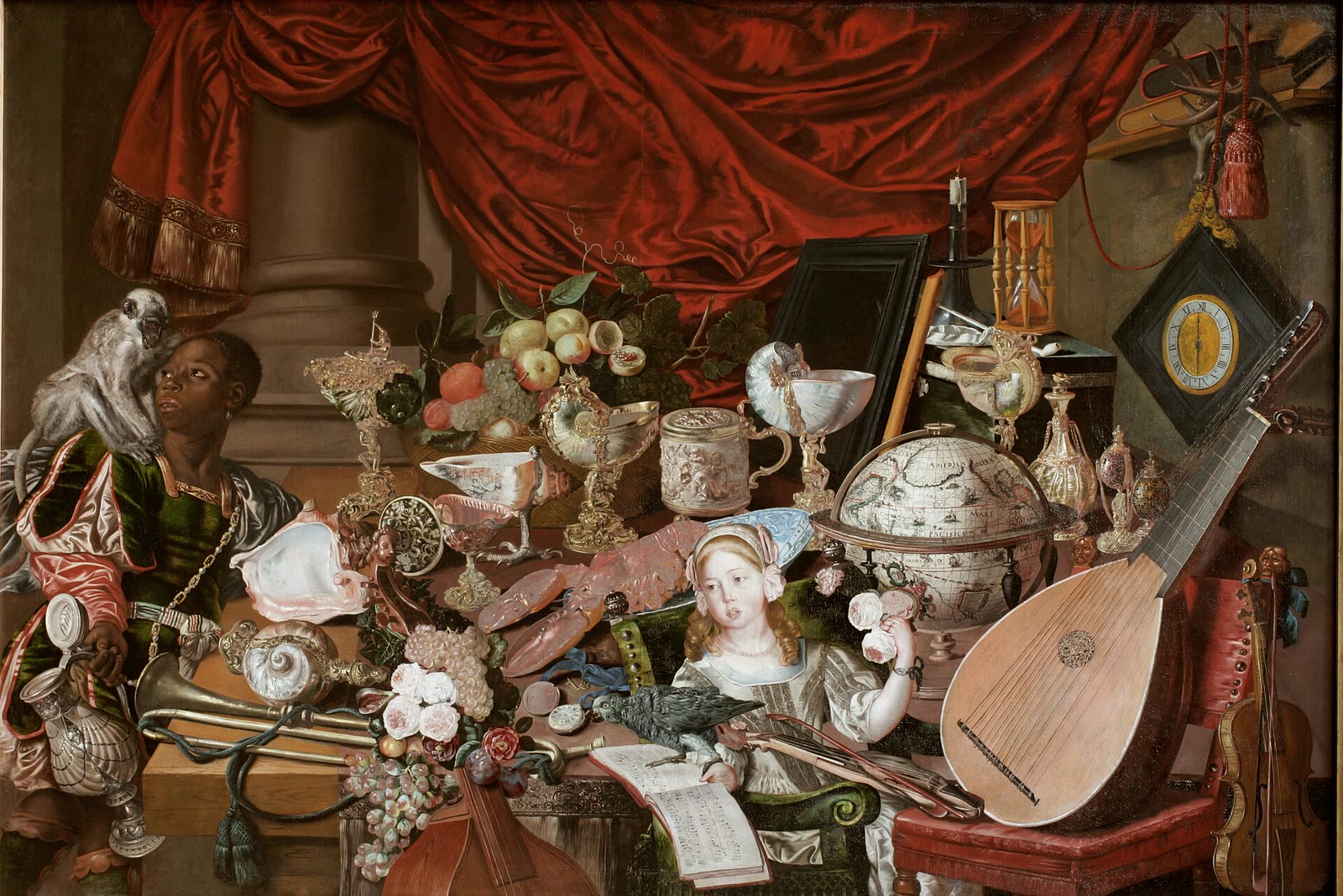
Image context: the cover is a real photograph of the painting, not a generated visual or analytical graphic. Its wide view matters: the argument depends on seeing people, animals, instruments, flowers, fruit, clocks, and precious vessels pressed into one unstable field.[1][2]
At first, The Paston Treasure looks less composed than accumulated. A silver-gilt flagon rises at the left. Shell cups glitter across a crowded table. A globe, a lute, a clock, fruit, flowers, a monkey, and a parrot compete for room. Dark red drapery turns the background into a theatrical enclosure, but no clearing opens in the middle to tell the eye where to settle.
Then the people emerge. At the far left, an unidentified young Black figure holds the flagon and looks upward, beyond the frame. At the right, a pale girl appears behind flowers and a sheet of music. Neither occupies the conventional center of a portrait. They enter among the possessions.
That placement supplies the painting's disturbing intelligence. Made around 1663 by an unresolved Dutch School artist, the enormous oil on canvas is precise enough to preserve identifiable objects from the Paston family's collection at Oxnead Hall. Yet it also fills itself with signs of expiry, revises one human figure out of sight, and turns another into part of a display of worldly reach. Within two generations, the collection it celebrates had been sold and scattered.[2][3]
This is not simply a boast corrected by hindsight. The picture is already coming apart on its own surface. It behaves like an inventory that knows possession cannot make a world stay put.
No object agrees to be background
The painting is approximately 165 centimeters high and 246.5 centimeters wide: nearly a wall rather than a window.[1] Its horizontal spread should make it easy to organize, but the artist denies it a stable axis. The eye jumps between hard highlights on metal, pale spirals of shell, wet fruit, black openings, feathers, glass, flowers, and exposed skin. Each material demands a different kind of looking.
The largest forms do not become secure anchors. The globe is partly obscured. The lute lies at an angle, its long neck directing attention across the table rather than holding it. The flagon in the young figure's arms is both an imposing vertical and an object being carried. A large shell cup near the center has the scale of a protagonist, but its pale mouth opens toward still more things.
This visual crowding corresponds to a real collecting ambition. Yale's publication overview describes at least six hundred decorative objects, including shell cups, crystal vessels, gemstones, instruments, paintings, and even a pair of crocodiles.[8] Thirteen glittering vessels appear in the painting, most fashioned from exotic shells. Their natural bodies had been transformed with elaborate metal mounts, making distant marine life into European luxury ware.[3]
The objects are not generic shorthand for wealth. A 1598 silver-gilt flagon, a 1592 nautilus cup, a Strombus shell cup, and a Gujarati mother-of-pearl flask with London mounts have all been matched to surviving things. In 2018, five depicted treasures were brought together for a Yale exhibition—the first such reunion in more than three centuries.[2] Exactness is therefore part of the painting's spectacle. The collector does not merely claim abundance; he claims that these particular marvels passed into this particular house.
But exactness cannot make the arrangement neutral. On the table, a Caribbean shell, an Indo-Pacific shell, Gujarati craft, English metalwork, Dutch painting, and a globe turned toward the Pacific become evidence of one Norfolk family's reach.[2][3] The display compresses travel, trade, extraction, manufacture, and exchange into a frictionless interior. Routes disappear so that possession can look natural.
The people do not stand outside the collection
The two visible figures sharpen that problem because the composition refuses to grant them a separate human zone.
The girl at right, commonly identified as Robert Paston's daughter Margaret, holds roses and a legible musical score. She is tucked behind the table, her face and hand surfacing between things. The painting can treat her as family continuity—a child positioned among inherited vessels—and still make her resemble another precious bearer of the Paston name. Yale's curatorial interpretation explicitly describes the work as an “heirloom portrait,” a category that joins genealogy to collection rather than choosing between them.[8]
The young man at left occupies a more violent ambiguity. His name and status are unknown. Researchers interviewed about the 2018 Norwich exhibition argued that the painting's meticulous specificity makes it likely he was a real person, possibly someone who lived in the Paston household; the archive has not established that relationship.[7] The King's College London and Wellcome-supported Renaissance Skin project places the painting within England's emerging colonial ambition.[5] The composition supplies a further fact of its own: he is pressed into the family's array of treasures rather than granted an independent portrait space.
His pose is crucial. The silver vessel fills his arms; a small monkey sits near his shoulder; his head turns away from the table and his gaze exits above the frame. Formally, that upward look helps circulate attention back into the drapery. Ethically, it refuses the easy satisfaction offered by the objects, whose surfaces wait to be admired. He is the only visible person who seems to look toward a space the collection does not contain.
That does not turn his gaze into freedom, and it cannot recover a biography the archive failed to keep. It establishes a boundary. The painting records the shape of his face more readily than his name. It gives the flagon a date and later provenance while leaving the person who carries it unresolved. The imbalance shows what the surviving record lets us specify: the vessel can be dated and traced; the person cannot.
Artist and performer Peter Brathwaite made this structure newly visible by restaging The Paston Treasure with his own body and family possessions. The project describes how Brathwaite substituted Afro hair products, Côte d'Ivoire textiles, a family patchwork, records, and migration luggage for the Pastons' display.[5] The restaging does not fill in the unidentified figure's life. It changes who gets to arrange the table—and whose history the objects are allowed to carry.
The luxuries contain their own ending
If the painting were only an advertisement for acquisition, its abundance would be exhausting but simple. Instead, death keeps interrupting the inventory.
Three timekeepers distribute that warning with unusual precision. Horologist Jonathan Betts identifies an open French enamel watch on the table, a sandglass beside a spent candle, and the diamond-cased wall clock at upper right. The watch's hand sits around eight: Betts reads it chiefly as a luxury object. The wall clock points to just before twelve, while much of the sand has fallen into the lower bulb. Different objects tell different kinds of time.[4]
Crucially, the wall clock is not a broken antique. Its ebony case probably held an early-1660s pendulum movement, a state-of-the-art technology only a few years after Christiaan Huygens introduced the practical pendulum clock in 1656. It could have kept time within seconds per day rather than the roughly quarter-hour daily error Betts gives for the older enamel watch.[4] The painting makes technical progress carry a memento mori: its most advanced clock is also the one nearest midnight.
Flowers will wilt; cut fruit will turn; musical vibration cannot be stored after the strings go quiet. These are familiar seventeenth-century reminders of transience, but here they do more than attach a moral footnote to luxury. They make failure one of the collection's materials.
The sheet in the girl's hand intensifies that effect. Researchers identified its music as Robert Ramsey's circa-1630 duet Charon, O Charon, heare a wretch opprest—an exchange between a suffering high voice and the ferryman of the dead, whose bass part has no visible singer in the painting.[7][9] The notation was painted carefully enough to be read centuries later. Precision again becomes the vehicle of disappearance: the artist preserves a song whose subject is passage out of life.
The arrangement consequently holds two incompatible models of time. Heirlooms such as the 1592 cup and 1598 flagon promise continuity across generations. The near-midnight clock, spent candle, falling sand, and death song insist that continuity is temporary.[3][4][7] The picture does not resolve the contradiction. It makes inherited wealth glitter more intensely because time has already entered the room.
This is why the word “treasure” is less stable than it sounds. Treasure names what a household removes from ordinary circulation and tries to protect. The painting shows that removal as impossible. Shells retain the memory of distant seas. Music requires time. Fruit continues to decay. People grow, die, marry, travel, or vanish from record. Even the most heavily mounted object carries a history before and after the Pastons.
One person was painted out
The visible crowd is not the painting's first arrangement.
In preparation for the 2018 exhibition, researchers scanned the canvas with a mobile macro X-ray fluorescence system. Six million measurements gathered over sixteen hours mapped elements associated with pigments beneath the surface. Under the diamond-shaped clock at upper right, they found the face, red dress, hair, and apparent leaf-like ornaments of a woman who had been painted and then covered.[6] Physical and X-ray study established the sequence more precisely: a plate gave way to the woman, then the clock and stag's head were painted over her.[4]
The scanner did not restore her name. Lady Margaret Paston, Sir William's second wife, is one proposed identity, but the figure may instead have been allegorical or combined portrait and allegory.[6] That uncertainty matters. Technical imaging can reveal that a person was removed without recovering the negotiation that removed her.
Her former position changes the visible composition. A woman beneath the clock would have given the upper-right corner a human counterweight to the figure at left and drawn family representation farther across the canvas. Painting her out replaced a human presence with another object—the clock and stag's head. The final inventory was therefore not a single act of recording. It was edited.
The hidden figure also makes the picture's vanitas machinery unusually literal. The newest timekeeping technology hangs where a face once appeared. Modern viewers can know that disappearance occurred because different pigments remain layered in the cloth, but the finished surface asks them to accept absence as design. The painting does not only tell us that lives pass. It demonstrates how representation can make a life pass out of view.
The painting became the collection's return address
Soon after completion, history performed the dispersal the picture had imagined. Yale records that the collection was sold off within two generations.[2] Reporting on the research behind the 2018 Norwich exhibition traces sales by 1709, bankruptcy in 1732, and the eventual abandonment and near-demolition of Oxnead Hall.[7] The table did not survive as a table.
Yet the painting did. That survival produced a curious reversal. Originally, the objects validated the family's picture of itself. Three and a half centuries later, the picture helped researchers identify, trace, and temporarily reunite the objects. A painted shell cup could point to a museum vessel; a tiny score could be matched to a song; a flask could connect Gujarat and London; elemental maps could disclose an erased portrait.[2][3][6][7]
The canvas became a return address for a household that no longer existed.
That achievement should not be confused with recovery in full. The 2018 exhibition assembled nearly 140 objects from more than fifty lenders, but only five were the exact treasures visible in the painting.[2] More importantly, identifying possessions is easier than identifying the social worlds that moved them. The silver flagon has an object record. The young figure still has no name. The hidden woman has candidate identities. The distant labor and exchanges behind shells, silver, pigment, and cloth remain mostly outside the frame.
The Paston Treasure is therefore valuable not because it defeats loss, but because it makes the terms of preservation visible. It preserves what a powerful family asked an artist to distinguish. It preserves the painter's revisions beneath that request. It preserves mortality inside display and dispersal after display. It even preserves, through an unidentified gaze leaving the frame, the fact that the inventory was never the whole world.
The table is still crowded. The collection is gone. The painting survives between those facts, exact and incomplete.
Sources
- Wikimedia Commons, “File: The Paston Treasure.jpg” — full-work photographic source, artwork dimensions, collection location, image dimensions, photographer, and license metadata for the cover asset.
- Yale Center for British Art, “The Paston Treasure: Microcosm of the Known World” — official exhibition record for date, authorship uncertainty, depicted objects, 2018 reunion, collection dispersal, and institutional credits.
- Nathan Flis, “A Painting that Reveals an Entire World while Concealing an Alchemical Secret,” Yale University Press (2018) — curatorial account of the shell vessels, global materials, heirlooms, patronage, pigment experiments, and Paston collection.
- Jonathan Betts, “Showtime at Oxnead: The timekeepers depicted in The Paston Treasure,” Antiquarian Horology 39, no. 2 (June 2018) — specialist analysis of the watch, sandglass, pendulum clock, dial times, vanitas meanings, and plate–woman–clock paint sequence.
- King's College London and Wellcome, Renaissance Skin, “The Paston Treasure” — Peter Brathwaite's photographic restaging and the project's interpretation of colonial ambition, family migration, and substituted possessions.
- Istituto Nazionale di Fisica Nucleare, “Nuclear Physics Reveal a Hidden Lady in the Painting ‘The Paston Treasure’” (2018) — macro-XRF method, scan scale, pigment findings, hidden figure, location, and cautious identity hypotheses.
- Maev Kennedy, “Framed in mystery: painting tells story of doomed Norfolk family,” The Guardian (2018; amended 2026) — reported research on the legible death song, the two visible figures, sales, debt, Oxnead Hall, and the collection's reunion.
- Yale Center for British Art, The Paston Treasure: Microcosm of the Known World (2018) — official publication overview for the collection's scale, the work's “heirloom portrait” function, and the scope of its technical study.
- Francesca Vanke, “Musical discoveries in The Paston Treasure,” Norwich Castle Museum & Art Gallery (2021) — official research note on the painted score, Robert Ramsey's duet, its vocal roles, and the absent bass singer.