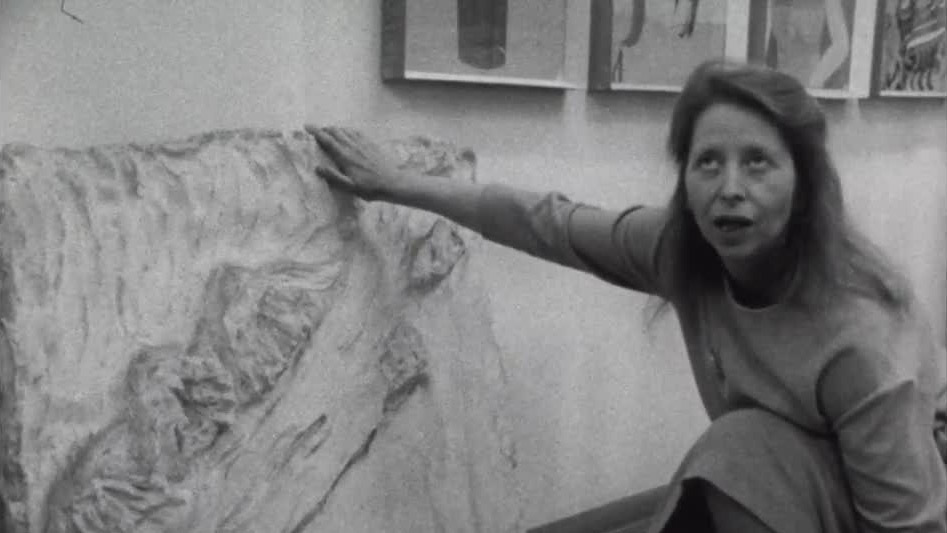

Image context: the cover is a frame from the 1971 film, supplied by BFI Replay. Polonsky is not posed at a polite distance from a finished object. She kneels beside a broad plaster relief and lays one hand across its rough upper edge, making scale and touch legible before any label can explain the work.[2]
The film offers Rolanda Polonsky visibility on troubling terms. Its institutional voice presents her diagnosis as the key that unlocks her sculpture: suffering has supposedly opened a hidden reservoir of vision. Then Polonsky enters the frame, touches the plaster, and begins giving meanings to the bodies she made. The explanation shifts. Her art no longer looks like material produced automatically by an illness. It looks authored—formally deliberate, theologically argumentative, and insistently concerned with women's experience.
That conflict is why Lionel Miskin's ten-minute Rolanda Polonsky, Sculptor remains worth watching. Made in 1971 for the Arts Council of Great Britain and now preserved online by the BFI, it is both an unusual encounter with a neglected artist and a period document of the institution looking at her.[1][2][5] The camera preserves voice, gesture, scale, and physical texture. The narration repeatedly tries to compress those things back into a case history. A useful viewing has to hold both records at once.
Polonsky was born in Rovereto, Italy, in 1923. She earned a political-science degree at the University of Florence in 1947, pursued sculpture in Paris, briefly studied at the Académie de la Grande Chaumière, and had work included in a 1950 London Gallery exhibition organized by E. L. T. Mesens.[3] This matters because the convenient category of the untutored “outsider” does not fit. Polonsky had chosen sculpture, sought training, undertaken a commission, and developed an exhibition history; the precise relationship between the 1950 show and her admission remains uncertain.[3][5]
Even the chronology of her confinement resists a tidy caption. BFI Replay says she had lived at Netherne for 26 years when the film was made; an account of the film by Clair Wills gives the commentary's figure as 24 years; Ben Uri's research biography places her admission after her 1950 arrival in London.[2][3][5] The sources therefore support a long confinement, not a confidently exact admission year. That discrepancy is more than bookkeeping. It warns us that much of Polonsky's life reaches the present through institutions that recorded her unevenly and often spoke on her behalf.
At Netherne, artist Edward Adamson developed a studio practice that moved away from treating patients' images simply as diagnostic evidence. A Bethlem Gallery paper describes how the postwar research studio initially standardized paper, easels, and materials so artworks could be compared, while Adamson gradually turned it into a place for open access and freer expression.[6] For Polonsky, even making sculpture required negotiation: Adamson had to obtain permission for her to use a hammer and chisel.[6] The studio created room for work, but the need for permission reveals the wall around that room.
The embedded video is the BFI's official YouTube presentation of Miskin's 1971 sound documentary.[1][2] Its archival value does not make its language neutral. Watch the exchange between its governing voice and Polonsky's own explanations: one tries to locate the origin of the art in diagnosis; the other keeps locating meaning in bodies, pressure, suffering, gender, faith, and the specific choices of an artist.
The voice-over tries to close the case
The documentary's most dated move is not its grain or monochrome photography. It is its causal shortcut. The narration makes mental illness sound like the secret author of Polonsky's “mystical vision,” granting the diagnosis explanatory priority over education, technique, memory, religion, and thought.[2][5] That language appears sympathetic by the standards of its moment: it asks viewers to recognize expression and feeling in a psychiatric patient. Yet the compliment extracts a price. Polonsky becomes exceptional because illness has allegedly spoken through her.
Looking carefully does not require the opposite simplification. We do not need to deny that illness, care, medication, confinement, or Adamson's studio affected her life. We need to refuse the leap from context to authorship. A hospital can provide materials while restricting tools. A therapist can protect a studio while a larger institution limits freedom. A documentary can preserve an artist's testimony while directing viewers to hear it as evidence of pathology. These conditions overlap without becoming the same thing.
The film itself supplies the correction. Polonsky does not merely display objects while an expert decodes them. She moves among works and interprets them. Her English is careful, her pace unhurried. She identifies figures, describes relations, and explains why familiar Christian scenes have changed under her hand.[1][5] The most important expertise in the room is hers.
Her hand makes plaster into evidence of choice
Return to the cover frame. Polonsky's outstretched arm gives the relief a human measure, while her palm settles on a surface built from ridges, depressions, and shallow bodies. This is not the clean distance of a catalogue photograph. Touch joins looking. The gesture reminds us that a relief is neither a flat image nor a sculpture in the round: forms must emerge from and remain bound to a shared plane.
That pressure carries through her Stations of the Cross. Wills describes surviving plaster reliefs on a scale that can reach roughly ten feet and notes the finger marks left where Polonsky worked the material.[5] Their religious content is inseparable from that bodily method. A crowd does not float in abstract spiritual space; it is pressed into matter. A bent figure shares a skin with the wall behind it. The Passion becomes a problem of how far a body can project before the surrounding field pulls it back.
Polonsky sometimes calls an image “simple” as she explains it, but simplicity here is an ethical directness, not a lack of construction.[5] Repeated bodies, continuous lines, crowded planes, and abrupt changes of scale make pain communal rather than picturesque. The work does not ask us to admire suffering from across a room. Its compressed space makes bodies bear against one another.
The archival inventories reinforce this sense of sustained method. Wellcome Collection catalogues a substantial group of her Netherne work—170 drawings, 11 sculptures, four sketchbooks, and one painting—within the Edward Adamson papers.[4] An older Bethlem Gallery paper gives a differently scoped inventory: the fourteen-part plaster Stations, around twenty other sculptures, and approximately 2,500 drawings in the Adamson Collection.[6] The records do not explain how their holdings or counts overlap, so the figures should not be added into a single total. Their shared evidence is more modest and more important: years of returning to figures, lines, crowds, crosses, and the conversion of drawing into relief.
Christian imagery becomes a woman's argument
The film becomes most intellectually precise when Polonsky explains her departures from inherited iconography. In one drawing, the crucified body is female. Her reason is not a private cipher for the narrator to solve: she argues that women carry more of the world's crosses.[3][5] The change is legible art-historical work. She takes a convention whose central suffering body is male and makes gender part of what the image asks viewers to confront.
That decision changes the surrounding motifs. Mothers and infants no longer read as soft devotional punctuation. Female bodies appear as sites where nurture, sexuality, pain, judgment, and religious authority collide. In Polonsky's account of the Last Judgment, even the damned must be allowed to speak.[5] Her Christianity is not merely consoling. It redistributes who can occupy sacred form and who receives a voice at the end of the story.
To translate all of this back into symptom would be to discard the argument as soon as it becomes difficult. It would also repeat a familiar critical mistake: treating a woman's use of bodily or religious imagery as involuntary autobiography while granting other artists the dignity of iconographic invention. Polonsky's experiences undoubtedly shaped her work, as artists' experiences do. The film is strongest when it lets her define the meaning and weakest when it suggests that diagnosis has already done so.
Preservation carries the institution with it
Moving images add something the object archive cannot. They preserve the tempo of Polonsky's explanations, the direction of her gaze, the reach of her arm, and the difference between a page she can lift and a relief that surrounds her body. Text can name those relations, but film makes them occur together. In that sense, Miskin's documentary is a rare studio visit inside a place designed to separate its residents from ordinary public life.
But access is not innocence. The Arts Council film chooses the order of works, the duration of Polonsky's speech, the narrator's authority, and the frame through which an outside audience enters Netherne.[5] The wider collection has comparable questions attached to it. The Bethlem paper notes uncertainties around ownership, permission, confidentiality, and whether people whose work was preserved had agreed to later display.[6] Those concerns do not make looking impossible. They change our obligation while looking: the artist is not raw material for either clinical proof or aesthetic rescue.
This is where the film's internal disagreement becomes valuable. Its narration shows how a public arts institution in 1971 could celebrate creativity and still reduce a creator. Its images show that reduction failing in real time. Polonsky's touch, scale, iconographic revisions, and spoken interpretations keep producing more meaning than the diagnostic frame can contain.
The artist's life continues beyond the film
An archival spotlight can accidentally freeze its subject at the moment a camera arrived. Polonsky's later record refuses that ending. After leaving Netherne, she eventually returned to Rovereto and continued making work. In 2024, the Fondazione Museo Civico di Rovereto presented Rolanda Polonsky Inedita, an exhibition of thirty later large-format pen drawings selected from a much larger collection made available by her niece; the museum also records an earlier 1999 retrospective devoted to her sculpture, drawing, and poetry.[7] Netherne was a decisive setting, but it was not her only geography, medium, or afterlife.
That later exhibition changes how the 1971 film should be held. It is not the definitive portrait of an artist whose meaning begins and ends in a hospital. It is one contested encounter within a longer practice: a trained sculptor explaining what she made while a documentary apparatus tries to explain her. Watch for the moments when those explanations diverge. The diagnosis offers a category. Polonsky offers hands, bodies, surfaces, and a theology in which even those pushed aside must have their say.
Sources
- British Film Institute, “Rolanda Polonsky, Sculptor (1971)” — official YouTube presentation of Lionel Miskin's archival documentary.
- BFI Replay, “Rolanda Polonsky, Sculptor” — archival record with year, runtime, synopsis, institutional context, and the film still used for the cover.
- Ben Uri Research Unit, “Rolanda Polonsky” — research biography covering her education, migration, exhibition history, institutionalization, themes, and later life.
- Wellcome Collection, “Works by Polonsky, Rolanda” — catalogue record for drawings, sculptures, sketchbooks, and related material in the Edward Adamson papers.
- Clair Wills, “Life Pushed Aside,” London Review of Books 43, no. 22 (2021) — critical account of Netherne, Miskin's film, Polonsky's explanations, and the surviving plaster reliefs.
- Bethlem Gallery, “On the Inside of Outsider Art” — institutional-history paper on Netherne's research and open studios, the Adamson Collection, Polonsky's oeuvre, and questions of ownership and consent.
- Fondazione Museo Civico di Rovereto, “Rolanda Polonsky Inedita” (2024) — museum record of the later-drawings exhibition and Polonsky's continued practice after Netherne.