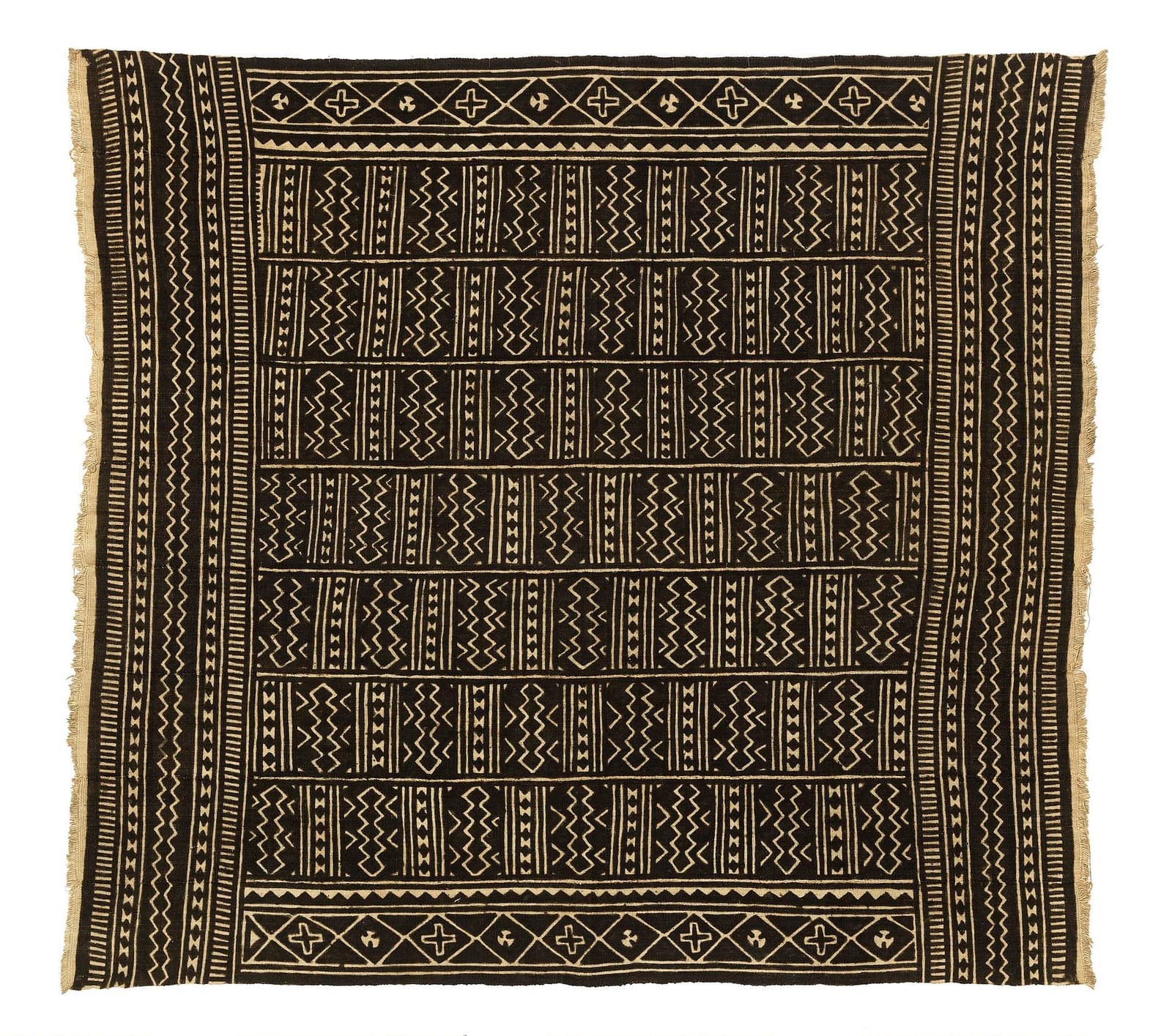
Image context: this is the National Museum of African Art's photograph of Nakunte Diarra's 1992 cloth, not a recreated pattern. Its seams, uneven brown-black field, and hand-drawn edges make visible what a flat “mud cloth” print would erase: the surface was built in strips and darkened through repeated applications rather than printed in one pass.[1]
The first surprise is that the mud does not remain.
Across Nakunte Diarra's 1992 cloth, a deep brown field presses against pale crosses, chevrons, dots, and nested angles. The usual English name—“mud cloth”—makes the surface sound almost elementary, as if wet earth were simply brushed onto cotton and left there. But the finished dark is produced by an encounter among several materials at different moments. Leaves prepare the fiber. Mud brings iron. Water carries away the visible soil. Sun and repetition deepen the reaction. A final wash clears the light areas.
The second surprise is compositional. In the Beledougou tradition for which Diarra was renowned, the artist does not begin by drawing the pale motif. She paints the darkness around it. The design is the territory she withholds from mud.
This double reversal—mud that disappears, image made from what is not painted—is the key to bògòlanfini. The technique is often compared with resist dyeing, yet the comparison can hide its most interesting fact. Nothing is placed on the cloth merely to block a dye bath and then peeled away. The dark colorant is applied directly to a tannin-prepared surface, while the light design survives as negative space.[2][4]
The picture begins as narrow cloth
Before there can be a field of signs, there has to be a field large enough to carry them. Historically, cotton was cleaned, carded, and spun, then woven into long narrow strips. Men commonly did the weaving; women joined and decorated the strips. The seams remain plainly visible in museum objects, including Diarra's square wrapper and Gneli Traoré's monumental 1969 display cloth, assembled from twelve strips only 4¾ inches wide.[1][4]
That construction is not neutral scaffolding. A strip sets a width, a seam establishes an interval, and the joined bands give the painter a latent grid. Diarra's cloth does not disguise this architecture. Its large compartments and crossing borders negotiate with it, sometimes reinforcing the underlying divisions and sometimes running across them. The image is planned on a surface that already records several hands and several kinds of labor.
The older division of work should not be mistaken for an unchanging rule. Contemporary production may use purchased cloth, machine sewing, stencils, and workshop arrangements shaped by new markets. Smithsonian documentation from Malian artists at its 2003 and 2011 Folklife Festivals records both inherited sequences and active variations.[2][6] The useful historical point is narrower: the classic object does not begin as a seamless commercial rectangle. Its pictorial ground is assembled.
Yellow prepares the black
Fresh cotton cannot move directly from loom to dark design. The cloth is first soaked in an infusion made from tannin-rich leaves, often identified in workshop accounts as n'gallama and n’tjankara, and then dried in sunlight. The bath turns the textile a saffron or ochre yellow. That color is provisional, but the chemistry it deposits is essential.[1][2]
Tannins are polyphenolic compounds familiar from plant materials and from iron-gall ink. On cotton, they adsorb and precipitate at the fiber surface. A 2012 Textile Research Journal study compared traditionally made Bogolan cloth with laboratory cotton treated using tannin and iron solutions. Infrared spectroscopy and electron microscopy located gallic and tannic acids at the fiber surface; X-ray absorption measurements confirmed that iron had transferred from the clay-rich mud to the textile. The researchers concluded that iron–tannin complexes dominate the finished black.[3]
That finding corrects the most literal reading of “mud-dyed.” The mud is not merely a store of ready-made brown pigment. It supplies iron to a cotton surface already loaded with plant tannins. When those materials meet, they generate a dark, comparatively insoluble complex on and around the fibers. Washing can remove the crust of clay without returning the treated area to yellow.
Science explains the color-forming mechanism, not a complete universal recipe. Artists select particular leaves, collect earth from particular wet places, judge fermentation, adjust consistency, and repeat stages according to season, cloth, and desired depth. Diarra kept her own mixture and working knowledge. Smithsonian records describe iron-rich streambed soil standing with water in a clay jar for as long as a year; other workshop documentation notes that collection season and decaying plant matter in a pond or lake bed can affect the material.[1][2] “Iron plus tannin” is therefore a chemical backbone, not a substitute for practiced judgment.
The motif is measured as an absence
Once the yellow-prepared cloth is dry, the artist maps the composition. In accounts of Diarra's practice, that did not require a drawn cartoon or a hard-edged template. She measured with her hand, held the pattern in memory, outlined its limits, and worked freehand. Smithsonian's profile of Diarra notes that she began learning at fifteen through a line of women in her family, later creating new designs alongside older ones and teaching an apprentice.[6]
The mud goes into the background. A stick, spatula, feather, brush, or other applicator presses it into the cloth while the intended pale figure remains untouched. Stretching the textile over a calabash can give a firm curved support beneath the working area. A dark compartment may look optically like the passive ground of a drawing, but technically it is the most worked portion: filled around every reserved line and corner.[2]
This is why calling bògòlanfini “resist” is both understandable and incomplete. The pale motifs do resemble the protected areas of batik or tie-dye. Yet the Metropolitan Museum's technical account of Gneli Traoré's cloth emphasizes direct application to a prepared fabric: fine black clay is painted around the design, rather than a temporary resist being placed over the design before immersion.[4] The British Museum uses both “mud resist” and “discharge” terminology in its catalogue records, a reminder that museum vocabularies often describe the visual outcome or later lightening stage from different angles.[5]
The process itself is clearer than any single label. Leaf solution treats the full surface. Mud selectively darkens chosen areas. Drying and washing remove loose matter. Additional leaf baths and mud coats can intensify the background. Finally, a prepared alkaline wash strips the residual yellow from the reserved zones, pushing them toward gray-white and sharpening the contrast.[1][2][4]
The light sign is thus not raw cotton that simply escaped every operation. It passed through the leaf bath, the sun, handling, and the final clearing wash. Its paleness is made as deliberately as the black around it.
Repetition produces depth, not sameness
One coat can state the composition; repeated coats give it authority. Smithsonian workshop documentation describes two mud applications and another leaf soak for a prized dark, with custom cloths sometimes receiving a second or third coat to improve saturation and resistance to fading. A cloth roughly two meters square could require about forty-eight hours of labor distributed across two weeks.[2]
The photograph of Diarra's wrapper keeps that time visible. Its background is not an industrially uniform black. Some areas lean warm brown, some approach charcoal, and narrow lines thicken or taper as they turn. These are not failures to approximate a printed pattern. They show that color developed through contact: wet material pressed into woven fiber, dried, rinsed, and approached again by hand.
Repetition also changes what precision means. A machine can duplicate a unit without remembering the last one. A bògòlanfini artist has to preserve the reserved motif while repainting its perimeter, maintaining the correspondence among panels and keeping enough mud in contact with the cloth to deepen the reaction. The virtuosity lies partly in returning to an edge without closing it.
The motifs carry knowledge as well as contour. Museum records connect combinations of signs to proverbs, songs, moral concepts, social roles, and historical episodes, while warning indirectly against treating each mark as a universal code. Meanings can be regional, contextual, layered, or lost. The Met's unusually well-documented Gneli Traoré cloth, for example, includes named patterns referring to cushions, drums, paths of soldiers, and the Beledougou anti-colonial figure Koumi Diosse.[4] Diarra's 1992 wrapper features a prominent combination of crosses, chevrons, and paired triangles identified in its museum label as turusina, but an object is not exhausted by translating one unit into one noun.[1]
Technique and meaning meet in the act of reservation. To transmit a sign, the painter must know not just its name but how much untouched cloth will let it remain legible after several wet, dark passes.
The tradition changed scale without becoming only a pattern
Bògòlanfini has never been confined to a museum wall. Cloths have marked bodily and social transitions, accompanied hunters, wrapped women, and carried protective associations. In the twentieth century they also became display textiles, fashion, painting grounds, home furnishings, and internationally recognizable signs of Mali.[1][4]
Those changes altered production. The Smithsonian's survey of the tourist market describes machine-joined strips, stenciled repeats, simplified motifs, and figurative scenes made for buyers seeking portable décor. Industrial printed cloth also reversed the economics of dress: imported machine-made fabric became cheaper, while labor-intensive hand production moved toward tourists and special uses.[6] It would be easy to turn this into a simple fall from “authentic” object to commercial imitation. The record is more complicated. Malian artists adapted motifs, tools, scale, and markets; tourist bogolan developed as its own branch; individual makers such as Diarra and Gneli Traoré distinguished older repertoires from new designs while working in both.[4][6]
What gets lost in a generic printed “mud-cloth pattern” is not merely an approved library of symbols. It is the order of operations that made the surface meaningful. A printed zigzag can imitate the silhouette while omitting narrow-band weaving, intergenerational training, leaf preparation, the collection and fermentation of mud, negative painting, repeated washing, and the artist's decisions about where not to place color.
That chain is what Diarra's cloth holds together. Cotton becomes strips; strips become a square; leaves turn the square yellow and prime it with tannins; mud brings iron to selected zones; repeated contact builds brown-black depth; a final wash releases the pale design from yellow. The earth is present not as a layer left sitting on top, but as iron transferred into a reaction and as knowledge transferred through a hand.
Look again at the dark field and it no longer behaves like background. It is the accumulated record of nearly every return the artist made to the cloth. The pale pattern is what she kept open through all of them.
Sources
- National Museum of African Art, Smithsonian Institution, “Cloth” by Nakunte Diarra (1992) — object record, museum photograph, dimensions, materials, process, uses, and motif context.
- Smithsonian Center for Folklife and Cultural Heritage, “Making Bogolan” — artist-based documentation of strip assembly, leaf baths, mud preparation, negative painting, repeated applications, tools, and working time.
- Mukta V. Limaye et al., “On the role of tannins and iron in the Bogolan or mud cloth dyeing process,” Textile Research Journal 82, no. 18 (2012) — spectroscopy and microscopy evidence for iron–tannin color formation on cotton.
- The Metropolitan Museum of Art, “Bògòlanfini (mineral-dyed cloth)” by Gneli Traoré (1969) — documented construction, direct-application technique, named patterns, social uses, and twentieth-century revitalization.
- The British Museum, “cloth,” museum no. Af1956,27.10 — record for an early twentieth-century Bamana example, including strip construction, technique terminology, dating, and curatorial comparison.
- Smithsonian Center for Folklife and Cultural Heritage, “Bogolan and the Tourist Market” — changes in stitching, stenciling, motifs, buyers, and the relationship between industrial cloth and hand production.