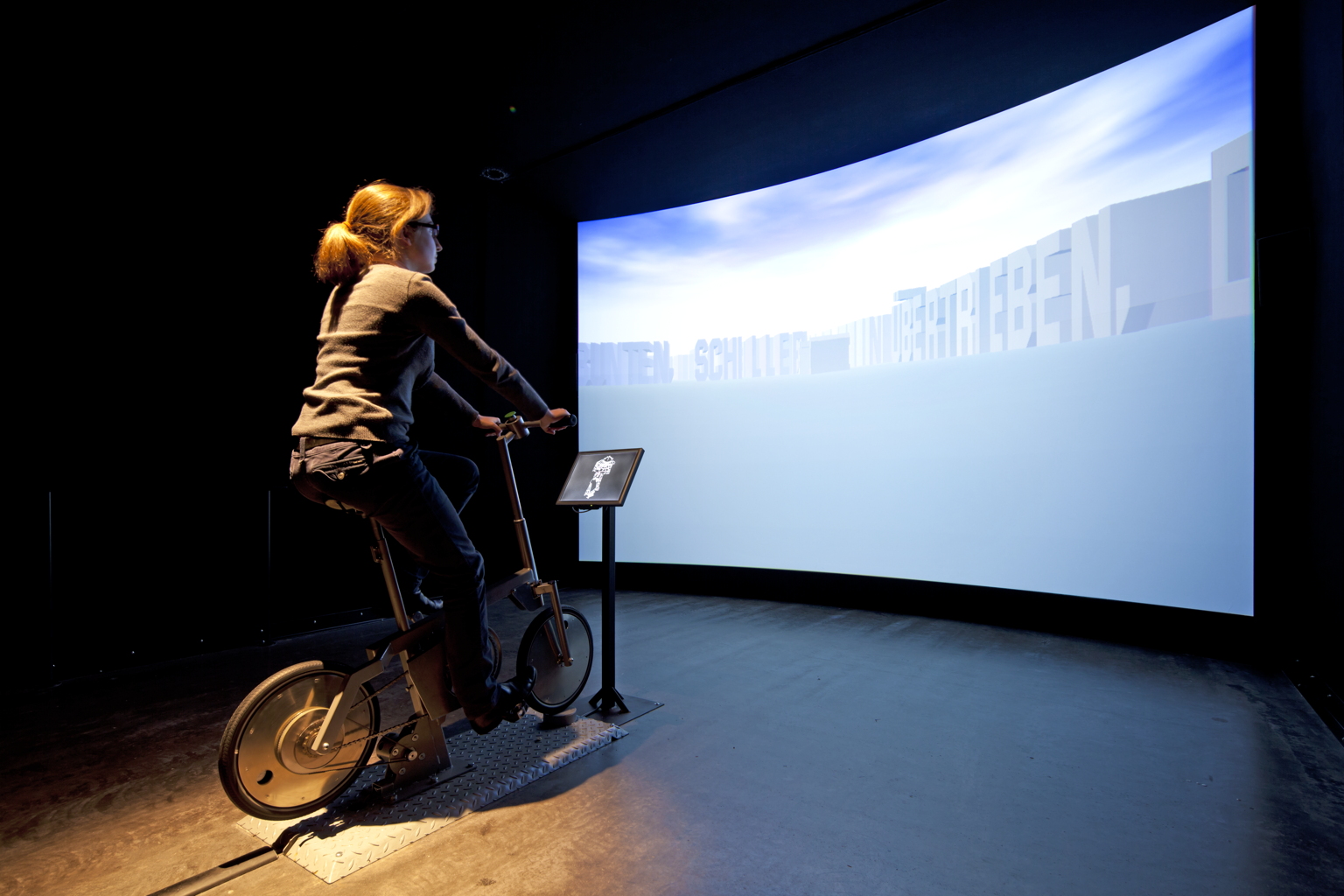
Image context: the cover is one real installation photograph of The Legible City, not a diagram, rendering, or generated visual. ZKM's collection view shows the work's modified bicycle facing its projected letter-city—the physical and virtual halves of the same artwork in one frame.[1]
The bicycle is going nowhere. The reader is not still.
In The Legible City, a stationary bike faces a large projection. Pedalling moves a viewpoint forward; turning the handlebars changes its direction. On the screen, buildings have disappeared. In their place stand three-dimensional letters, aligned along streets and scaled into a city of words. To find the next sentence, the rider has to choose a road.[1][2]
After a joystick-controlled Manhattan prototype in 1988, Shaw and Groeneveld made bicycle-based versions for Manhattan in 1989, Amsterdam in 1990, and Karlsruhe in 1991, with Gideon May and Lothar Schmitt contributing programming. The work is often introduced as a milestone of interactive media art, which is true but slightly bloodless. Its sharper achievement was to make an interface carry an argument: reading is never only receiving information. It has pace, direction, missed turns, physical effort, and a point of view.[1][2][3][4][6]
More than three decades later, that argument survives because the machine behind it has not remained untouched. Computers age; licensed software becomes difficult to run; custom sensors fail. ZKM's conservation history reveals a productive paradox. Keeping this particular ride alive has required the artwork to change.[4][6]
The bicycle is not a prop
The earliest prototype did not yet have the interface that would define the work. In 1988, visitors navigated a wire-frame Manhattan with a joystick. Shaw's archive explains that the austere graphics were not a retro style applied later: the limits of real-time computer graphics determined what the system could draw. The prototype established the city of text, but the user's hand still controlled it from outside the familiar bodily logic of a street.[3]
The bicycle changed the terms. Electronic devices attached to the pedals and steering assembly measured speed and direction. A Silicon Graphics computer calculated and displayed the Manhattan environment in real time, while another computer drove a small map showing the rider's position and heading. Pedal faster and the text-city advances faster; turn and a different corridor opens.[2]
That arrangement borrows a skill the body already knows. A rider does not need an instruction card explaining that handlebars steer. Yet familiarity does not make the interface transparent. The legs set the tempo of reading, and the arms edit its route. Daniel O'Brien's study of bodily extension in interactive art treats this human-technology relation as one in which body and apparatus co-compose the experience rather than one simply commanding the other.[5]
The distinction matters. A joystick can select a direction while leaving movement almost weightless. The bicycle makes virtual distance answer to exertion. The user remains in the gallery, visible on a bicycle fixed on its platform, while the viewpoint travels. Instead of pretending that the body has vanished into a frictionless digital world, The Legible City gives that contradiction a physical form.[2][5][6]
Streets become sentences
The first realized version used part of Manhattan's plan, roughly from 34th to 66th Streets and from Park Avenue to Eleventh Avenue. Shaw's project sheet describes architecture replaced by solid letters that follow the real arrangement and scale of streets, avenues, intersections, and parks. Dirk Groeneveld wrote eight color-coded narrative lines for this Manhattan: voices included a cab driver, a tour guide, Mayor Ed Koch, and other figures whose claims on the city do not naturally resolve into one account.[2]
Color gives a rider one way to remain with a voice. The street grid supplies another kind of order. But every intersection offers an editorial cut: continue with one line, turn toward another, or cross between them. The result is not a book liberated from sequence. It is a book whose sequences multiply while remaining constrained by geography.
The later Amsterdam and Karlsruhe versions sharpened that relation between text and place. All three environments used actual city plans, but the NTT InterCommunication Center's archive distinguishes their contents: Manhattan carries fictional stories, while Amsterdam and Karlsruhe draw on documents tied to historical events. The work therefore does not merely pour interchangeable words into a novel display. Each plan asks what kind of language can occupy it.[1][4]
This is where the title earns its precision. The city is “legible” not because it has been simplified into clear signage, and not because software reveals a hidden truth about urban life. It becomes readable because architecture has been exchanged for writing. At the same time, writing becomes urban: dispersed, scaled, colored, approached from one side, and partly concealed by whatever route the reader did not take.
Speed edits the page
Most reading interfaces treat speed as a private matter. A page remains the same whether someone lingers or skims. The Legible City turns pace into a visible operation. Pedalling does not alter the stored text, but it changes the rider's chance of taking it in. Accelerate and the letters approach and pass more quickly. Slow down and the apparent architecture becomes available as language.
That tension keeps the interaction from collapsing into a clever input device. The bike offers control, but not mastery. A rider cannot occupy every street at once or preserve every juxtaposition. Choosing one path means allowing other passages to remain unread. Even the small orientation monitor—which marks location and direction on a plan—cannot turn the city into a complete overview. It helps the rider know where they are while reminding them how much lies elsewhere.[2]
The graphics make this incompleteness unusually clear. In the prototype, wire-frame letters disclosed the system's computational limits. In the developed work, solid colored forms gained architectural weight without becoming naturalistic buildings.[2][3] The screen offers enough depth for navigation but too little illusion to hide the act of construction. A street is visibly a database, a projection, and a piece of writing at the same time.
Seen now, the work can resemble an ancestor of a game world. Yet a game usually makes traversal serve an objective located elsewhere: reach the destination, collect the object, complete the map. Here traversal is the content. The meaningful event is the shifting fit among route, sentence, city plan, and moving body. There is no neutral path through which the “real” artwork is delivered.
One artwork, several machines
This dependence on a particular fit makes The Legible City a difficult object to conserve. Oil paint can crack while remaining visibly itself. An interactive installation may look intact even after its essential relation has stopped: a sensor no longer reports smoothly, software will not launch, or a replacement display changes scale and timing enough to alter the ride.
Conservator Arnaud Obermann describes the work as a history of multiple embodiments. Its proprietary software, obsolete hardware, and custom components made simple maintenance expensive. ZKM initially pursued hardware preservation, documenting and retaining technological configurations. It later undertook a software port in dialogue with Shaw as part of the 2010–2012 Digital Art Conservation project.[6]
The collection record carries traces of that layered history. Its material list names both a Silicon Graphics machine running IRIX and a PC running Linux, alongside custom software, electronics, the bicycle, monitors, projector, and concave screen. That is not a tidy list of timeless art materials. It reads like an artwork and its survival strategy occupying the same catalog entry.[1]
When NTT ICC exhibited a reproduction in Open Space 2014, it explicitly presented the work as a result of ZKM's conservation project. The accompanying account frames repair, reproduction, and rewritten programs as live museum questions rather than invisible technical housekeeping.[4] A visitor may encounter a coherent ride; behind it sits a chain of decisions about which changes preserve the work and which would make it behave like something else.
The bicycle helps answer that question, but it does not settle it. Preserving only the original computer would eventually preserve an object that could not perform. Replacing everything with current equipment could produce a smoother, brighter simulation that erases the resistance and visual character through which the work was understood. Authenticity has to be negotiated across hardware, software, timing, image, scale, and bodily feedback.[6]
What has to remain difficult
The most durable part of The Legible City is not a specific processor or projection technology. It is a structure of consequences. Pedalling must become distance. Steering must become a turn. The turn must reorganize what can be read. The city plan must constrain the language without fixing a single sequence. The rider must have agency without receiving the fiction of total access.
This is also why the work should not be celebrated simply for arriving early. Calling it a prediction of virtual reality or game navigation shrinks it into a technical forecast. Its real intelligence lies in what it refuses to make effortless. Words do not wait in a menu. They occupy space, and reaching them costs time and excludes another route.
The conservation story extends that refusal. A living digital artwork cannot be kept by pretending time has stopped. Institutions have to identify which dependencies carry meaning, then accept substitutions without treating every substitution as neutral. In The Legible City, the machine can change, but the bargain with the rider must remain exact.
The bicycle still goes nowhere. That is not a limitation to overcome. It is the fixed point from which reading becomes travel—and from which every turn makes another text possible, another one absent, and the reader responsible for the difference.
Sources
- ZKM | Center for Art and Media, “The Legible City” — official collection record, artwork credits, current material and technical description, interaction design, three city versions, and source for ONUK's installation photograph used as the cover.
- Jeffrey Shaw, Virtual World Voyaging: The Legible City (1989–1990) — primary project sheet detailing the Manhattan version, bicycle sensors, computer system, map display, city boundaries, and color-coded narrative lines.
- Jeffrey Shaw Compendium, “Legible City Prototype” — primary archive record for the 1988 joystick-controlled prototype and the wire-frame graphics imposed by contemporary real-time computing limits.
- NTT InterCommunication Center, “The Legible City” — institutional work record covering the Manhattan, Amsterdam, and Karlsruhe texts and the ZKM conservation-project reproduction exhibited in Open Space 2014.
- Daniel O'Brien, “Postphenomenological performance: bodily extensions in interactive art,” International Journal of Performance Arts and Digital Media 13, no. 2 (2017) — scholarly analysis of how bodies and technological systems co-compose interactive experience, using The Legible City as a case study.
- Arnaud Obermann, “The Legible City—One Artwork, Multiple Embodiments,” Electronic Media Review 3 (2013–2014) — conservation account of the work's obsolete hardware, custom components, evolving versions, documentation, and artist-guided software port.