Odilon Redon is still too often split into two artists. First comes the Redon of black charcoal and lithographic apparitions: eyes, heads, spores, wings, and sentences that seem to have drifted out of a dream half intact. Then comes the late Redon of flowers, mythic figures, and pastels so luminous that Henri Matisse and other painters could treat him as a major colorist.[1] The sequence is true, but the split is crude. What changed in Redon's career was not the depth of the inward life. What changed was the light source. The same Symbolist imagination that once pressed itself into soot-black pressure later learned how to float.
Britannica's short biography remains useful because it names the two poles without pretending they cancel each other. Redon, born in Bordeaux in 1840, studied under Jean-Leon Gerome, learned engraving from Rodolphe Bresdin, and practiced lithography with Henri Fantin-Latour.[1] Those facts matter less as résumé than as a map of method. Redon did not build his art around empirical description. Britannica says plainly that his aesthetic was one of imagination rather than visual perception, and that formulation helps explain why his career can move so far in material terms while staying recognizably his.[1] Whether he is working in charcoal, lithography, pastel, or oil, the image keeps arriving as an interior event first.
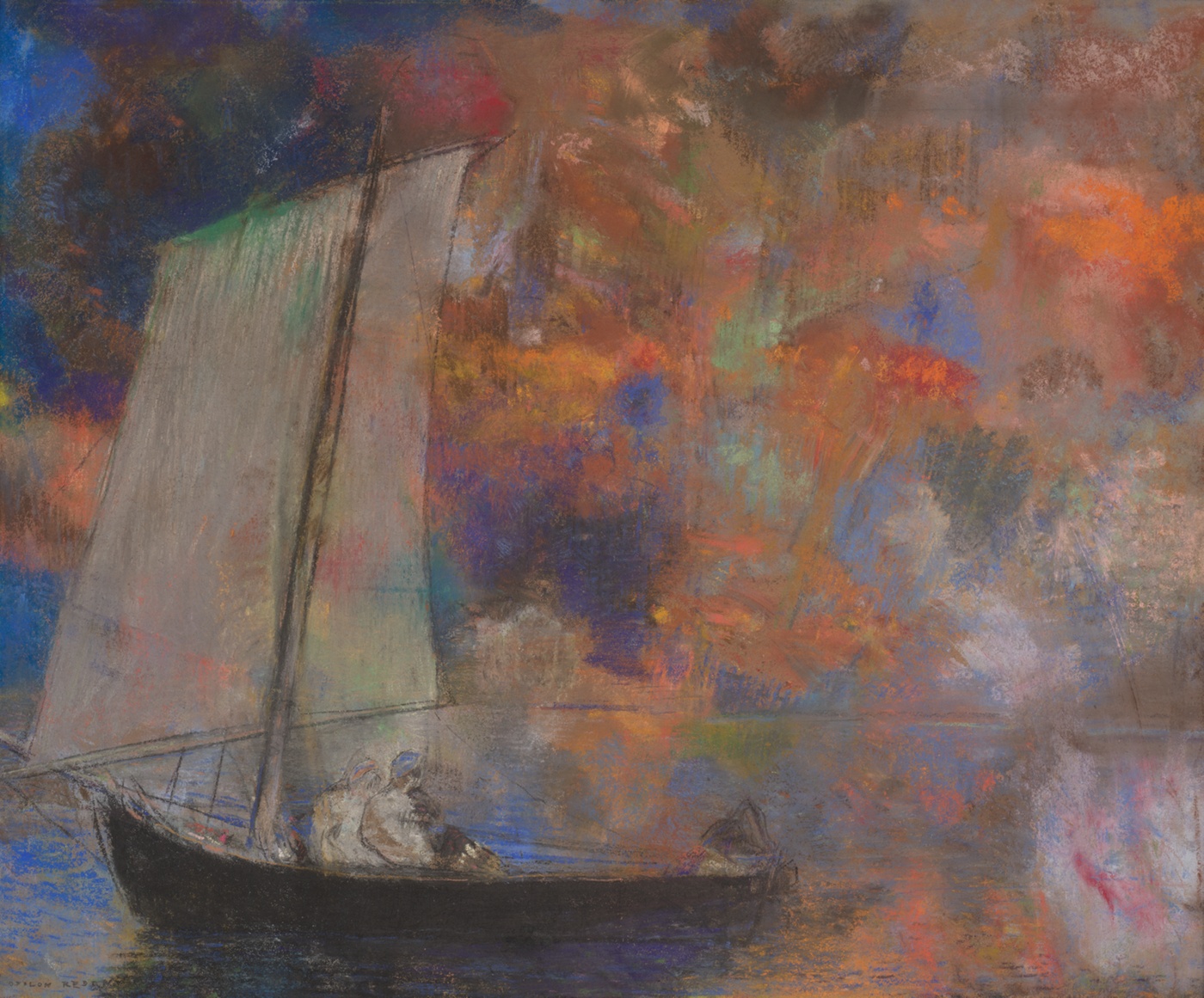
Image context: the cover image uses the Art Institute of Chicago's Flower Clouds because it compresses Redon's late achievement into one sheet. Two tiny boat figures remain almost secondary to the color weather above them. The picture still belongs to the logic of vision-as-revelation, but revelation now comes as buoyancy rather than menace.[4]
1) The early noirs are not juvenilia; they are the pressure chamber
It is tempting to read Redon's dark work as the necessary apprenticeship before he "found" color. That is backwards. The noirs are where he establishes the terms of the whole career. In works like the Art Institute's Guardian Spirit of the Waters from 1878, the medium itself behaves like psychic weather.[2] The museum's object record is almost comically technical in its inventory of means: various charcoals, touches of black chalk, stumping, erasing, incising, subtractive sponge work, and traces of white chalk.[2] Yet that list matters because Redon was not simply drawing in black. He was engineering emergence. Figures seem coaxed out of a dark field rather than placed onto it.
That same logic carries into print. Britannica notes that Redon produced nearly 200 prints, beginning with In the Dream in 1879, then a Poe-related series in 1882, and later cycles such as Homage to Goya.[1] The important point is not just productivity. Print let Redon make interior imagery reproducible without making it ordinary. Lithography was a public medium, but Redon used it to circulate privacy, dread, and symbolic pressure. He took what might have remained a private notebook of hallucinations and gave it formal, repeatable shape.
2) Print is where Redon learned how to make thought visible
The Art Institute's 1889 lithograph Death: "My irony surpasses all others!", plate 3 of 6 is a good object lesson because its title alone sounds like a line overheard in a nightmare.[3] The sheet is small, the medium direct, the palette absent except for black itself.[3] But the effect is not merely macabre decoration. Redon's prints do something stranger: they detach narrative from ordinary sequence. A head can become a planet, a flower can behave like a face, death can speak in aphorism. Britannica's claim that the prints explore haunted and fantastic themes, and even foreshadow Dada and Surrealism, is persuasive precisely because Redon keeps refusing literal explanation.[1]
This is also where his connection to Symbolist poetry matters. Britannica notes his friendship with Stephane Mallarme and stresses that his imagination had an intellectual catalyst in that world.[1] You can feel that proximity in the prints. They are not illustrations waiting for a key. They are visual poems that accept obscurity as structure. If Redon keeps painting eyes, hovering heads, and impossible floral beings, it is because he is testing how far an image can carry suggestion before it hardens into message.
3) The move into color is a change of register, not a surrender
Once that continuity is visible, the late work stops looking like a conversion narrative. The Art Institute's Flower Clouds from about 1903 already shows how radical the shift really was.[4] The work is pastel, but its softness should not mislead. Two figures in a sailboat remain anchored below while the upper field swells into bright, unstable color.[4] Redon has not abandoned the dream. He has changed what dreams are made of. In the noirs, the image advances out of pressure, smoke, and grain. In the late pastels, it arrives through suspension, bloom, and drifting chromatic intervals.
The Met's Vase of Flowers (Pink Background), dated about 1906, pushes the same point into oil on canvas.[5] Redon's late flowers are often taken as evidence that the old darkness evaporated. They read more accurately as vessels for transfiguration. Flowers are perfect Redon subjects because they allow him to keep one foot in observation while letting color exceed botany. A bouquet gives him permission to stage ascent, radiance, and fragility at once. The object remains recognizable. The atmosphere around it refuses to remain merely descriptive.
That is why the late Redon appealed so strongly to painters. Britannica notes that his oils and pastels, especially still lifes with flowers, won the admiration of Matisse and others as the work of an important colorist.[1] This does not mean he became "retinal" in the Impressionist sense. It means he discovered that color could do what black had done before: release inward intensity without pinning it to one stable story.
4) Why Redon still reads clearly now
A strong artist profile should make one thing plain: Redon's career was not a march from darkness to happiness. It was a sustained argument that images do not have to choose between material beauty and mental strangeness. The charcoals and lithographs matter because they build an art of emergence, where forms seem barely rescued from obscurity.[2][3] The flowers and pastels matter because they prove that this same inwardness can survive saturation, lightness, and decorative pleasure.[4][5]
That continuity is what makes Redon feel contemporary. Plenty of artists can produce atmosphere; fewer can make atmosphere behave like thought. Redon could. His best works do not simply show strange things. They teach the viewer how to occupy uncertainty without rushing to decode it. That is the real line connecting the noirs to the late blooms. Black was one vehicle, color another. The interior theater never shut down.[1][2][4]
Sources
- Encyclopaedia Britannica, "Odilon Redon" - biography on Redon's training, Mallarme connection, print cycles, and late flower paintings.
- The Art Institute of Chicago, "Guardian Spirit of the Waters" - 1878 charcoal object page and medium record.
- The Art Institute of Chicago, "Death: 'My irony surpasses all others!', plate 3 of 6" - 1889 lithograph object page.
- The Art Institute of Chicago, "Flower Clouds" - c. 1903 pastel object page and hero image source.
- The Metropolitan Museum of Art, "Vase of Flowers (Pink Background)" - ca. 1906 oil on canvas object page.