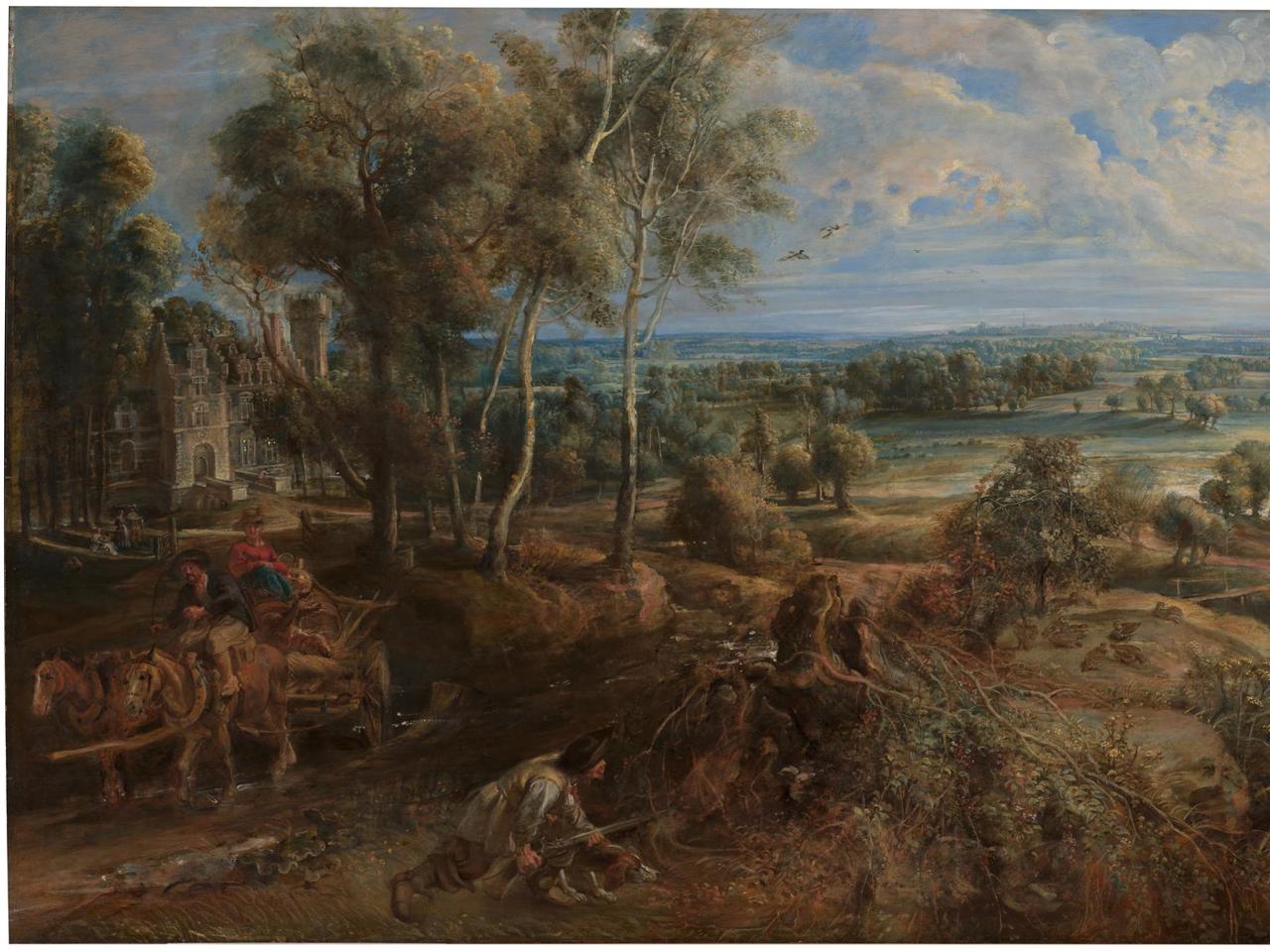

Rubens's A View of Het Steen in the Early Morning is easy to misread if it is encountered only as a handsome landscape by a famous Baroque painter. The National Gallery's conservation video is useful because it keeps redirecting the eye away from generic beauty and back toward the painting's real structure.[1] This is not countryside as background. It is a property picture, a weather picture, and a status picture built so tightly together that yellowed varnish can dull the argument as much as it dulls the color.
The collection page already gives the key historical frame. Rubens bought the manor of Het Steen near Mechelen in 1635, and the painting probably dates from 1636.[2] The Gallery's interpretation is blunt about what is at stake: in this landscape Rubens celebrates both private success and "the prosperity and peace of Flanders."[2] That matters because the picture's calm is never abstract. It has to be staged through very specific visual means: cool morning light, long shadows, wet grass, twinkling windows, a stream, game birds, a couple heading to market, and the manor itself held high enough in the composition to dominate without crushing the rest of the scene.[2]
The video matters because conservation is what makes that staging readable again.[1][4] The National Gallery's related project pages explain that Het Steen was painted for Rubens's own pleasure as a companion to The Rainbow Landscape, that the two panels remained together until after Rubens's death, and that they were separated after arriving in London in 1803 before being reunited for exhibition in 2021.[3][4] Watching the cleaning with that history in mind changes the painting's emotional scale. It stops looking like a pastoral mood board and starts looking like a carefully maintained self-portrait through land.
Image context: the cover image uses the National Gallery's collection photograph of the painting itself, rather than a conservation-lab still, because the article's claim is that the treatment matters insofar as it returns the whole morning world to legibility. The estate, the figures, the stream, and the weather have to be visible together for Rubens's larger statement to come back into focus.[2]
1) The video's opening correctly treats the picture as personal, not generic
Within the opening half-minute, the conservator says the painting is special because it was made for Rubens's "own pleasure" and because "everything you see here is him."[1] That is the right place to begin. The National Gallery's written materials make the same point in slower form: this was not a routine commission but a landscape of Rubens's own estate, intended as one half of a pendant pair and bound up with the decoration of his home.[3] Once that is established, the painting's abundance stops being merely descriptive. The fields, manor, hunters, market-bound couple, and nursemaid are not casual incidents sprinkled across a pleasant view. They form a vision of ordered possession.
That is why the work's serenity should not be confused with passivity. The collection record stresses the crispness of the autumn morning, the cool light on the house, the dew in the meadows, and the stream catching light.[2] None of those details functions as pure atmosphere. They announce control over distance. Rubens organizes the eye so the estate can be scanned as a coherent whole, from nearby figures to far horizon, without losing the sensation of first light settling across the land. The calm is therefore compositional labor. It has to be built.
2) Around the 0:40 to 2:15 mark, the cleaning shows that varnish had become an interpretive problem
The video's most practical lesson arrives when Larry Keith explains that the team is removing varnish applied long after Rubens finished the work and that much of what is coming off is around seventy-five years old, yellowed from age after having once been clear.[1] This is a conservation fact, but it is also an art-historical one. If the paint surface has shifted toward an overall amber cast, then morning light stops functioning with the delicacy Rubens designed. The contrast between cool blues in the distance and warm yellow light nearer the sun cannot separate cleanly, and depth begins to clot.
The video is especially sharp when it turns this into a viewing lesson rather than a chemistry lesson. Around the 1:25 mark, Keith points to white clouds catching yellow light and to the cool blues that lead the eye back into the landscape, then calls the varnish removal "revelatory."[1] That word is justified. The National Gallery's press release uses almost the same logic when it says that removing aged, discoloured varnish revealed the depth and vibrancy of Rubens's original colors.[4] What returns is not simply brightness. What returns is a directional system. Morning weather begins working again as a structure of attention.
That distinction matters because Het Steen is often admired as late Rubens freedom, all sweep and abundance. The video does show freedom, but not vagueness.[1] Light has assignments here. It makes the manor windows twinkle, distinguishes raking sun from cooler recession, and lets the estate read as prosperous without becoming inert.[1][2] Once the varnish yellows over everything, those assignments flatten. Cleaning is therefore not a cosmetic refresh. It is a way of recovering how Rubens distributed visual authority across the panel.
3) Midway through the clip, old retouchings and panel repair make the painting look historical again
Another useful moment arrives around 4:20, when the conservator says that, as varnish comes off, he also encounters older retouchings from previous restoration campaigns, many of which have discoloured themselves.[1] This prevents the standard fantasy that conservation simply removes a single veil and reveals an untouched original beneath. The press release and project story make the same point in a broader register: Het Steen required not only varnish removal but also comprehensive structural repair to a highly fragile network of panels nearly four centuries old.[3][4] The painting survives as a layered object with a treatment history, not as a perfectly sealed message from 1636.
That is one reason the video is worth annotating rather than just embedding. It reminds viewers that the picture's calm sits on top of technical instability. Rubens painted the work on panel; the National Gallery's project notes emphasize both the scale and fragility of that support.[3][4] In a painting devoted to stable possession, the material object itself has needed repeated intervention to remain intact. That irony deepens the work instead of weakening it. The estate may represent peace, but the artifact carrying that peace is vulnerable, and our access to Rubens's "private" landscape depends on institutional stewardship.
4) By the last third, brush freedom and low sun restore the picture's actual intelligence
Late in the video, especially around the 6:00 mark, Keith starts talking about freedom of movement in the brushwork and the juxtaposition of very fine handling with rougher strokes.[1] This is where the clip becomes most valuable for readers who might otherwise file Rubens under baroque fullness and move on. The point is not only that the surface is lively. It is that Rubens varies speed and finish to keep different parts of the estate readable at different distances. Labor on the panel mirrors labor in the land.
Then, around 7:20, the explanation returns to the low sun in the sky and the strong raking light it casts across the scene.[1] That observation reconnects the cleaning to the collection page's prose about dew, long shadows, and twinkling surfaces.[2] The painting's title promises "early morning," but the restored surface shows that Rubens did not mean a generic sunrise effect. He built a very particular hour: low enough for long lateral light, cool enough for moisture to hold, and clear enough for every human incident inside the estate to register without dissolving into haze. Weather here is the instrument that turns ownership into atmosphere.
That is why the National Gallery's conservation series is more than a behind-the-scenes bonus.[1][5] It reveals that the painting's composure depends on precision. Remove too little varnish, and the morning thickens. Ignore old retouchings, and time fogs the scene unevenly. Neglect the panel, and the estate's apparent stability rests on a support that may fail.[1][3][4][5] What the video finally restores is not just color but argument: Rubens wanted this world to look abundant, ordered, and peaceable, and that effect can survive only if the surface keeps carrying distinctions finely enough for the eye to trust them.
Sources
- The National Gallery, "Cleaning Rubens's 'Het Steen' | National Gallery," YouTube video.
- The National Gallery, "Peter Paul Rubens | A View of Het Steen in the Early Morning" - collection page.
- The National Gallery, "Reuniting Rubens's beloved landscapes" - project story on the pendant paintings, their separation, and conservation context.
- The National Gallery, "400-year-old Rubens masterpiece unveiled after extensive conservation work" - press release on varnish removal, panel repair, and the 2021 reunion.
- The National Gallery, "Retouching Rubens's 'Het Steen'" - conservation project page covering the final stages of retouching, varnishing, and framing.