Archival footage of artists often gets treated as proof of charm: a glimpse of the studio, a few quotable lines, a reassuring sense that the paintings came from an identifiable human hand. The 1978 film Alice Neel: They Are Their Own Gifts, now resurfaced through The Met's From the Vaults series, is more valuable than that.[1][2] It catches Neel late in life, after decades of stubborn commitment to figurative painting, and it shows why her portraits never settle into mere likeness. Even when the sitter is absent, the room still feels occupied.
That matters because Neel's career was built against several kinds of headwind. The Met's 2021 retrospective materials describe a painter who moved from Pennsylvania to New York in 1927, kept making what she called "pictures of people," and held to the human figure while abstraction dominated much of the American art world in the 1940s and 1950s.[3] Her subjects ranged across neighbors in Spanish Harlem, activists, artists, lovers, mothers, queer performers, and wounded public figures.[3] The through line was not social type. It was her conviction that people carried history on the surface of the body.
By the time Murphy and Rhodes completed the film in 1978, that conviction had started to receive broader institutional attention.[2][3] The Met's press release for Alice Neel: People Come First describes the 1960s and 1970s as the period of Neel's resurgence and notes that her late work embraced a productive "unfinishedness" that could function as both aesthetic method and metaphor.[4] That is the key background for watching the film now. The footage is not simply a record of an established portraitist in the studio. It is a record of an artist whose pictures still refuse closure, even when the sitting appears over.
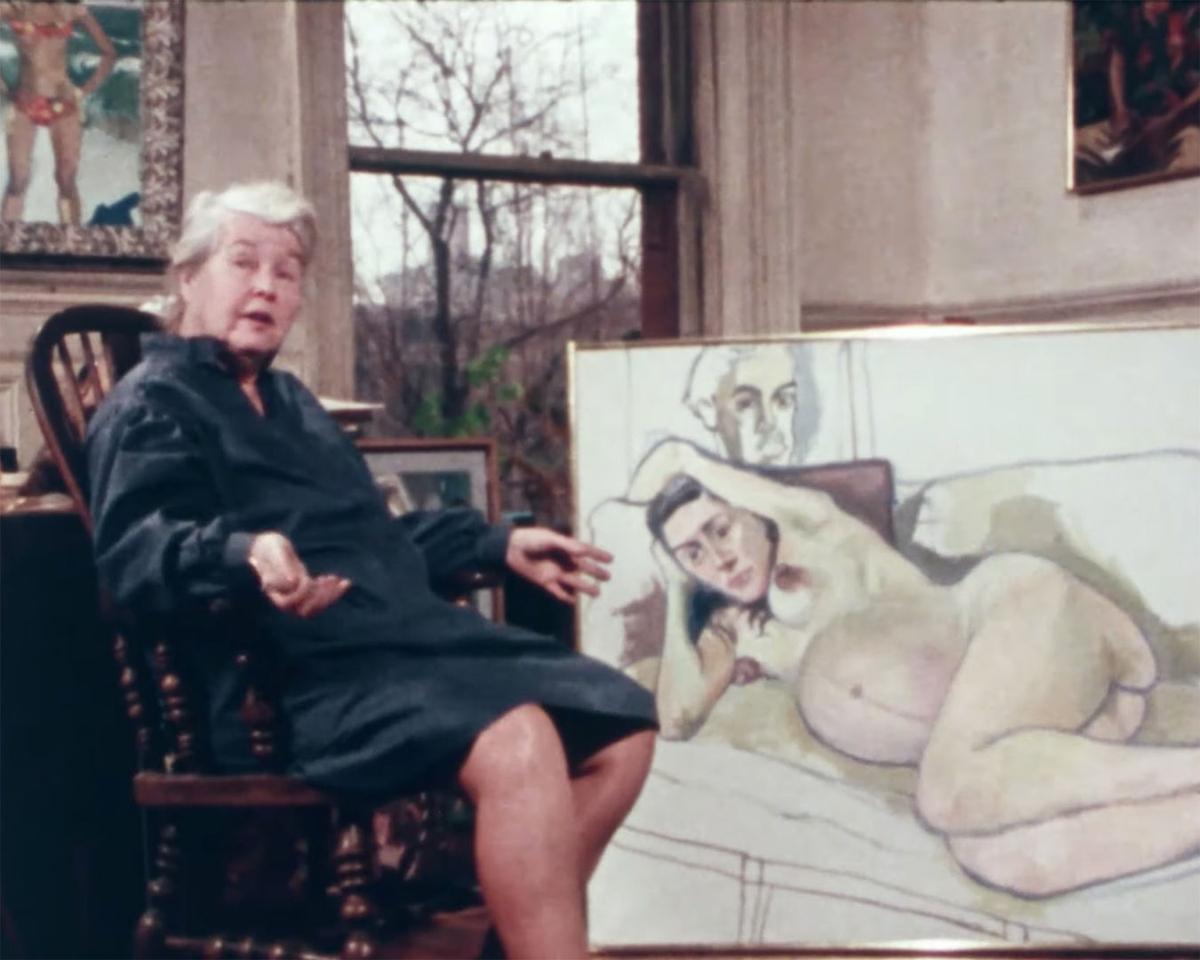
Image context: the cover image comes from The Met's 2020 Perspectives feature on the film and shows Neel seated in front of a large nude portrait. It works here because the photograph already contains the central tension of her portraiture: painter and painting share one interior, and the finished canvas continues to act like another body in the room.[2]
The provenance is unusually clear. The footage was shot in 1978 by filmmakers Margaret Murphy and Lucille Rhodes as one panel of their film triptych They Are Their Own Gifts, devoted to three women artists and writers. The Met later republished the Neel segment on its official YouTube channel on December 18, 2020 as part of the museum's From the Vaults program.[1][2]
1) The historical context is a portrait argument before it is a biographical one
The strongest way to place this footage is not to start with anecdote but with Neel's larger pictorial wager. The Met's exhibition pages stress that Neel kept the figure at the center of her painting during decades when that choice could look backward to contemporaries captivated by formal abstraction.[3][4] Yet the film makes clear that her figurative commitment was never conservative in the stale sense. Her portraits are radical because they do not flatter the fiction of stable identity. They watch how nerves, class, illness, fatigue, politics, and intimacy settle unevenly into posture and skin.[3][4]
That explains why Neel's portraits can accommodate such different sitters without flattening them into a house style. The Met describes her work as grounded in "profound humanism," and that word is useful so long as it is not sentimentalized.[3] Neel's humanism does not smooth people out. It permits awkwardness, asymmetry, and strain. The face might hold, but the hands drift; the torso is vulnerable; the couch, wall, or studio corner keeps participating in the scene. In that sense, her pictures are not only about who sat for her. They are about the charged conditions in which one person agrees to be seen by another.
The filmmakers understood that structure. In their discussion with The Met, Rhodes recalls that Neel was at first wary, then silent, then suddenly precise in her scrutiny of the people filming her.[2] Murphy says they wanted to capture Neel painting, and that Neel agreed on the condition that Rhodes pose nude for her.[2] That anecdote matters because it turns the documentary into an exchange rather than a one-way act of observation. Neel would not simply be looked at. She would create a counter-situation in which looking had stakes.
2) What the film shows is a studio where completed paintings still behave like sitters
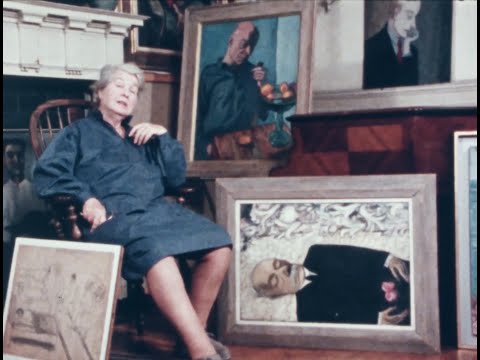
The first thing the moving image adds is spatial evidence. On the page, one can describe Neel's interiors as psychologically charged, but the film lets you feel the density of that charge.[1][2][4] Chairs, canvases, doorways, and fragments of painted bodies do not sit quietly behind the artist as decor. They remain active presences. That is why the large nude behind Neel in the publicity image matters so much: it is not background in any ordinary sense. It is another participant.
This is where the footage deepens the argument made by the 2021 retrospective. The Met's press materials emphasize Neel's long interest in interior spaces and in the home as an intimate but dramatic setting.[4] In the film, that intimacy never becomes domestic coziness. The studio is full of afterlives. Each finished canvas feels like a sitter who has left physically but not pictorially. The portrait keeps occupying the room, and the room in turn keeps pressing on the next portrait. The result is a chain of presences rather than a sequence of completed commissions.
Neel herself reinforces that sense through tempo. She does not perform mastery as a smooth demonstration. The pauses matter. The glances matter. The slight shifts in emphasis matter.[1][2] Even without a brush in hand for every moment, she appears as someone still measuring the people in front of her, still locating where the emotional pressure sits. The film therefore records more than biography. It records the continuity between Neel's conversation and her pictorial method: both proceed by attention that is affectionate, invasive, funny, and unsparing at once.[2]
3) The footage makes vulnerability look structural, not incidental
One reason Neel's late portraits remain so hard to domesticate is that vulnerability is never treated as a side note. The Whitney's entry for her portrait of Andy Warhol is useful here. It describes Neel as a "collector of souls" and emphasizes how she painted Warhol not as a sealed celebrity surface but as a scarred, fragile body after the 1968 shooting by Valerie Solanas.[5] The point is not that Neel could reveal a hidden truth behind public image like a detective. It is that she built pictures in which bodily exposure and psychological pressure could coexist without melodrama.
Seen from that angle, the 1978 film is full of the same ethic. It does not need a confession scene to make vulnerability visible. It only needs Neel's relation to looking. Her attention is steady but not neutral. She makes clear that portraiture is a risk shared by artist, sitter, and now filmmaker.[2] Rhodes and Murphy are not outside the frame simply because the camera is technically in their hands. Their presence is folded into the event of being sized up, negotiated with, and eventually drawn into Neel's working logic.
The late self-portrait at the National Portrait Gallery helps show what becomes of that logic when Neel turns it on herself.[6] Begun in 1975 and completed in 1980, the painting rejects idealized femininity and accepts the aging body with a candor that still feels confrontational.[6] Read beside the film, that self-portrait looks less like a shock tactic than like the inevitable extension of Neel's practice. If she granted other bodies dignity by refusing cosmetic lies, her own body had to enter the same contract.
4) Why this archival footage matters now
The 2021 Met retrospective was the first museum retrospective of Neel in New York in twenty years, and that fact alone says something about the rhythm of her reception.[3][4] Recognition came, but slowly and unevenly, and often only after later viewers could see how much twentieth-century art history had lost by telling its central story through abstraction alone. The film matters because it gives that correction a texture. It lets us see Neel not as a footnote restored to the canon, but as an artist whose way of facing people still alters the atmosphere around painting.
It also matters because contemporary image culture is full of portraits that are fast, frictionless, and optimized to prevent residue. Neel's world runs on the opposite premise. A sitting should leave marks. A room should hold memory. A body should exceed the smooth story told about it. The 1978 footage preserves that premise in motion. It shows portraiture as an encounter that does not end when the sitter gets up from the chair. The painting remains, and with it the pressure of having really been seen.[1][2][4]
Sources
- The Met, "Alice Neel: They Are Their Own Gifts, 1978 | From the Vaults," YouTube, published December 18, 2020.
- The Metropolitan Museum of Art, "Picturing Alice Neel" - interview with filmmakers Lucille Rhodes and Margaret Murphy about the 1978 film and working with Neel.
- The Metropolitan Museum of Art, "Alice Neel: People Come First" - exhibition overview for the 2021 retrospective.
- The Metropolitan Museum of Art, "Career-spanning Survey of One of the Century's Most Radical Painters, Alice Neel, Opens March 22 at The Met" - press release on chronology, themes, and late style.
- Whitney Museum of American Art, "Alice Neel | Andy Warhol" - collection entry on vulnerability, exposure, and portrait structure.
- National Portrait Gallery, Smithsonian Institution, "Alice Neel Self-Portrait" - collection entry and exhibition label for the 1980 self-portrait.