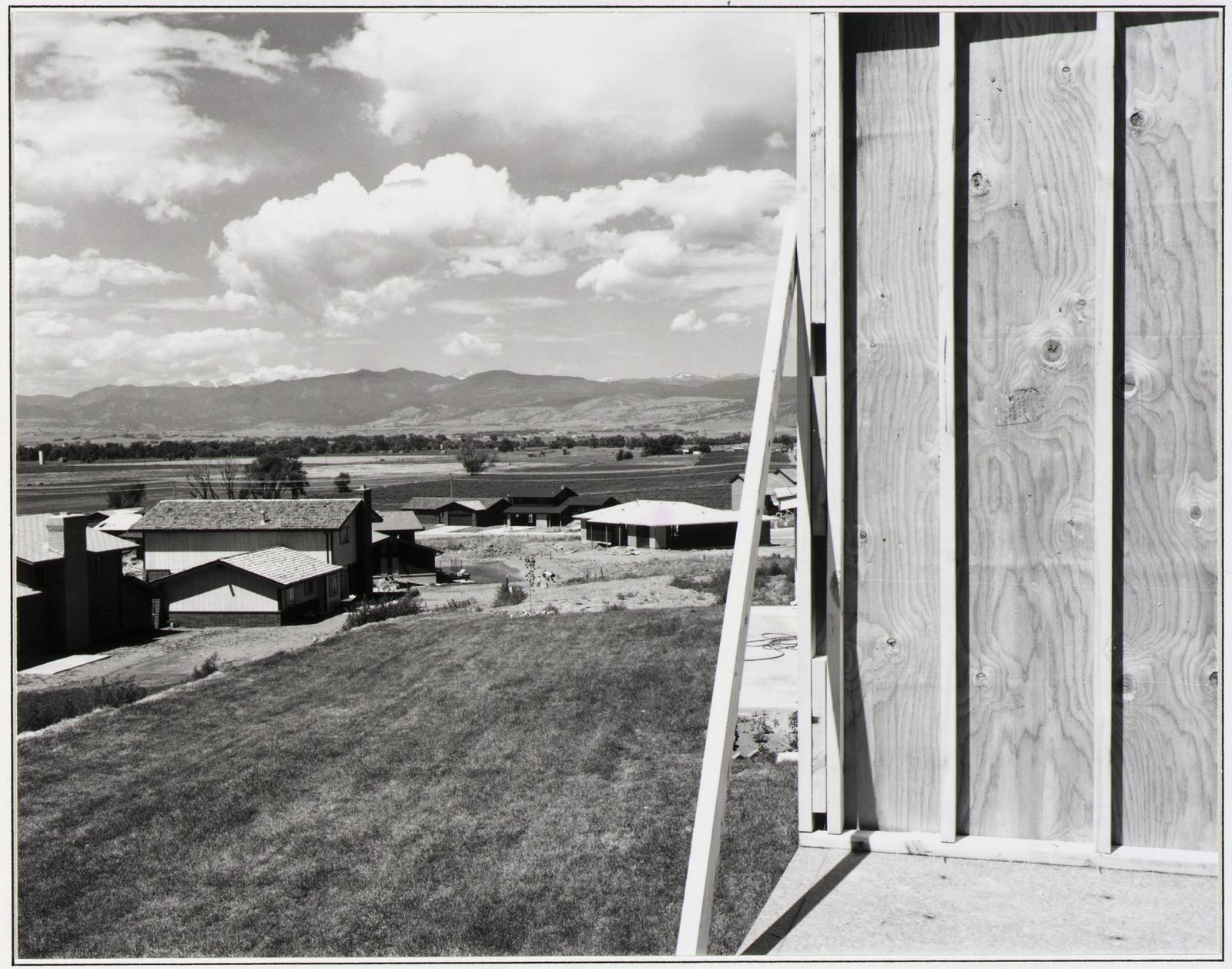
Knotted plywood fills the right side of the photograph. Beyond a diagonal timber brace, houses step down toward fields and a mountain range beneath a generous sky. In Robert Adams's New Housing, Longmont, Colorado (1973), a suburban home is close enough for its wood grain to compete with the distant terrain. The Smithsonian describes the photograph as a meeting between the West as scenic promise and the West as somewhere people actually live.[1] The building belongs to the landscape even when it interrupts our enjoyment of it.
That interruption offers a way into New Topographics: Photographs of a Man-altered Landscape, the exhibition William Jenkins curated at George Eastman House in Rochester in 1975. Its industrial sites, housing developments and ordinary streets expanded what a landscape photograph could ask us to notice.[2][4] Places we might pass through on the way to a beautiful view became worth stopping for themselves.
An exhibition becomes a name
The original exhibition brought together ten photographers: Robert Adams, Lewis Baltz, Bernd and Hilla Becher, Joe Deal, Frank Gohlke, Nicholas Nixon, John Schott, Stephen Shore and Henry Wessel Jr. Count the Bechers as a partnership and there were nine artistic practices. LACMA's 2009 restaging brought back more than two-thirds of the original photographs and placed them beside earlier and related work. The exhibition itself had become an object of historical inquiry.[2]
The name now makes the group sound more uniform than it was. A useful starting point is a shared willingness to give sustained attention to the built environment. From there, the differences become as interesting as the resemblance.
There were also precedents. The 2009 reconsideration placed these photographers alongside Walker Evans's documentary approach, Ed Ruscha's photographic books and other work at the boundary between photography and conceptual art.[2] An ordinary subject could carry an argument about how pictures organize information. A building could be both a specific structure and an occasion to examine the act of description.
Plainness takes work
Baltz's The New Industrial Parks near Irvine, California (1974) comprises 51 gelatin silver prints. MOCA's account draws attention to construction details: dirt heaps, partially painted walls and landscapes being converted into industrial complexes. People are conspicuously absent.[3] Development appears through surfaces and traces of work rather than through a human protagonist.
That gives the viewer an unusual task. A bare wall offers few instructions about where to begin or how to feel. Its proportions, marks and relation to the ground have to sustain attention. The very restraint that makes a picture look informational can make it intensely formal. We start comparing edges and intervals because there is so little theatrical action to follow.
Yet a photograph's sober appearance cannot guarantee a complete account. In a 1975 text discussed in MoMA's Photography at MoMA: 1960 to Now, Baltz observed that documentary photographs must convince us of their accuracy while inevitably offering only a selection of the world. The catalogue describes the New Topographics photographers' neutrality as an appearance, alongside their individual ways of giving meaning to a document.[4]
This distinction matters when looking at an empty industrial site. The picture may show a building with extraordinary clarity while leaving its ownership, workforce and financing unexplained. Those omissions do not make it worthless as evidence. They tell us where visual evidence ends. Its coolness can invite questions without supplying all the answers.
Different kinds of attention
Adams's pictures complicate the idea that the group simply exchanged beauty for criticism. The Getty's account of his work describes pleasure in the western landscape alongside distress at its degradation. Light remains central to his photographs of roads and houses.[5] A damaged place can still be beautiful, making the damage more difficult to settle into a comfortable verdict.
Look again at the Longmont photograph with that in mind. The house's closeness and the land's distance occupy the same sheet of paper. We cannot enjoy one without encountering the other. My reading is that this proximity makes the act of inhabiting the West inseparable from the act of admiring it. The photograph gives that tension a spatial form.[1][5]
For the Bechers, repeated photographic conditions enabled comparison. They documented industrial architecture in Europe and the United States, often isolating structures against overcast skies and grouping related forms into ordered grids. Their practice also included contextual views and sequences from different angles. The Walther Collection connects this work to their concern for industrial buildings that were disappearing.[6]
The repeated format directs attention toward small differences within a type: the particular shape of a tank or the supports beneath a tower. It also preserves a record of structures whose usefulness may outlast their prestige. Set beside Baltz's newly developing industrial sites, the Bechers' concern with disappearance gives industrial architecture a different temporal direction.[3][6]
Stephen Shore further unsettles any definition based on monochrome austerity. SFMOMA's restaging includes his color photograph 2nd Street East and South Main Street, Kalispell, Montana, August 22, 1974.[7] The shared terrain accommodates color and a street intersection as readily as black-and-white studies of walls. A movement name is most useful here when it helps us find relationships without erasing distinct choices.
The view on the way home
The exhibition's lasting invitation is easy to test. Consider the places that ordinarily fall between destinations: a frontage road, a warehouse setback, a new house facing open ground. Giving them sustained attention reveals decisions already made about land, access and habitation.
The photographs do not all pronounce the same judgment on those decisions. Their value lies partly in how long they allow us to look before judgment feels settled. Adams's house stays in the foreground. The distant land remains visible. The picture holds both together, leaving us to work out what living with that view entails.
Sources
- Smithsonian American Art Museum, “New Housing, Longmont, Colorado” — Robert Adams's 1973 photograph, object metadata, collection credit, reproduction and interpretive account.
- Los Angeles County Museum of Art, “New Topographics: Photographs of a Man-Altered Landscape,” October 25, 2009–January 3, 2010 — the original participants, restaging and conceptual context.
- Museum of Contemporary Art, Los Angeles, “The New Industrial Parks near Irvine, California,” 1974 — Lewis Baltz's 51-print series and its construction subjects.
- Sarah Hermanson Meister, “They Like the Real World”: Documentary Practices after The Americans, in Photography at MoMA: 1960 to Now, Museum of Modern Art, 2015, p. 23 — Baltz on documentary selectivity; PDF preview.
- J. Paul Getty Museum, “Robert Adams: Landscapes of Harmony and Dissonance,” 2006 — environmental damage, beauty and the importance of light in Adams's work.
- The Walther Collection, “Becher, Bernd & Hilla” — industrial subjects, standardized views, contextual sequences and typological grids.
- San Francisco Museum of Modern Art, “New Topographics,” July 17–October 3, 2010 — restaging of the exhibition, participant list and reproduction identifying Stephen Shore's Kalispell photograph.