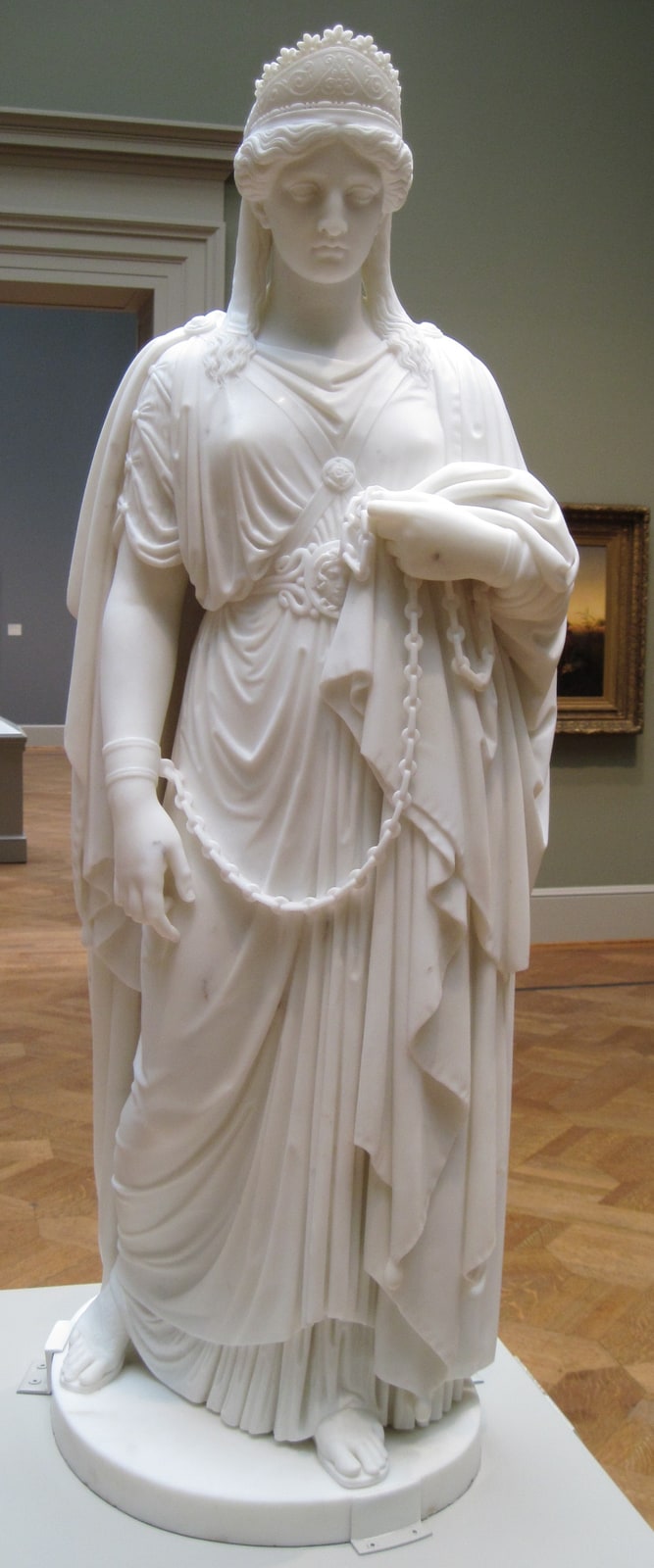
Zenobia still wears her crown. Before you register the restraint at her wrists, Harriet Hosmer has given you a ruler: the elaborate dress, the upright body, the face held above a gathering of heavy folds. Then the chain changes the encounter. This woman has been captured. The sculpture asks you to keep both impressions in view.[5]
The photograph shows Zenobia in Chains at the Saint Louis Art Museum, a marble version dated about 1859 and measuring 44¼ inches high. It is important to keep that object distinct from the monumental, 82-inch marble at The Huntington. The shared composition represents the third-century queen of Palmyra, in present-day Syria, after her defeat by Rome. The Huntington describes the story of Emperor Aurelian freeing her in response to her dignity and beauty as legend; the statue should likewise be approached as an interpretation of the queen, rather than an eyewitness record of her captivity.[1][2]
Begin with the hands, which occupy different heights. Her right arm hangs down, while the left hand gathers chain against the drapery. Between them, the links fall in a broad curve across the robe. There is no sprawling struggle, no arm flung outward to summon help. The slack does not mean freedom; the cuff remains visible at the lowered wrist. But the chain does not pull her body out of balance.[5]
That arrangement gives the sculpture its tension. A chain pulled tight toward a guard would make the guard's action part of the composition. Here, no captor shares the base. The viewer encounters the person who must carry the condition of captivity, with the machinery of conquest left outside the frame. To my eye, the absence makes the chain more troubling: it is enough to establish another person's power without allowing that person to become the subject.
The dress works differently. Broad folds accumulate around the arms and travel downward toward the feet, giving the figure breadth and continuity. Across that larger movement, the small ornaments and worked surfaces invite a slower look. Court dress remains court dress even when its wearer is a prisoner. The crown supplies a particularly clear cue: the Romans may determine where Zenobia goes, but Hosmer has left the sign of her rank on her head.[5]
Yet the face does not deliver an easy expression of triumph. It inclines downward, and the eyes do not meet ours. Read only the head and the mood might seem subdued; follow the body down and the upright bearing complicates that reading. The figure holds an unresolved relation between what has happened to her and how she carries herself. Calling her simply victorious would flatten that achievement as much as calling her broken.
Susan Waller's study of the sculpture helps explain how deliberate those choices were. Hosmer knew the Historia Augusta, whose accounts described the captive queen weighed down by jewels and golden restraints. Waller contrasts that burdened figure with Hosmer's more limited wrist chains and sustained bearing. She also traces the sculptor's exchanges with the writer Anna Jameson, who offered criticism of the developing model. The work emerged through research, conversation and revision, including attention to how the crown affected the face.[3]
This context keeps the jewellery from becoming mere decoration. In Waller's reading, Hosmer redirects attributes that earlier writers could treat as evidence of vanity toward an assertion of royal authority. That is a useful distinction when looking at the statue: the ornaments help identify who Zenobia remains, even as the chain announces the power she has lost.[3]
The question of authority followed the sculpture into Hosmer's own profession. The Huntington records the scepticism of male critics who doubted a woman could execute such a monumental work. Her 1864 essay, “The Process of Sculpture,” answers the broader suspicion surrounding artists who employed assistants by taking readers into the workshop.[2][4]
Hosmer describes a sequence beginning with a small clay model, proceeding through enlargement and refinement, and reaching marble through the labour of specialist workers. Throughout, the sculptor directs and corrects. She acknowledges that the quality of the carving matters, while insisting that authorship cannot be measured by how much stone the artist personally removes. She also points out the unequal reception of that assistance: practices accepted in prominent men's studios became grounds for withholding credit from women.[4]
Read beside Zenobia, the essay offers a further reason to attend to arrangement. The relation of crown to forehead, hands to chain, and drapery to stance belongs to the conception of the figure. These decisions determine what the marble asks us to see. Admiring the labour of carving need not obscure the judgement that organised it.
Return finally to the downward glance. Hosmer has given the queen neither an appeal to the spectator nor a gesture that resolves her predicament. The chains stay visible. So does the crown. The longer encounter lies in the distance between those two objects: one records what has been done to her, while the other makes it impossible to forget the ruler standing there.
Sources
- Saint Louis Art Museum, “A sculpture’s unusual journey to SLAM” (December 8, 2020) — identification, dimensions and collection history of the photographed marble.
- The Huntington, “Zenobia in Chains,” accession 2007.26 — the monumental version, its dimensions, historical subject and reception.
- Susan Waller, “The Artist, the Writer, and the Queen: Hosmer, Jameson, and Zenobia,” Woman’s Art Journal 4, no. 1 (Spring–Summer 1983), pp. 21–28 — literary sources, Jameson’s advice and the sculpture’s development; PDF hosted by The Huntington.
- Harriet Hosmer, “The Process of Sculpture,” The Atlantic Monthly 14, no. 86 (December 1864), pp. 734–737 — the artist’s account of modelling, workshop assistance and unequal standards of attribution, transcribed by Project Gutenberg.
- QuartierLatin1968, “Zenobia SLAM 4067.jpg” (May 27, 2011), Wikimedia Commons — source photograph of the Saint Louis Art Museum sculpture, licensed CC BY-SA 3.0.