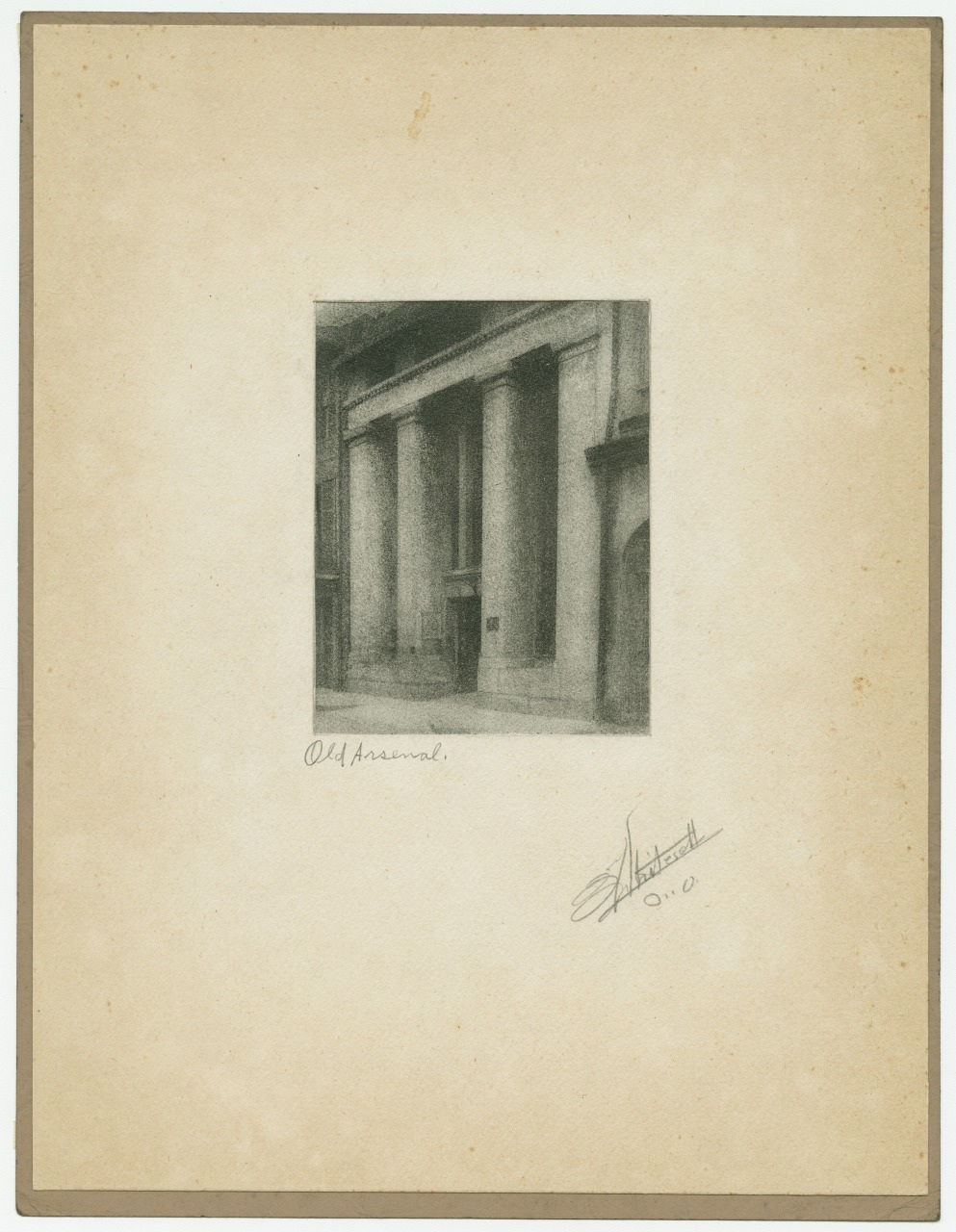
A bromoil printer starts with a photograph that already looks finished, then makes its silver image disappear. The scene survives in a less obvious form: differences in the hardness of the gelatin coating. Soaked in water and worked with greasy ink, that apparently depleted sheet becomes a picture again.[2][4] What looked like an ending—the developed print—was only the beginning of another kind of authorship.
Joseph Woodson “Pops” Whitesell's Old Arsenal, dated to the 1930s by the Historic New Orleans Collection, carries the process one stage further. It is a bromoil transfer: the image has moved from the treated photographic sheet onto another sheet of paper.[1] Its columned facade offers a useful way into a technique in which photographic description and the handling of ink become inseparable.
The picture survives as a surface
The crucial operation is selective hardening. Chemical treatment of a gelatin silver print removes the silver image while hardening the gelatin in relation to that image. After washing and subsequent soaking, the less-hardened highlight areas take up more water and swell. They resist the oily ink; the more-hardened areas accept it. Midtones fall between those extremes.[1][5]
The brush therefore meets a surface already organized by the photograph. A printer need not redraw each column or window. The distribution of water helps determine where the ink will settle, while its application remains open to intervention. This is what makes the process so interesting: the camera's description persists as a material constraint that the hand can work with.
The George Eastman Museum dates bromoil's development to 1907 and explains its practical advantage over the earlier oil-printing process. In that predecessor, a sheet coated with sensitized gelatin was exposed directly against a negative. Bromoil could begin with a positive enlargement on bromide paper.[2] The printer could establish the picture's scale photographically before beginning the ink work.
That change widened the space for decisions. The printer no longer needed a working negative the size of the finished image. Enlargement and inking became successive opportunities to shape the result. It also explains why bromoil belongs within photographic practice even when the finished surface suggests a drawing: an ordinary photographic print provides the image that the later operations transform.[2]
What the brush adds
A surviving bromoil kit in the Science Museum Group's Kodak Collection makes this work feel tangible. The catalog records brushes, tubes of pigment, a ceramic palette, a mixing stick and a finishing rubber, housed with other implements in a modified Kodak paper box.[3] It is the equipment of someone who expects to keep making decisions after the darkroom exposure.
Consider what such tools imply about attention. A camera gathers an entire field into one exposure; brushwork proceeds through parts of the surface. The printer can spend time on a passage that the exposure recorded in an instant. The possibility of local control is central to the appeal of bromoil, which the Finnish Museum of Photography describes as yielding soft-lined images that could be further worked with a brush.[4]
Softness, then, need not mean a failure to focus. It can belong to the chosen printing method and its handling. Nor does a soft outline prove that an artist deliberately suppressed one particular detail. Without the negative, intermediate prints or working notes, that attribution would go beyond what the finished object tells us. The useful question is how the final distribution of light and dark directs our looking.
A second sheet changes the object
In a direct bromoil, the inked photographic sheet is the finished print. For a transfer, the inked matrix is pressed against a separate receiving sheet. The Finnish museum names watercolor and lithographic papers among the possible destinations.[4] This gives the printer another material choice: the paper carrying the final picture need not be the photographic paper that first received the enlargement.
Whitesell's Old Arsenal makes the print's presentation worth noticing, too. The reproduction shows a small image within a broad cream surround, with the handwritten title beneath it. Pale columns emerge from deep recesses; the cornice cuts diagonally across the upper frame. Their surfaces have a granular softness, yet the architecture remains solid and readable. The huge margin slows the encounter further. We approach a dark, concentrated view through an expanse of paper, then find a signature set well outside the picture. The presentation announces an object someone has handled and finished.
A digital reproduction can show that arrangement, but it cannot let us feel the paper or establish the precise sequence of Whitesell's brushwork. The museum's identification of the object as a transfer matters more than any resemblance to charcoal or watercolor. Appearance invites a reading; the catalog establishes which process we are reading.[1]
Looking beneath the softness
Recent conservation research sharpens the distinction between an image's appearance and its material construction. In a 2024 study, Raquel Freixas-Jambert and colleagues examined sixteen bromoil prints using infrared spectroscopy and microscopy. Their findings describe the greasy ink as a separate layer above the gelatin, rather than pigment dispersed inside it. They also found that the white baryta layer used in some photographic papers was absent in some examples.[5]
Those findings concern the studied bromoils, not an analysis of Whitesell's transfer. They caution against treating a process name as a guarantee of one identical stack of materials. Even a seemingly modest photographic print can contain several different histories: the exposure, the chemical preparation, the application of ink and the choice of support.
Return to the columns in Old Arsenal. Their photographic origin remains legible, yet the image has passed through a surface that held water unevenly and a press that moved ink onto paper. Bromoil's extra labor made the moment after exposure unusually consequential. The view was already recorded; how it would become an object was still being decided.
Sources
- Historic New Orleans Collection, “Bromoil and Bromoil Transfer Processes: 1907–1930s” — process sequence and reproduction of Joseph Woodson “Pops” Whitesell's Old Arsenal, accession 1978.122.5.
- George Eastman Museum, “Photographic Processes Video Series & Glossary,” written entry “Bromoil Transfer Print” — the earlier oil process, bromoil's 1907 development and use of a positive enlargement.
- Science Museum Group, “Bromoil Materials,” object 1990-5036/2755 — brushes, pigment and working tools preserved in the Kodak Collection.
- The Finnish Museum of Photography, Pictorialism: The Dawn of Photographic Art, exhibition glossary (2022), PDF page 3 — brush intervention and the distinction between bromoil and bromoil transfer.
- Raquel Freixas-Jambert, Cristina Ruiz-Recasens, Alejandra Nieto-Villena and Marta Oriola-Folch, “Non-Invasive Characterisation of Bromoil Prints by External Reflection FTIR Spectroscopy,” Molecules 29, 5833 (December 11, 2024) — University of Barcelona repository PDF; ink-layer structure and variation in photographic supports.