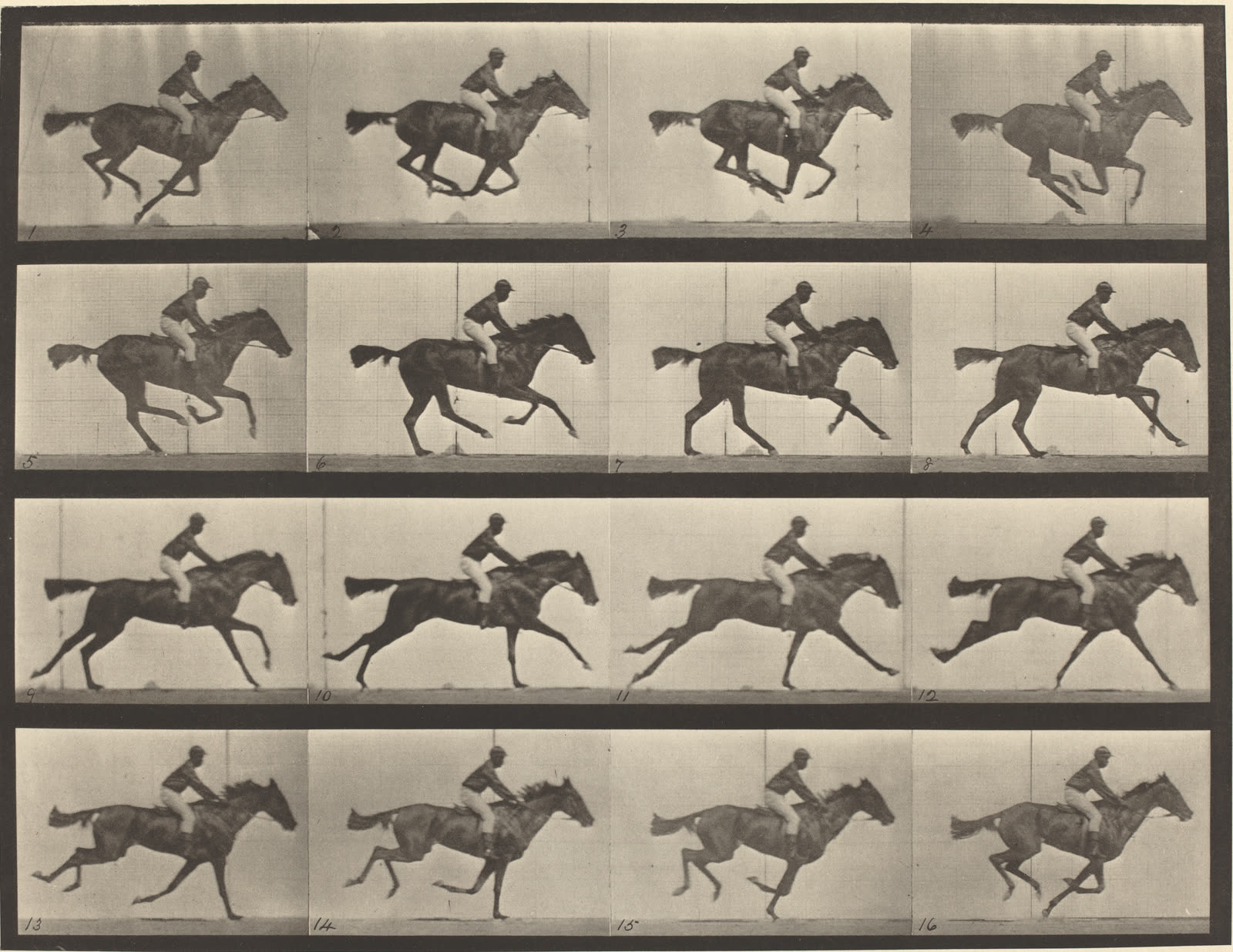
Eadweard Muybridge is often introduced as the man who helped settle whether a galloping horse ever lifts all four feet from the ground. That story is true, but it is too small for the visual machine he built. The larger achievement of Animal Locomotion was not one solved horse puzzle. It was a new interface for looking at movement: a body passing before cameras, a measured background, timed exposures, and printed plates that let motion be studied after the moment had vanished.[1][2]
That is why Muybridge belongs in art history as much as in the prehistory of cinema. His 1887 plates turned time into something a viewer could scan, compare, and repeat. They did not merely freeze action. They cut action into intervals and arranged those intervals on a page. The result sat between laboratory record, performance document, drawing aid, and visual culture prototype. Before film made movement flow across a screen, Muybridge made movement readable in rows.[1][3][4]
Image context: the cover uses the National Gallery of Art/Wikimedia Commons reproduction of Animal Locomotion, Plate 626. It is a real archival photographic plate, not a diagram. The horse, rider, measuring grid, and repeated positions make the article's argument visible at once: Muybridge's technology did not hide behind the image; it became the image's grammar.[2][5]
The grid made time behave like space
The University of Pennsylvania Archives gives the technical scene with unusual clarity. In the early phase of the Penn project, Muybridge worked in an outdoor studio at 36th and Pine Streets, using a three-sided black shed and three batteries of cameras placed to capture a subject from the side, from the front or back, and from a forty-five-degree angle.[1] Exposures were released in sequence at equal intervals by electromagnets, while white strings on the back wall formed a measuring grid.[1]
That apparatus matters because it changes what the photograph claims to know. A single action photograph says: this instant existed. Muybridge's system says: this instant can be placed beside the next instant, measured against a stable field, and read as part of a repeated motion pattern. The grid is not background decoration. It is the contract that lets the viewer treat the body as evidence instead of spectacle.[1]
This is where the art-tech story begins. Muybridge did not produce a neutral window onto life. He built a stage where life could be converted into comparable visual units. The black shed controlled distraction. The cameras divided duration. The grid stabilized distance and height. The printed plate returned the vanished action as a visual table. Every part of the system pushed motion away from anecdote and toward legibility.[1][2]
The horse stopped being an emblem and became evidence
Plate 626, the image used here, is useful because it keeps the original horse problem in view while showing how far Muybridge had moved beyond a wager or curiosity.[2][5] The Pennsylvania Academy of the Fine Arts identifies the work as an 1887 collotype from Animal Locomotion, Volume IX, devoted to horses.[2] The plate is not dramatic in the usual equestrian sense. It does not flatter the horse into heroic extension or the rider into command. Instead it makes the gallop stutter across the page.
That stutter is the point. Nineteenth-century painting inherited many conventions for rendering speed: stretched legs, flying manes, diagonal force, dust, theatrical imbalance. Muybridge introduced a different authority. The horse no longer had to symbolize speed through a persuasive pose. It could be shown as a sequence of mechanically captured positions, some elegant, some awkward, some almost unreadable until the viewer learned the rhythm.[1][2]
The familiar all-hooves-off-the-ground discovery sits inside that larger change. According to Penn's account, Leland Stanford first engaged Muybridge in the 1870s to photograph galloping horses and clarify the gait question; improved shutter speeds later helped Muybridge produce successful evidence.[1] Yet the enduring visual result was not just the corrected fact of a horse's gait. It was a correction to looking itself. The eye had trusted the continuous impression of speed. The camera showed that movement could be rebuilt from discontinuity.[1][2]
Human gesture became a printed interface
The human plates sharpen the issue because they remove the romance of the racehorse. The Smithsonian American Art Museum's Animal Locomotion (plate 319) (Man Throwing a Ball) is an 1887 photogravure classified under photography and photomechanical reproduction, with subjects including motion study, sport, and the full-length male figure.[3] Another Smithsonian work, Descending Stairs and Turning, from the same project, shows how an ordinary bodily transition could be split into a readable arc.[4]
These subjects make Muybridge feel less like a horse photographer and more like a designer of bodily notation. Throwing, walking, descending, turning, lifting, carrying: actions that normally disappear into habit become sequences one can inspect. The page invites a viewer to move back and forth rather than surrender to forward flow. One can compare the load-bearing leg, the angle of the torso, the moment of release, the turn of the head, the distribution of weight.[3][4]
That is also where the work becomes ethically and culturally complicated. The Penn project drew on artists, scientists, engineers, medical and veterinary faculty, athletes, zoo animals, and disabled models from the nearby almshouse.[1] The archive of motion is therefore not just an innocent library of bodies. It is a nineteenth-century knowledge project, shaped by institutions that wanted to see, classify, teach, and measure. Muybridge's plates are beautiful partly because they are so severe. They make bodies legible, and legibility always carries power.[1][3][4]
Before cinema, a page taught viewers how to edit
Muybridge's zoopraxic projection device is often used to pull him toward cinema history, and Penn's archive notes that he developed such a device in 1879 so action photographs could become projected moving pictures.[1] That connection is real. Still, the printed plates deserve their own importance. A film carries the viewer through time. A Muybridge plate leaves time spread out on the table.
That difference is not secondary. On the page, the viewer becomes the editor. The eye can start at the first frame, skip to the sixth, return to the third, isolate the suspended phase, or compare the side view against the measuring grid. Motion is no longer only performed by the subject. It is reconstructed by the reader. This is why the plates remain useful to artists and animators as well as historians. They teach that movement has structure before it has illusion.[1][3][4]
Read across the Penn and Smithsonian records, Muybridge's plates belong to a zone where modern visual culture was learning to treat the body as sampled data.[1][3][4] The nineteenth-century page already contains a logic familiar from later media: frame, interval, repeat, compare, animate.
The technology became the look
What makes Animal Locomotion still feel modern is that its apparatus is visible. The grid, serial layout, blank setting, and repeated figure do not vanish into illusion. They are the look. That is the strongest reason to treat Muybridge as an art-and-technology figure rather than as a mere technical precursor. He did not only use cameras to answer a scientific question. He created a visual form in which measurement, sequencing, performance, and print all shared the same surface.[1][2][5]
In that sense, Plate 626 is not only a horse picture. It is a compact theory of media. It says that seeing can be rebuilt by machines, but also that machines need a format before their evidence becomes intelligible. The horse runs once. The plate lets the run continue as comparison. The rider crosses the frame once. The grid keeps holding the passage open. Cinema would later restore flow. Muybridge's page preserves the more radical lesson underneath: motion becomes newly visible when it is first broken apart.[1][2][5]
Sources
- University of Pennsylvania Archives, "Muybridge's Animal Locomotion Study" - institutional history of the Penn project, including the outdoor studio, camera batteries, electromagnet releases, measuring grid, and zoopraxic projection context.
- Pennsylvania Academy of the Fine Arts, "Animal Locomotion, Volume IX, Horses. Plate 626" - object page for the 1887 collotype horse plate used as the article's central visual example.
- Smithsonian American Art Museum, "Animal Locomotion (plate 319) (Man Throwing a Ball)" - object page for an 1887 Muybridge photogravure showing the sport and human-motion side of the project.
- Smithsonian American Art Museum, "Descending Stairs and Turning, from the book Animal Locomotion" - object page for a ca. 1887 Muybridge collotype that turns ordinary movement into sequential photographic study.
- Wikimedia Commons, "Eadweard Muybridge, Animal Locomotion, Plate 626, 1887, NGA 136536.jpg" - National Gallery of Art file record for the public-domain reproduction used as the cover image.