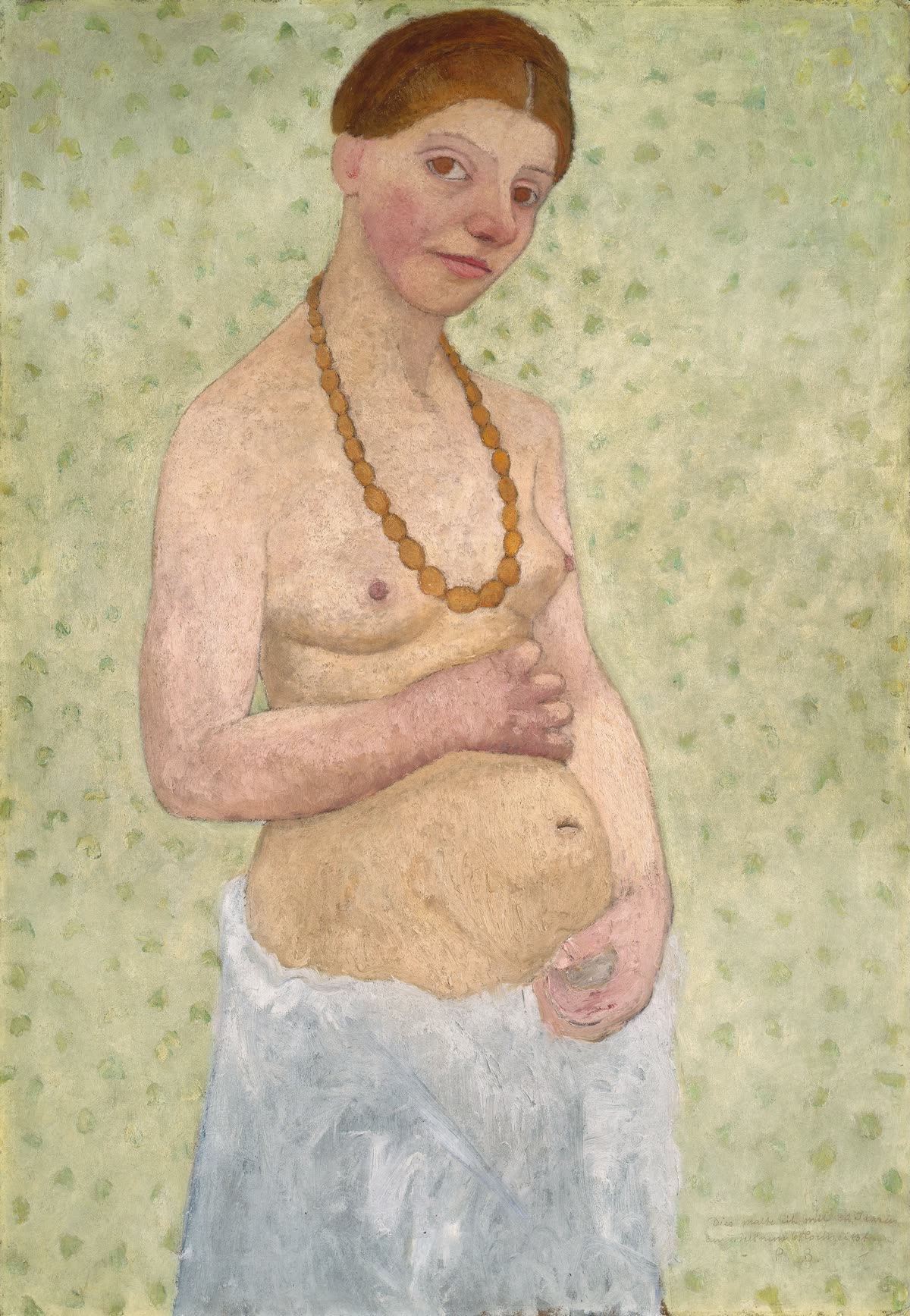
Paula Modersohn-Becker's Self-Portrait on the Sixth Wedding Anniversary looks quiet only if it is read too quickly. The painting, made in Paris in 1906 and now held by the Paula Modersohn-Becker Museum in Bremen, shows the artist bare-chested, front-facing, wearing a heavy amber necklace, and placing one hand against a rounded belly.[1][2][6] It carries the pressure of a declaration without theatrical gesture. The body is presented plainly, but the picture is not plain. It is a constructed statement about artistic authority, marital naming, maternity, and the right of a woman painter to make her own body the site of modern form.
The museum's own framing explains why the work still carries historical voltage. Its 2013 exhibition Sie. Selbst. Nackt. began from this 1906 self-portrait, described it as belonging to the Paula Modersohn-Becker Museum collection, and treated it as the first female nude self-portrait to enter art history.[1] Neue Galerie's 2024 retrospective page widens the scale: Modersohn-Becker, born in 1876 and dead by 31 after a postpartum embolism, produced more than 700 paintings and about 1,400 drawings, with self-portraits and pregnancy subjects central to her achievement.[3] The painting therefore sits at a dangerous intersection. It is intimate, but it is also institutional. It is small enough to feel like one body speaking, and large enough to alter a genre.
Image context: the cover image is the Wikimedia Commons photographic reproduction of the 1906 painting. It is the right visual because this is a specific artwork essay, and the argument depends on seeing the painting itself rather than a portrait of the artist, an exhibition room, or an illustrative substitute.[6]
The amber necklace is not decoration
The first thing that holds the eye is the amber necklace. It forms a warm, uneven circle at the top of the torso, almost the only object in the painting allowed to behave like an heirloom. The Paula Modersohn-Becker Museum's 2025 notes identify the necklace as a family inheritance from the Becker side, something the artist loved, and also stress its pictorial importance: it distinguishes her and matters to the color structure.[2] That double function is crucial. The necklace is biography and form at once.
Amber changes how the nude is read. It prevents the body from becoming an anonymous academic exercise, and it also prevents the painting from settling into conventional erotic display. The beads say: this is a particular person, carrying a family object, but refusing to let family identity settle the meaning of the body. That is why the necklace feels both tender and firm. It rests on skin, but it also acts like a boundary marker. Above it is the face, compact and unsmiling; below it is the bare torso, simplified into broad planes. The necklace holds the two registers together.
This is where Modersohn-Becker's modernity begins to show. She does not need distortion to announce rupture. She changes the social contract of the nude by letting a familiar object sit inside an unfamiliar act. A woman artist paints herself bare, not as allegory, not as goddess, not as available model, but as an artist arranging the terms under which she will be visible.[1][2][3]
The body is exposed, but it refuses spectacle
The painting's boldness lies partly in how little it performs boldness. Modersohn-Becker does not twist the pose into drama. She gives the torso volume, weight, and frontal clarity, then keeps the face almost withholding. Cleveland Museum of Art's note on a related likely self-portrait is useful here because it describes her larger method: she moved away from idealized appearance and toward flattened forms that make the body feel fundamental rather than decorative.[4] That same logic governs the sixth-anniversary portrait.
The breasts are not polished into academic finish. The shoulders and arms are heavy and simplified. The abdomen is rounded, but held with a kind of quiet pressure rather than sentimental softness. The surface has a matte, concentrated density, closer to an icon of presence than to a salon nude. The viewer is not invited to possess the body by looking. The viewer is asked to recognize that the body has already claimed the space.
This matters because the nude self-portrait was still a rare and charged form in 1906. The Bremen exhibition text says that even among male artists, the nude self-portrait was uncommon at the time, and that Modersohn-Becker's self-nude gave new art-historical standing to a misunderstood subject.[1] Her risk was therefore formal and social together. She took a genre built around looking at bodies and turned it into a structure for looking from within a body.
The pregnancy is an image of possibility, not a diary entry
The rounded belly is the painting's most tempting shortcut. It is easy to treat it as evidence, confession, or prophecy. The museum's own program text gives the sharper boundary: Modersohn-Becker represented herself as pregnant in this famous self-portrait although she was not pregnant at that moment.[5] That fact should not reduce the painting to biographical irony. It makes the image more deliberate.
Pregnancy here is not only a state of the body. It is a visual grammar for becoming. The hand on the abdomen does not simply point to future motherhood; it points to a body imagined as carrying form, work, and time. Neue Galerie notes that many of Modersohn-Becker's self-portraits and pregnancy-focused works were firsts among Western women artists.[3] In that light, the rounded belly is neither costume nor prediction. It is a way of painting the self as unfinished without painting the self as incomplete.
That distinction is the center of the picture. Modersohn-Becker had separated from ordinary expectations of artistic wifehood and was trying to make a life as an independent artist in Paris.[2][3] The painting lets several futures coexist: artist, wife, mother, Becker, Modersohn, self. None of those names wins the picture. The image holds them under pressure.
The inscription pulls marriage into the frame
The title points to the sixth wedding anniversary, and the painting itself carries an inscription at the lower edge. The museum's 2025 question-and-answer notes caution that the inscription most likely marks the occasion and approximate period of making rather than a one-day execution; the work was painted in layers and took days or weeks.[2] That matters because it shifts the inscription from calendar trivia into staged self-definition.
The same museum note makes the signature question even more pointed. It connects the work's making to a period when Modersohn-Becker wanted to separate from her husband and live independently as an artist in Paris, and reads the omission of her husband's name against that background.[2] The painting therefore turns marital time into artistic material. An anniversary normally measures continuity between spouses. Here it measures the artist's need to name herself.
Neue Galerie's exhibition title, Ich bin Ich / I Am Me, comes from Modersohn-Becker's 1906 letter to Rainer Maria Rilke, where she struggled with how to sign her name and claimed an identity beyond both "Modersohn" and "Paula Becker."[3] The self-portrait belongs to that same emotional and formal territory. It does not discard relation; it refuses to be exhausted by relation.
Why the painting still feels modern
The painting lasts because it keeps refusing the simplest available reading. It is not only a nude, because the amber necklace, inscription, and frontal authorship make the body a signed field. It is not only a pregnancy image, because the pregnancy is imagined at the time of painting and works as a grammar of becoming.[5] It is not only a marital image, because the anniversary frame becomes the ground on which artistic selfhood is tested.[2][3]
Its modernity also lies in the surface. Modersohn-Becker compresses space, simplifies flesh, and lets the body become almost monumental without turning it ideal. That is where the Cleveland description of her broader practice helps: the point is not perfected appearance, but a distilled body that carries emotional and spiritual presence.[4] In the sixth-anniversary self-portrait, that presence is not soft. It is watchful.
What the picture finally claims is the right to appear in transition. Modersohn-Becker paints herself between names, between marital roles, between bodily fact and bodily imagination, between private heirloom and public art history.[1][2][3][5] The amber necklace stays warm at the throat. The hand stays pressed to the abdomen. The gaze stays direct. The painting does not resolve the self into one stable answer. It makes selfhood visible as a form under construction.
Sources
- Museen Bottcherstrasse, "Sie. Selbst. Nackt. Paula Modersohn-Becker und andere Kunstlerinnen im Selbstakt" - exhibition archive on the 1906 self-portrait, collection context, and nude self-portrait history.
- Museen Bottcherstrasse, "Fragen zum Selbstbildnis am 6. Hochzeitstag" - museum Q&A on the painting's inscription, necklace, making process, signature, and identity questions.
- Neue Galerie New York, "Paula Modersohn-Becker: Ich bin Ich / I Am Me" - 2024 retrospective page with biography, career scale, self-portrait context, and the 1906 identity statement.
- Cleveland Museum of Art, "Seated Female Nude (Self-Portrait?)" - collection note on Modersohn-Becker's non-idealizing body language and flattened forms.
- Museen Bottcherstrasse, "Bildbetrachtung mit Baby" - program note stating that Modersohn-Becker represented herself as pregnant in the 1906 self-portrait although she was not pregnant at that moment.
- Wikimedia Commons, "File:Paula Moderson-Becker - Selbstbildnis am 6 Hochzeitstag (1906).jpg" - photographic reproduction and file metadata for the article image.