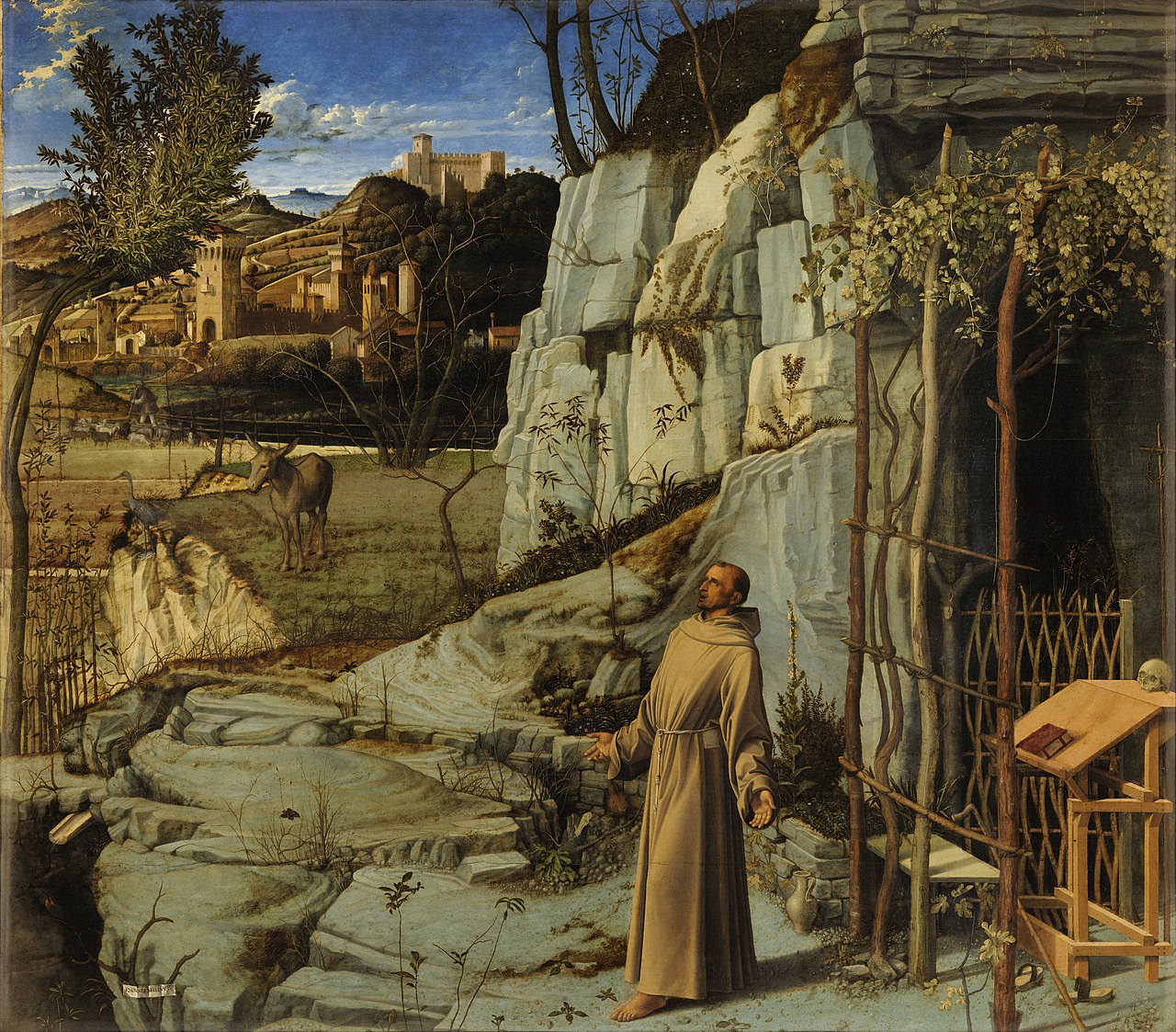
Giovanni Bellini's St. Francis in the Desert is often introduced as a Renaissance saint picture, then left there.[1][2] That description is true and still too small. The panel matters because it refuses to keep holiness in one visual compartment. Francis is not shut inside a cell, pinned to a gold ground, or arrested in a single miracle diagram. He steps out from a rough shelter into a world that has been made strangely alert: split rocks, a narrow desk, a skull, a donkey, a heron, a rabbit, a bridge, a town, and a flare of light arriving across the whole landscape.[1][4] Bellini does not simply show a holy man in nature. He makes revelation travel through the visible world.
That is why the picture still feels so open. The saint's experience is intense, but the painting never turns mystical transport into private haze. Bellini gives it structure. Francis stands barefoot on a ledge, arms parted, face lifted, mouth slightly open.[1][4] The wilderness does not swallow him; it answers him. Stone edges rise and angle around the body as if the terrain itself were receiving the shock.[4] The painting's greatness lies in that transfer. An inner event becomes spatial.
Image context: the cover uses a full reproduction of the Frick's panel because this picture cannot be reduced to the saint alone. The essay's claim depends on Bellini's entire field of relations: the hut at right, the cultivated distance at left, and the rocky threshold Francis crosses between them.[1][4]
The picture is about Francis, but it resists a simple miracle formula
The Frick's own material makes clear how unusual Bellini's image is inside Franciscan iconography.[1][2][4] In standard depictions of the stigmatization, Francis kneels before a winged seraph and receives the five wounds of Christ in explicit, almost diagrammatic form.[4] Bellini does something else. Francis stands. No seraph appears. The miracle is displaced from spectacle toward aftereffect.[1][4]
That difference became sharper after the painting's technical examination.[2][4] Conservators confirmed that the top edge really was cropped, but only by a small amount, probably just enough to lose a narrow strip of sky, cliff, and trees rather than a fully legible heavenly apparition.[4] They also established that the faint red stigmata on Francis's hands are original, and that traces of red on the saint's left foot show Bellini once painted a wound there as well, later abraded by cleaning.[4] The result is decisive. The picture alludes to the stigmatization, but it refuses to describe it in blunt narrative terms.[4]
That restraint changes the whole emotional register. Bellini treats sanctity less as a supernatural interruption than as a condition of heightened perception.[1][4] Francis has already been touched, yet what we witness is not a theatrical visitation from above. We witness a body learning how to stand inside the aftermath of grace. The saint's parted hands and lifted face register awe, but the panel is too materially exact to drift into vagueness.[4] Bellini wants revelation to remain legible in things.
Rock, shelter, and weather make the saint's body readable
The rocky setting is one of the painting's strongest devices.[1][4] Francis emerges from a dark, makeshift shelter built into the stone, a place that feels half hermitage and half worksite.[1] This is not a picturesque cave offered as generic backdrop. It is a threshold. The saint moves from enclosure into exposure, from shadow into a golden wash of light that seems to cross both skin and earth at once.[1][4]
Bellini makes the terrain carry emotion without turning it melodramatic. The cliffs fracture into shelves and angular seams; the ledge beneath Francis feels firm and precarious at the same time.[4] In the technical-study language, the scene is charged by "tectonic movement" in the rocks and by rays coursing through the sky.[4] That is exactly how the picture reads in person even through reproduction: the landscape is not merely there to situate an event. It is part of the event's pressure system.
Francis's body answers this pressure with extraordinary economy.[1][4] Bellini planned the head and figure in detailed underdrawing, attending already to wrinkles, cowl, fingers, and the fall of light across the face.[4] That care matters because the saint is neither ecstatic in a Baroque sense nor immobilized like an icon. He is alert, weathered, elderly, and fully physical. The painting asks us to read sanctity through fatigue, exposure, and attention.
The left side opens the desert into a worked world
One reason the panel never collapses into private mysticism is the landscape at left.[1][4] Bellini gives Francis not an empty wasteland but a long, habitable distance: water, fields, a walled town, cultivated hills, and a bridge that leads the eye outward.[1][4] The Frick's technical release notes that Bellini even rethought the bridge during underdrawing, changing it from a post-and-lintel form into a partly ruined arch better suited to the surrounding terrain.[4] That is a small fact with a large consequence. The picture was composed to keep movement flowing through the world.
This matters for the painting's theology and its visual intelligence at once. Franciscan spirituality is not only about retreat from society; it is also about perceiving creation as charged with relation.[2][4] Bellini's widened distance makes the saint's revelation inseparable from town life, paths, cultivation, and travel. Francis stands apart from the city, but not outside creation's common fabric. The open left half of the panel keeps the picture from becoming a sealed meditation on one soul alone.
The animals help lock that reading in place.[1][4] A donkey near the shelter, a heron, and a rabbit register the disturbance with their own subdued attention.[4] Bellini does not sentimentalize them. They are not cute witnesses. They widen the range of awareness inside the panel. Sanctity, here, is not a beam descending onto one privileged body. It is a reordering of the whole field of perception.
The hut is a study, and the study is part of the revelation
The right side of the painting is just as important as the open left.[1][4] Inside the shelter sits a desk with a book; behind it rise a cross and a skull.[4] These details prevent us from misreading Francis as pure natural spontaneity. Bellini insists on discipline, reading, prayer, and mortality. The saint's revelation does not bypass study; it grows out of a life shaped by it.
What makes this area especially rich is that Bellini revised it as he worked.[4] Technical examination showed that the desk originally ended more simply at the slanted reading surface. The shelf, skull, and slender cross were added later and painted thickly over an earlier dark zone.[4] In other words, Bellini strengthened the panel's meditation on death and contemplation during the making itself. The wilderness was not enough. He wanted the hermitage to think.
That adjustment sharpens the painting's tension. Francis is both outside and inside, both creature in the elements and reader before a book.[1][4] The skull points toward mortality; the cross toward imitation of Christ; the open ledge toward the world that must still be inhabited.[4] Bellini's close reading of Francis is therefore broader than biography. He paints a structure of life: study, renunciation, bodily exposure, and sudden illumination held together without strain.
Why the painting lasts
The Frick's provenance essay adds one final reason the work keeps its hold.[3] The panel moved through Venetian palaces, Milan, Paris, London, English country houses, and the shifting judgments of the art market before arriving in New York.[3] Its current title itself descends from an early Venetian notice of Bellini's "panel of St. Francis in the desert."[3] The work has been cut, cleaned, sold, refused, and reinterpreted, yet the central experience still comes through with unusual force.
That endurance has to do with Bellini's refusal to simplify.[1][3][4] He does not give us pure narrative, pure symbol, or pure landscape. He gives us a saint crossing a threshold while every surrounding thing becomes newly articulate. Stone does not merely frame Francis; it seems to absorb his inward shock. The distance does not merely decorate him; it opens revelation onto a social and cultivated world. The hut does not merely shelter him; it preserves the skull, book, and cross that make solitude answerable to thought and death.[1][4]
Bellini's panel lasts because it treats spiritual life as something that must become visible without losing subtlety.[1][2][4] The miracle is there, but diffused into posture, terrain, weather, and relation. Francis steps into sunlight, and the entire painting steps with him.
Sources
- The Frick Collection, "St. Francis in the Desert" - collection/exhibition page with work metadata, Francis at La Verna, and Bellini's presentation of the saint stepping from shelter into transfiguring light.
- The Frick Collection, "A Discussion on Bellini's St. Francis in the Desert" - program page noting the painting's importance in America and the Frick's technical study overview.
- Christopher Snow Hopkins, "Mapping Provenance: Bellini's 'St. Francis in the Desert'" - Frick curatorial blog tracing the panel's title history, ownership route, and market afterlife.
- The Frick Collection, In a New Light: Bellini's St. Francis in the Desert press release PDF - technical-study findings on cropping, original stigmata, lost left-foot wound, underdrawing, revised bridge, and later additions to the lectern.