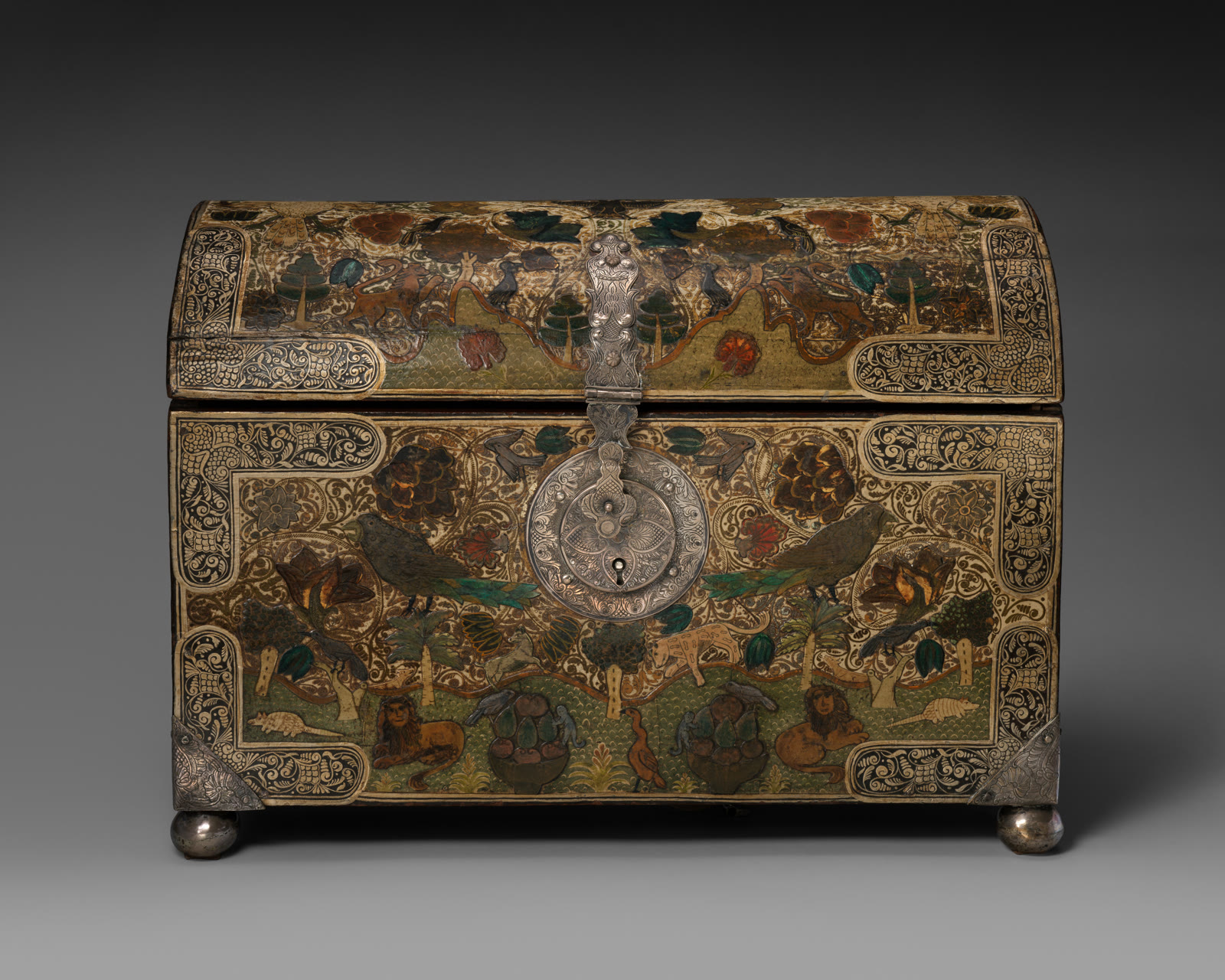
Image context: this article uses one verified museum photograph of the exact early-eighteenth-century Colombian chest under discussion. The Metropolitan Museum of Art identifies its materials as wood, barniz de Pasto lacquer, and silver; the archival reproduction is public domain, photographic, and has not been generated or analytically altered.[1]
The chest seems to have caught light under its skin. Red petals, green leaves, pale scrolls, parrots, monkeys, jaguars, and armadillos crowd its burnished surface, but the color does not sit there like ordinary paint. Some passages gleam as if metal were shining through stained glass. Others rise by a fraction above their neighbors. The silver fittings belong to the box; the more elusive metallic flicker appears to belong to the image itself.
The Metropolitan Museum of Art dates this chest to the first half of the eighteenth century and attributes it to an unknown artist in the Viceroyalty of New Granada, in present-day Colombia. At 62 centimeters wide, it is furniture on an intimate scale, dense enough to reward the distance one might give a manuscript.[1] Its surface was made with barniz de Pasto, or Pasto varnish, a name that is useful geographically and misleading materially.
Varnish normally suggests a liquid brushed over a finished object. Mopa-mopa, the resin at the center of this technique, follows a stranger route. It is gathered from resin-rich leaf buds, cleaned and softened, kneaded with color, stretched while warm into a membrane, cut with a blade, and pressed onto wood. A design may be assembled from many such pieces, with translucent resin laid over silver leaf to hold light inside the pattern.[2][4] The chest is not merely coated. It is laminated, one sliver of color at a time.
The material begins in a wet forest
The first studio is far from Pasto. Species of Elaeagia, a genus in the coffee family, produce hard, resinous structures around developing leaf buds. The species associated with the living Colombian practice is Elaeagia pastoensis, found in the Andean forests around Mocoa in Putumayo. Its resin is unusual among the natural resins used in art: it is largely insoluble, yet heat and working can turn it from a hard mass into an elastic material that accepts color and stretches without immediately tearing.[2]
That botanical fact determines the social shape of the medium. UNESCO describes three linked trades rather than one solitary artist: harvesters in Putumayo gather mopa-mopa with detailed knowledge of forest paths, plant condition, timing, and careful picking; carpenters, turners, and carvers in Nariño prepare the wooden forms; varnish masters in Pasto transform and apply the resin.[3] A decorated chest therefore begins as a relay across terrain. Forest judgment, woodworking, and surface design are not background services around the art. They are its material grammar.
Harvesting also imposes a limit that cannot be solved at the decorating table. Resin is not an industrial film arriving in identical rolls. The buds must be reached without damaging the plant, then carried out of a landscape under pressure from deforestation, climate change, and more profitable forms of work. In 2020, UNESCO placed the associated knowledge and techniques on its List of Intangible Cultural Heritage in Need of Urgent Safeguarding, citing threats to raw materials, access, workshop conditions, and transmission among generations.[3] The fragility of the practice begins before the finished object can be fragile.
Heat turns a lump into a membrane
Raw mopa-mopa does not look ready to draw. Makers repeatedly soften it in hot or boiling water and remove bark, twigs, and other plant matter. Working and reheating make the mass increasingly clean and pliable. Dyes or pigments can be folded in by kneading, changing not only its hue but its opacity. The warm resin is then pulled outward between makers until it becomes an exceptionally thin sheet.[2][4]
This is the decisive transformation. Oil paint remains a paste carried by a brush. Gold leaf arrives as a sheet but cannot supply its own red, green, or blue. Mopa-mopa occupies the space between: color has a body thin enough to transmit light, but firm enough to lift, cut, turn, and place. The Victoria and Albert Museum's technical study describes makers stretching the resin without tearing, slicing shapes with a blade, pressing warm film onto wood or gourd, and sometimes twisting two colors into threads or cross-hatching a sheet for shading.[4]
The material usually needs no separate adhesive. Warm resin bonds to the support—or to another layer of itself—as it cools.[2][4] That property makes the knife as consequential as the hand that stretches. A curve can be cut from the center of a nearly translucent sheet, a narrow strip can become a contour, and one color can be fitted against or over another. On the Met chest, the density of small animals and scrolling foliage is therefore also a record of subdivision. What looks continuous from across the room was constructed from edges.
Historical descriptions often linger on chewing because mastication was one way to soften, clean, and mix the resin. It should not be turned into an exotic shortcut for understanding the art. Contemporary documentation also records hot-water processing and mechanical grinding, while methods vary among periods and workshops.[2][3][4] Art historian Catalina Ospina argues that attention to oral production can instead recover the bodies and knowledge of Indigenous makers whom colonial object histories have often rendered anonymous.[6] The mouth matters here as labor and technique—not as spectacle.
A blade lets color behave differently from paint
Cut film changes how an image is planned. A brush can taper a wet line through pressure and speed; a resin strip has to be stretched, cut, positioned, and made to follow the support. Its thickness remains part of the result. Overlapping pieces produce slight relief. Fine joins turn the wooden surface into a shallow topography, even when the pattern reads as fluid.
That helps explain the chest's peculiar balance of abundance and control. Its flowers and creatures do not dissolve into painterly atmosphere. Each motif keeps a clipped clarity, while the glossy field joins hundreds of decisions into one skin. Curved leaves can repeat without becoming identical because every fragment has passed through warm hands and a blade. The technique encourages pattern, but it does not require mechanical sameness.
The word lacquer can also blur an important distinction. Mopa-mopa is not urushi, the sap-based East Asian lacquer that cures through a different chemistry and is commonly applied in liquid layers. Colonial barniz de Pasto objects entered a world fascinated by Asian lacquerware, and their forms and visual effects participated in long-distance exchange. Yet the Colombian technique was not a provincial imitation made from an inferior substitute. Its membrane method, rooted in Indigenous material knowledge, posed its own design problem: how to make a forest resin carry line, color, relief, and reflection at once.[2][5]
Technical analysis makes that inventiveness visible. Research on seventeenth-century objects at the Hispanic Society Museum & Library has identified indigo, insect-derived reds, calomel, lead white, and other colorants within complicated surface structures. It has also shown that there was no single immutable recipe: layers, grounds, pigments, and metallic elements vary by object, and some materials once proposed as dating clues appear across a less tidy chronology.[5] “Traditional” here does not mean chemically static. It names a field of practiced experimentation.
Silver makes the film hold light
The most dazzling variant is known as barniz brillante. A maker lays silver leaf within the construction and covers it with translucent, colored mopa-mopa. The metal returns light through the tint, so silver can appear green, red, blue, or gold without ceasing to shine. The 2023 scientific review compares this optical structure to a colored glaze over metal leaf, but its material logic remains distinct: the upper color is a cut resin membrane rather than a brushed film.[2]
Microscopic cross-sections turn the shimmer into a stack. In examined colonial objects, researchers have found transparent colored resin layers only tens of micrometers thick over silver, as well as thicker resin strata that lift motifs slightly from the background. Another study found silver distributed across a glossy coffer in a way consistent with leaf beneath the colored sheets.[2][5] These measurements do not drain the magic from the surface. They locate it. Light crosses dye-bearing resin, strikes metal, and returns through color; relief changes the angle at which that exchange reaches the eye.
Look again at the Met chest and the ornament no longer seems painted onto a dark box. It behaves more like a shallow, flexible mosaic whose tesserae are membranes. A bird can be both a flat silhouette and a reflective event. A flower can change intensity as the viewer moves. The wood supplies volume, but the resin-and-silver laminate gives the object weather: flashes that arrive and recede across the lid and front.
The silver also introduces a conservation bargain. Protected beneath mopa-mopa, it can remain bright; where the resin is lost or compromised, metal and color become more vulnerable.[2] The same thinness that makes light travel also gives damage an edge to catch. Preserving barniz de Pasto therefore means preserving an interface among organic film, metallic leaf, pigments, and wood—not simply cleaning “varnish” from furniture.
The surface is a chain of knowledge
The Met's unknown artist cannot be recovered by attaching a convenient name to the chest. Anonymity should instead make the work's dependencies more legible. Someone knew when to enter the Putumayo forest and which buds could be taken. Someone cleaned and worked resin until it would stretch. Someone prepared the wooden carcass and silver hardware. Someone understood how a translucent green would change over metal, how tightly a curve could be cut, and how hundreds of fragments could remain coherent across hinges, borders, lid, and front.[1][3]
Those skills traveled through families, workshops, guild relationships, observation, and repetition. UNESCO's safeguarding account stresses that transmission is embodied and social; an instruction sheet cannot replace access to plants, tools, experienced hands, or time beside a master.[3] Contemporary apprenticeship efforts matter for precisely that reason. They do not preserve a frozen eighteenth-century recipe. They keep the chain capable of making new judgments.
Barniz de Pasto asks for a revision in how a surface is read. A finish is often treated as the last, thinnest, least structural part of an object. Here the surface contains a geography, a division of labor, a material science, and a history of colonial demand answered through Indigenous technique. Its depth may measure only fractions of a millimeter, but conceptually it reaches from an Andean leaf bud to a varnisher's blade and onward to the changing light around a chest.
Mopa-mopa does not disguise wood by pretending to be paint. It gives color another physical state. Resin becomes sheet; sheet becomes cut edge; cut edges become animals, flowers, and reflected light. The name says varnish. The object answers with a membrane.
Sources
- The Metropolitan Museum of Art, “Chest” — official object record, dimensions, materials, geographic and period attribution, curatorial description, and public-domain photograph for the early-eighteenth-century barniz de Pasto chest.
- Richard Newman, Emily Kaplan, and Maria Cecilia Álvarez-White, “The Story of Elaeagia Resin (Mopa-Mopa), So Far,” Heritage 6, no. 5 (2023) — peer-reviewed review of botany, material properties, terminology, historical use, film application, colorants, and silver-layer structures.
- UNESCO Intangible Cultural Heritage, “Traditional knowledge and techniques associated with Pasto Varnish mopa-mopa of Putumayo and Nariño” — official 2020 safeguarding record on the three linked trades, transmission, harvesting knowledge, and threats to continuity.
- Lucia Burgio, Nick Humphrey, Dana Melchar, Lucia Noor Melita, and Valentina Risdonne, “Mopa Mopa and Barniz de Pasto at the Victoria and Albert Museum: Recent Developments,” Heritage 7, no. 9 (2024) — museum study of resin preparation, stretching, cutting, bonding, layering, metallic effects, and conservation.
- Elena Basso et al., “Seventeenth-Century Barniz de Pasto Objects from the Collection of the Hispanic Society Museum & Library: Materiality and Technology,” Heritage 7, no. 5 (2024) — technical imaging and analysis of layer structures, silver leaf, pigments, dyes, and variation across colonial objects.
- Yale Institute of Sacred Music, “The Art of Chewing: Mopa Mopa Objects in the Colonial Andes” (February 16, 2022) — interview with art historian Catalina Ospina on oral production, Indigenous makers, colonial interpretation, and embodied knowledge.