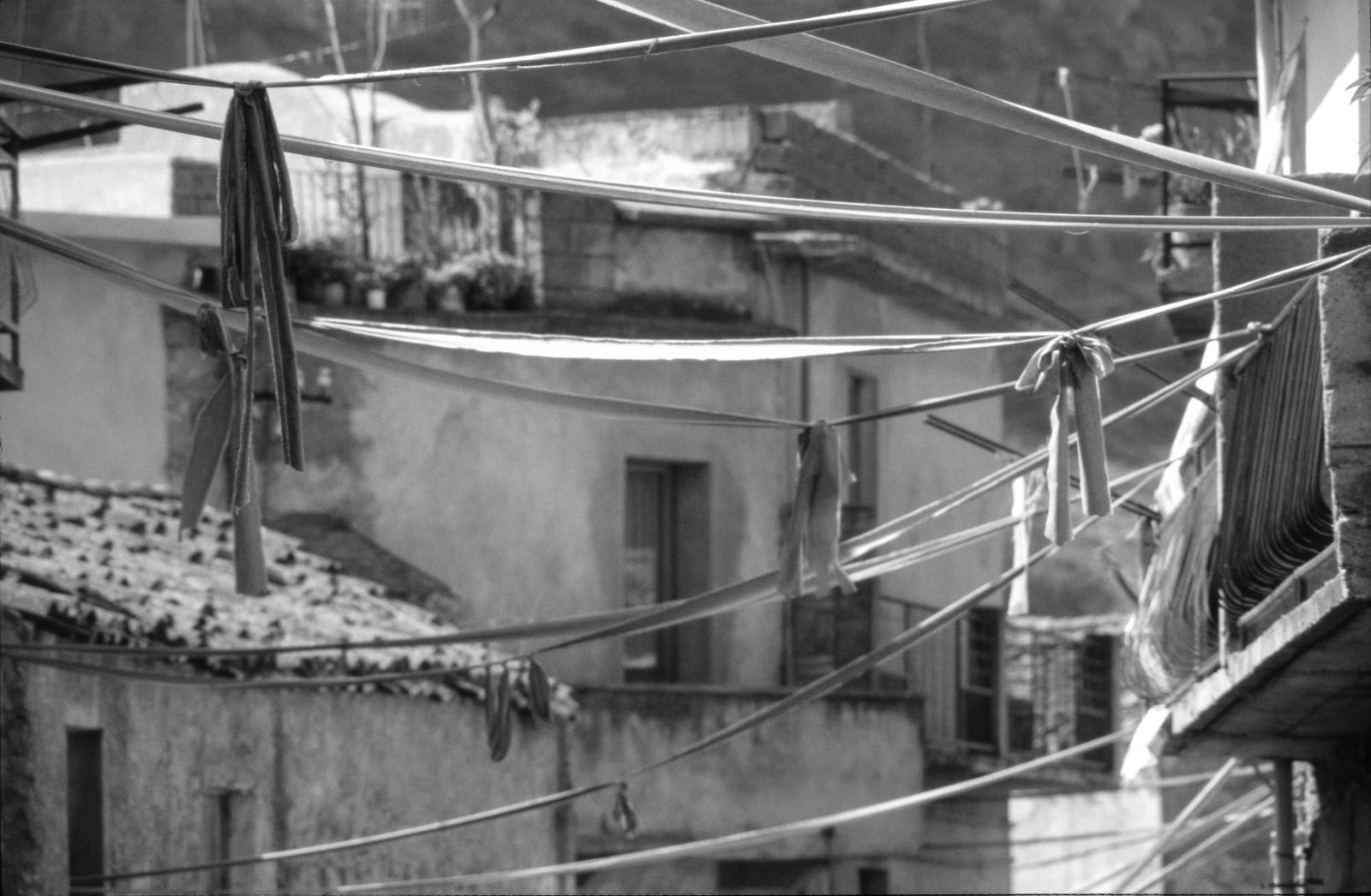
Image context: the cover is one real archival photograph of Maria Lai's 1981 collective artwork Legarsi alla montagna, not a reconstruction, diagram, or generated visual. It shows the exact intervention discussed here: ribbons suspended between buildings in Ulassai, photographed by Piero Berengo Gardin as the temporary work passed through the village.[4][5]
The line looks too light to hold anything. In Piero Berengo Gardin's black-and-white photograph, broad ribbons sag between the stone buildings of Ulassai, catching on balconies and crossing the street overhead. No single strip dominates the scene. The work appears instead as an interruption of ordinary routes: a soft material where one expects wire, masonry, laundry, or sky.
That modest line is the key to Maria Lai. She worked with wood, bread, cloth, books, paint, clay, public buildings, stories, and performance, but her deepest medium was relation. A thread could join two pieces of fabric, imitate writing, map an invented constellation, lead a reader through a fable, or expose the emotional distance between neighboring households. By 1981, in Legarsi alla montagna, it could ask an entire Sardinian village to decide what kind of connection it was willing to make visible.[1][2][4]
Calling Lai a textile artist is accurate and insufficient. It names the material but misses the verb. She did not simply make art from thread. She made thread perform the difficult work of linking things that remained distinct.
Before thread, there was weight
Lai was born in Ulassai in 1919 and encountered art first through teaching, literature, drawing, and sculpture. The Fondazione Maria Lai chronology records early lessons with the Sardinian sculptor Francesco Ciusa, study with Renato Marino Mazzacurati in Rome, and training from 1943 to 1945 in Arturo Martini's sculpture class at the Accademia di Belle Arti in Venice.[1] Those years matter because the work that later looked weightless came from an artist educated to think about mass.
Her early career followed recognizable paths: drawing, painting, teaching, exhibitions. Then, between 1961 and 1970, she largely withdrew from exhibiting and began testing wood, thread, bread, and cloth. In 1971 she showed her Telai, or Looms—assemblages in which wooden frameworks and stretched fibers make the apparatus of weaving more visible than any finished textile.[1] MAXXI describes this shift as thread becoming both the material and the concept of the work.[2]
The loom gave Lai a structure without forcing an image. A warp is an arrangement of tensions before it is a picture; every strand gains function through its relation to the others. Lai could therefore keep the sculptor's concern with weight, balance, edge, and interval while replacing the solid block with a field of lines. The frame did not contain a composition so much as stage a set of dependencies.
This was not a retreat into nostalgic craft. Everyday and traditionally domestic materials gave Lai a grammar for making connection physical. The thread remained humble enough to be handled, knotted, cut, or passed onward. At the same time, it could cross a gap without pretending the gap had vanished.
A line learns to write without explaining
During the late 1970s, Lai's lines left the loom. She made Libri cuciti—sewn books whose stitched pages resemble writing—and Geografie, fantastic celestial maps assembled in paper, fabric, and machine-sewn thread.[1] At Documenta 14, these strands of her practice appeared together: looms, sewn canvases, a Pagina, bedsheets, geographies, bread books, and the photographic record of Legarsi alla montagna.[3] Seen as a group, they make a career look less like a series of medium changes than a line repeatedly changing scale.
The sewn books are especially revealing. They retain the form of knowledge—a page, a sequence, marks moving across a surface—while refusing a single verbal message. MAXXI connects their invented writing to childhood, pre-alphabetic imagination, literary gifts, and forms of knowledge made collectively rather than delivered as fixed instruction.[2] The thread can be followed, but not translated word for word.
That refusal is generous rather than obscure. A conventional sentence tells readers how its signs should be ordered. Lai's stitched scripts make sequence visible while leaving interpretation open. The reader has to become an active participant: tracing, turning, comparing, and inventing relations among marks. Even before Lai invited a town to enter one of her works, she was making objects that could not be completed by passive looking.
Her Geografie extend the same problem outward. A stitched line becomes an astronomical route; knots and intersections suggest constellations that belong to no settled atlas. MAXXI reads these works as invitations to imagine unknown worlds and to join distant points.[2] The cosmos, like the book, is not illustrated. It is proposed as a structure that another mind must navigate.
The village becomes the loom
In 1981, the scale changed radically. Ulassai had invited Lai to make a conventional memorial. She answered with a work that would have no single privileged object and could not exist without local participation. Drawing on a village story about a girl who escapes a collapsing cave after following a blue ribbon, Lai proposed running blue denim through the town and up toward the mountain above it.[4][5]
The resulting work, Legarsi alla montagna—usually translated as To Bind Oneself to the Mountain—unfolded over three days in September. Residents cut and carried nearly 17 miles of fabric through streets, around houses, and between balconies; climbers took the final line onto the mountain.[5] The statistic conveys scale, but not the work's intelligence. Lai did not ask the ribbon to symbolize an easy, undifferentiated unity.
Instead, the line carried a social code. Between households joined by friendship, the ribbon received a knot. Where family attachment or affection linked people, a ceremonial bread was added. Where relations were hostile, the ribbon continued without decoration.[4] The empty interval was not a failure to finish the artwork. It was one of its most exact signs.
That decision prevents Legarsi alla montagna from becoming a sentimental story about art curing disagreement. The village did not have to pretend that every relationship was warm. It had to negotiate a continuous route through actual affiliations, resentments, intimacies, and refusals. Lai made connection visible without making sameness the price of participation.
Here the artist profile turns inside out. Lai devised the proposition, selected the material, worked through the legend, listened to residents, and set the conditions. But no studio assistant could fabricate the work on the village's behalf. Its form depended on local knowledge: who could approach whom, where a line could pass, which bond deserved bread, where only an undecorated strip could remain. Authorship became distributed without becoming anonymous. The work is recognizably Lai's because she designed a situation in which other people's decisions had formal weight.
A temporary work acquires a second surface
The physical intervention disappeared. Its photographic life did not. Documenta 14 listed black-and-white photographs of Legarsi alla montagna by Piero Berengo Gardin among Lai's works, while the 2021 book co-published with the Fondazione Maria Lai describes how she later marked some of his images with blue felt-tip pen.[3][4] Documentation became more than proof that an event had happened. It gave the vanished ribbon another surface on which to travel.
The cover photograph used here remains black and white. Ribbons hang between buildings, their original blue unavailable except through the caption and the reader's imagination.[5] That absence is productive. The image preserves the work's architecture—stone, street, balcony, span—while reminding us that photography cannot restore the residents' negotiations or the movement of fabric from hand to hand. The archive keeps the line and loses the event.
Lai's later interventions on photographs answer that loss without concealing it. A blue mark laid over a documentary image is plainly subsequent. It does not pretend to be the original ribbon; it reasserts the artist's line inside the record. The performance, photograph, and colored intervention form three different objects: collective action, witnessed trace, and remembered route.
This layered afterlife also clarifies why Lai's art resists a clean division between object and participation. The 1981 work required a town, yet it survives through images that can enter collections and exhibitions. The photographs stabilize a temporary event, but the event destabilizes the photographs: each static view points toward conversations, distances, and choices beyond its frame.
Relation is not the same as harmony
Lai's strongest work keeps a useful tension between binding and freedom. A stitch holds pieces together by piercing them. A loom orders threads by placing them under tension. A book binds pages while allowing them to turn. A map links points by crossing the space between them. Legarsi alla montagna brought those material truths into public life.
This is why its bare sections matter as much as its knots. If the ribbon had decorated every relationship identically, it would have reduced community to an image of agreement. By allowing difference to remain legible, Lai made the work less utopian and more demanding. Participation meant accepting a shared structure, not endorsing a shared feeling.
The mountain sharpened that distinction. It was not a scenic backdrop added to complete a picturesque composition. Ulassai lived under a landscape associated with shelter, danger, legend, and falling rock; the local story that inspired Lai made beauty and survival inseparable.[4][5] Binding the village to the mountain therefore did not tame nature. It acknowledged dependence on a force that could not be absorbed into civic design.
The blue line joined households to one another and the built settlement to its geological condition. Its softness was crucial. A monument in stone would have competed with the mountain in permanence and mass. Denim could move, sag, tear, pass through hands, and disappear. The work matched social relation not because relation is weak, but because it has to be maintained.
After the mountain, the thread kept widening
Legarsi alla montagna did not end Lai's movement into public space. MAXXI traces it into later projects in Ulassai, collective theater at Siliqua, and the 2008 action Essere è tessere in Aggius, where communal weaving joined her longstanding belief that “to be is to weave.”[2] Her practice moved among intimate objects and urban-scale encounters without treating one as preparation for the other.
The town also became a long-term site rather than the backdrop to one famous event. Lai developed permanent interventions around Ulassai, worked with others on the former public washhouse, and donated works that became the core of the Stazione dell'Arte, opened in a disused railway station in 2006.[1][2] A station was an apt home for an artist preoccupied with departure, return, routes, and connection.
Later exhibitions have made Lai increasingly visible beyond Sardinia, but the retrospective frame should not turn her into a solitary visionary whose village merely supplied material. The sharper legacy of Legarsi alla montagna lies in its authorship problem. Lai's achievement was not getting “ordinary people” to decorate her concept. It was constructing a concept that remained incomplete until their knowledge, labor, boundaries, and disagreements entered its form.
That is what it means to say Maria Lai made a village the author. She did not surrender authorship or claim the residents spoke with one voice. She changed authorship from possession into arrangement: who sets the conditions, who carries the line, who ties the knot, who leaves the interval bare, who remembers the route.
The ribbon in Berengo Gardin's photograph still looks too light to hold anything. That is its power. It holds no building up and resolves no feud. It makes relation briefly visible—strong enough to cross a street, flexible enough to register difference, and unfinished enough that everyone along its path has to decide what the line means.
Sources
- Fondazione Maria Lai, “Biografia Maria Lai” — official chronology covering Lai's birth and training, turn to wood, thread, bread, and cloth, the Looms, sewn books, geographies, Legarsi alla montagna, later collective works, and the opening of the Stazione dell'Arte.
- MAXXI, “Maria Lai. Tenendo per mano il sole” — official retrospective text on thread as material and concept, sewn books and geographies, participation, public-space projects, and Lai's continuing work in Ulassai.
- Documenta 14, “Maria Lai (1919–2013)” — institutional artist and work record listing looms, pages, geographies, bread books, and Piero Berengo Gardin's black-and-white photographs of Legarsi alla montagna.
- 5 Continents Editions, “Maria Lai: Legarsi alla montagna” — publisher's research note for the Fondazione Maria Lai co-publication, describing the participatory method, the ribbon's relationship code, and Lai's later interventions on Berengo Gardin's photographs.
- Lauren Moya Ford, “Why an Italian Village Tied Itself to a Mountain,” Hyperallergic (September 7, 2021) — account of the three-day Ulassai action, its legend and collective labor, and source page for the archival cover photograph.