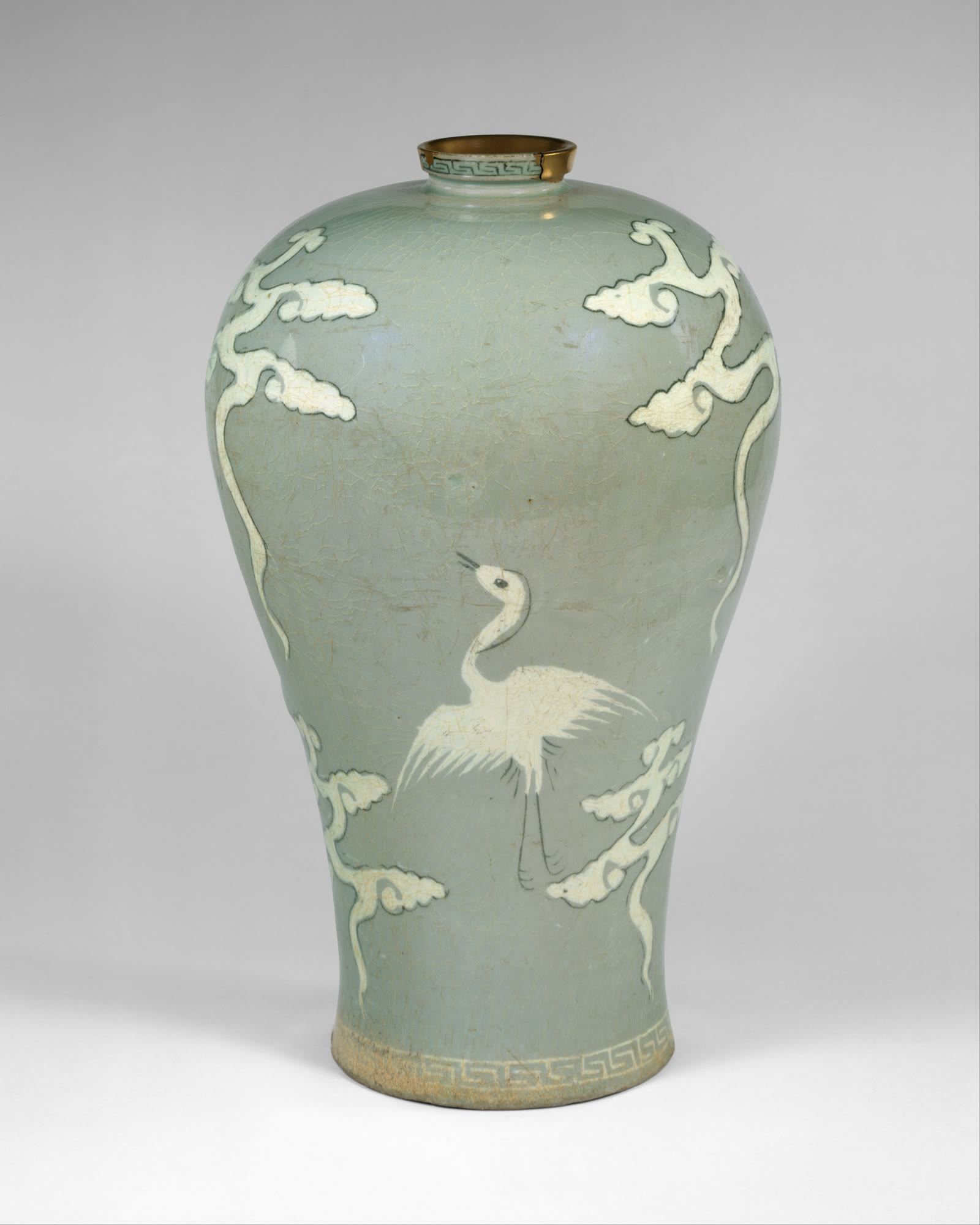
Image context: this article uses one verified museum photograph of the exact object under discussion, The Metropolitan Museum of Art's late-thirteenth-century Maebyeong (plum bottle) decorated with cranes and clouds. The reproduction is archival, public domain, and has not been generated or analytically altered.[1]
The crane near the center of the bottle does not fly across a flat sky. Its breast rounds forward with the clay. Its legs descend toward a body that narrows, while the clouds around it stretch, disappear at the vessel's edges, and continue beyond the photograph. Above, the shoulder swells so broadly that the small mouth seems to sit on a low horizon.
The Metropolitan Museum of Art dates this Korean maebyeong to the late thirteenth century, identifies its material as stoneware with inlaid design under celadon glaze, and traces its production to the kiln site at Buan Yucheon-ri in North Jeolla Province. At 29.2 centimeters tall, it was a vessel made for alcohol or another beverage, not a monument.[1] Yet its surface carries a world larger than its use.
That world is not simply painted onto the container. The gray-green field becomes open air; white cranes rise and descend through black-edged clouds; the curve of the bottle makes flight continue where sight cannot. The object turns a practical vessel into a private weather system.
The image begins below the glaze
The Korean inlay technique known as sanggam starts by cutting away material. A potter etched motifs into the dry clay body, filled the recesses with pale and darker slips, covered the whole vessel with a translucent celadon glaze, and fired it.[2] On this bottle, the Met explains, the large white cranes and clouds were filled with a pale clay mixture. A red clay mixture supplied the finer lines around clouds and the cranes' beaks, eyes, legs, and feathers; firing turned that filling black.[1]
This sequence changes the meaning of decoration. The cranes are not a detachable skin laid over a finished green pot. Their shapes occupy the pot's body before the glaze gives the surface its final optical unity. White, black, and gray-green meet beneath one glassy layer.
Inlay therefore creates a productive contradiction. The design is materially embedded but visually light. It has been cut, filled, covered, and fired, yet it reads as air, feathers, and vapor. The harder the process fixes the image into stoneware, the more effortlessly the scene seems to float.
That is why the glaze does more than color the undecorated areas. It passes over figure and ground together, softening the border between an object and the atmosphere pictured on it. The surface remains unmistakably ceramic—fine crackling and small tonal variations keep it physical—but it also behaves like depth. The eye looks at the glaze and, at the same time, through its translucence.
Green had to happen in the kiln
Goryeo celadon did not begin from nothing. During the Goryeo dynasty, which lasted from 918 to 1392, Korean potters adapted glaze and kiln technologies associated with Chinese celadon traditions. By the mid-twelfth century, major production had consolidated around Gangjin and Buan in the peninsula's southwest, while Korean potters and patrons developed increasingly distinctive forms and decoration. The Met describes inlaid celadon—rare in China—as the culmination of that development.[2]
Even the color was a collaboration among materials and atmosphere. Iron in the clay, iron and manganese oxides and quartz particles in the glaze, temperatures around or below 1,150°C, and a stage of firing with sharply reduced oxygen all helped produce Goryeo celadon's variable blue-green and gray-green hues.[2] “Celadon” can sound like a paint chip. On the vessel, it is closer to a recorded event: evidence of what clay, glaze, heat, and air did together.
The origin of sanggam is less tidy than a single invention date. Yun Yong-I's chronological study begins by noting that no surviving record says exactly when or how Goryeo inlaid celadon started. Working instead from dated tomb finds, kiln material, inscriptions, and formal comparisons, Yun argues that the technique's emergence is best placed in the 1150s.[3] The Met bottle, made more than a century later, belongs to a mature practice, not an isolated flash of discovery.
That longer history matters because the bottle's calm can disguise how many uncertainties had to be mastered. A recess had to be deep enough to hold slip but controlled enough to preserve a clean contour. Different clays had to survive firing together. A translucent glaze had to reveal the design rather than cloud it. Reduction firing had to turn chemistry into color. The serenity of the finished sky is the visible end of a sequence full of possible failure.
A curved surface has no single sky
A framed painting can establish a privileged rectangle. This bottle refuses one. Its swelling shoulder, compressed neck, tapered lower body, and circular plan make turning a condition of seeing. The photograph offers one lucid view, but clouds are already cut by both edges of the image. They do not stop there; the visible scene is a section of a design that wraps around the vessel.
The shape controls the pace of that wrap. Across the shoulder, the field expands and motifs have room to separate. Down the body, the circumference tightens and the sky seems to draw inward. A line that would remain straight on paper changes direction as the clay curves away. Near clouds appear broad; others slip toward the side and narrow. Volume becomes a kind of editing.
The National Museum of Korea makes a related point about Goryeo maebyeong designs: cranes often alternate upward and downward, creating harmony and spaciousness even when many birds occupy a limited surface.[4] The alternation is more than pattern balance. It keeps the vessel from acquiring a simple top-to-bottom narrative. Flight happens in several directions at once.
On the Met bottle, the clouds answer that motion. Their scrolling outlines echo the cranes' long necks and extended wings, while their wide spacing allows the gray-green glaze to operate as sky rather than filler.[1] Empty green is not unfinished space. It is the interval that lets each crane appear airborne.
The motif also carried cultural meaning. Both the Met and the National Museum of Korea connect cranes with longevity; the latter also identifies nobility as part of their symbolic register.[1][4] But symbolism alone cannot explain the object's force. A crane sign placed on a flat label could still mean long life. Here, the bird's meaning is joined to a bodily experience of looking: following a neck, losing a cloud around the curve, and imagining the flight continuing on the side one cannot see.
A container holds more than its contents
The maebyeong has a quiet conceptual doubleness. Inside, it held liquid. Outside, it holds air. Its narrow opening and ample body promise containment, while its cranes and clouds insist on release. The form gathers volume; the design disperses attention around it.
That tension makes refinement visible without making it loud. The surface is neither blank nor crowded. Black is reserved mostly for definition, white establishes the birds and clouds, and green performs the enormous task of joining everything into atmosphere. Luxury resides in calibrated intervals: enough untouched field for the glaze to breathe, enough contour for vapor and feathers to remain distinct, enough repetition for the eye to keep moving without finding a mechanical grid.
Highly refined celadons belonged to the aesthetic world of the Goryeo court, and the color, form, and decoration of these wares marked a conceptual as well as a technical change in Korean ceramics.[2] Still, the object should not be reduced to courtly taste floating free of labor and place. Its body points back to Buan's kilns, to raw materials, carving, slip, firing, and a chain of practiced judgments.[1][2] Atmosphere was manufactured.
The later repair at the mouth makes that fact harder to forget. The Met records lacquer resin mixed with powdered gold there, and the museum photograph leaves the intervention visible.[1] It would be easy to turn that band into a separate philosophy of beautiful damage. The more precise reading is simpler: this particular bottle was vulnerable, handled, broken, valued, and kept. The repair interrupts the illusion of a seamless sky just enough to return it to an object biography.
The bottle's greatest transformation remains below that repaired rim. Sanggam makes incision produce lightness. The kiln makes chemistry produce color. The vessel's curve makes a finite surface feel continuous. Cranes and clouds do not escape the stoneware; they reveal what the stoneware can become.
Goryeo celadon gave this bottle a sky, but not by making matter disappear. It made clay, slip, glaze, fire, and curvature agree—for one astonishing surface—to behave like air.
Sources
- The Metropolitan Museum of Art, “Maebyeong (plum bottle) decorated with cranes and clouds” — official record, curatorial audio transcript, object metadata, kiln attribution, repair note, and public-domain image for the late-thirteenth-century vessel.
- Soyoung Lee, “Goryeo Celadon,” Heilbrunn Timeline of Art History, The Metropolitan Museum of Art (October 2003) — dynasty context, raw materials, reduction firing, production centers, Chinese precedents, and the sanggam process.
- Yun Yong-I, “The Origin and Development of Goryeo Sanggam Celadon,” Horim Museum (1992), translated by Virginia Moon for the Smithsonian's Freer Gallery of Art — scholarly chronology based on excavated, inscribed, and datable ceramics.
- National Museum of Korea, “Celadon Maebyeong with Inlaid Cloud and Crane Design” — official gallery note on maebyeong form, crane symbolism, directional alternation, and the spacious effect of the wrapped design.