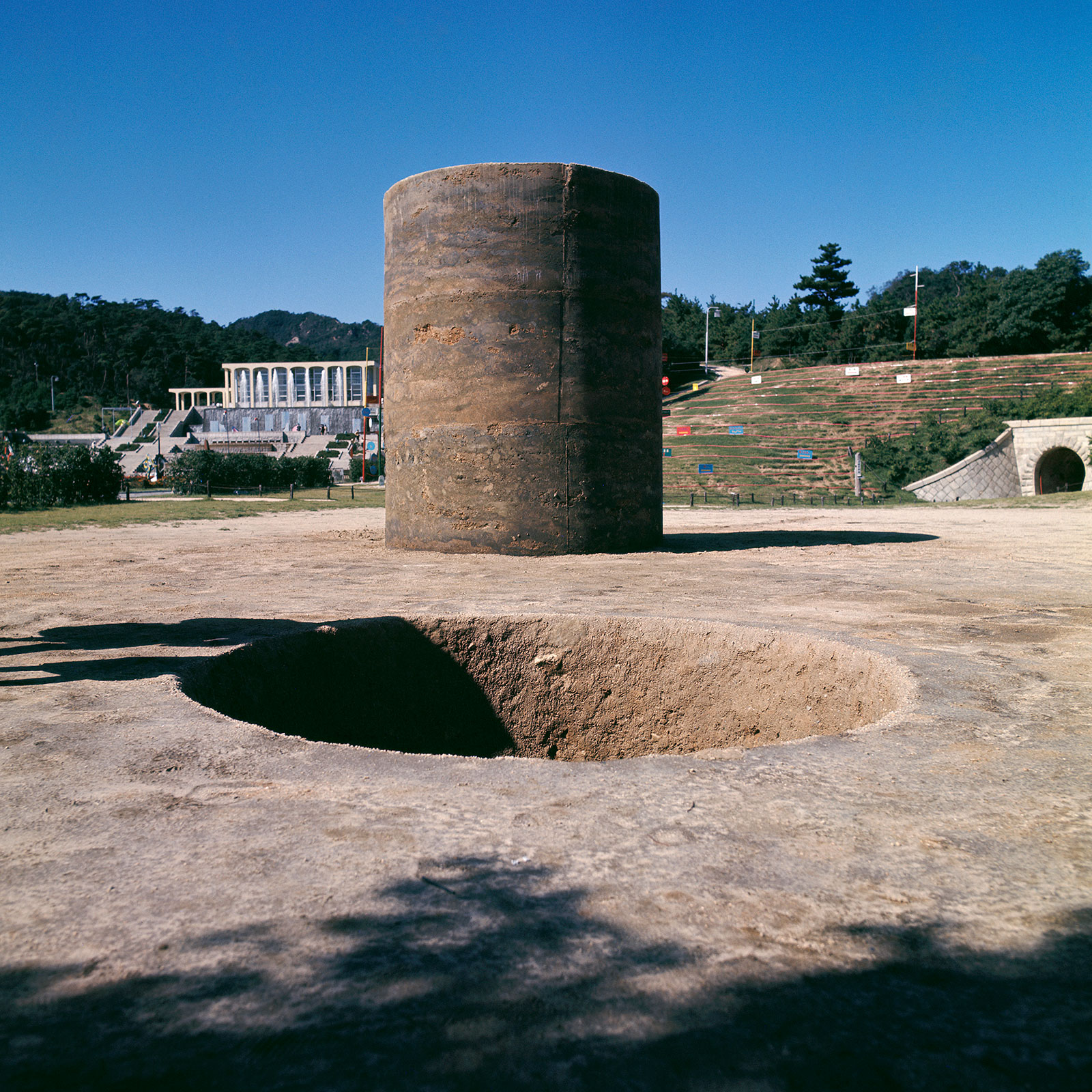
Image context: this article uses one real archival photograph of Nobuo Sekine's Phase—Mother Earth at its original 1968 installation in Kobe. The photograph is not a substitute for the vanished earthwork; it is evidence of a temporary arrangement whose meaning depended on that ground, that excavation, and the encounter between a solid mass and its corresponding absence.[1][7]
The photograph looks almost too plain for an origin story. A circular hole opens in a park. Beside it stands a cylinder of compacted earth, taller than a person, its layered sides visibly resisting collapse. Low buildings, trees, and an ordinary blue sky keep the scene from acquiring the romance of remote land art. Nothing has been transported to a wilderness. The ground has been made strange where it already was.
Nobuo Sekine created Phase—Mother Earth for the 1st Kobe Suma Rikyū Park Contemporary Sculpture Exhibition in October 1968. The excavated void and the upright mass had matching diameters of 2.2 metres; one descended 2.7 metres while the other rose to the same height. Earth and cement made the proposition physical.[1][7] It did not present soil as a noble substance or model the planet in miniature. It made a relation impossible to ignore: absence beside presence, below beside above, loose ground beside a precariously stabilized form.
That charged interval became one of Mono-ha's defining spaces. The movement's artists used stone, wood, cotton, paper, glass, steel, paraffin, water, and earth, but their real medium was often the temporary condition between things. A rock compressed a cushion. Glass threatened to break under another rock. Two pieces of timber held each other upright. A gallery floor became newly visible because material interrupted it. The artwork was no longer an autonomous object placed in a neutral room. It was an encounter among matter, force, site, viewer, and time.
A movement recognized after the fact
Mono-ha translates literally as “School of Things,” but the name can mislead twice. First, these artists did not assemble around a shared manifesto or stable membership. The National Museum of Art, Osaka describes Mono-ha as a tendency rather than a group governed by one doctrine, active from 1968 into the early 1970s.[1] Second, the “things” were not the final subject. Their arrangements were designed to loosen the familiar names and uses attached to them.
The label itself arrived from outside. Dia's account of Lee Ufan's early work notes that reviewers used “Mono-ha” derogatorily for artists arranging commonplace materials.[2] What sounded like an accusation—these people merely put things down—eventually became the movement's art-historical name. The insult preserved a useful tension. How little could an artist appear to do while still changing everything about what a material meant?
Sekine's earthwork is often treated as the catalytic answer. The National Museum of Art, Osaka traces a decisive shift to its appearance in Kobe and to Lee Ufan's subsequent interpretation of the work as an encounter with a new world.[1] But even this beginning should not be hardened into a creation myth. The museum also places Mono-ha beside earlier investigations by Jirō Takamatsu and other artists into the instability of real and represented space.[1] A network of teachers, students, exhibitions, protests, essays, and experiments preceded the convenient name.
The historical setting also resists a timeless story about “Japanese respect for nature.” Lee, a Korean-born artist and philosopher working in Japan, remembers the late 1960s as a moment when faith in industrial modernity was reaching a dead end amid political upheaval. He describes moving from destructive gestures—smashing glass or letting paper be ruined by wind—toward questions about relationships among objects, space, action, the made, and the unmade.[3] Mono-ha included stones and earth, but it also included plate glass, steel, wire, concrete, motor oil, and paraffin. Its field was not untouched nature. It was a postwar world where industrial and natural materials had already been forced into contact.
The thing was only one participant
Lee supplied the movement's most sustained theory. In his installations, a material rarely earns attention alone. Relatum (formerly Language), from 1971, places seven boulders on seven thick cushions. The stone's weight becomes visible through compression; the cushion's softness becomes visible through resistance. Neither component illustrates an idea independently. Each reveals the other.[2]
In 1972, Lee retitled his earlier sculptures Relatum, a word that shifts emphasis from a self-contained thing to something constituted through relation.[2] That linguistic move clarifies why the emptiness around Mono-ha works is not leftover room. Space has work to do. So does gravity. So does the spectator, whose changing position alters which contacts, pressures, and alignments become legible.
This is the difference between sparse sculpture and simple sculpture. A small inventory can generate a crowded field of consequences. A rock, a sheet of glass, and a floor bring weight, brittleness, reflection, danger, architecture, and the viewer's own cautious body into one situation. Mono-ha reduced fabrication without reducing attention.
The artist's role therefore changed rather than disappeared. Lee's recent account distinguishes imposing a complete design on the world from intervening partially enough for what is outside the artist to become perceptible.[3] “Not making” did not mean doing nothing. It meant declining to make authorship the only active force in the room.
Arrangement remained an exacting art
Kishio Suga's work makes that boundary especially clear. In Diagonal Phase (1969), two wooden elements push against each other while stones arrest their outward thrust. The angle must respond to the ceiling height and to the work's position in the gallery. Every component depends on the others, and every installation recalibrates the relation.[4] The materials are recognizable, but their usual state of rest has been disturbed.
Suga called his installations “situations,” emphasizing their mutability. His Abandoned Situation (1971) extended corrugated sheets, cement, water, and ink across the Tokyo Metropolitan Art Museum. The official work record lists its dimensions as variable and documents later realizations in Milan and at Dia Beacon.[5] The title suggests neglect; the construction demands care. Water must occupy the channels, the long horizontal spread must negotiate a particular floor, and each new installation must decide what continuity with 1971 can mean.
This is where the lazy summary of Mono-ha—raw materials left “as they are”—breaks down. Materials were cut, compressed, balanced, excavated, stabilized, folded, suspended, or allowed to change. Even Phase—Mother Earth, apparently the most elemental gesture of all, required cement to hold its cylinder upright.[7] The artists did not withdraw in order to reveal a pure voice already hidden inside matter. They composed conditions under which material could exceed the artist's plan.
Composition moved from silhouette to dependency. The decisive line might be the point where timber touches stone, where a cushion yields, where water ends against concrete, or where a viewer hesitates before glass. Mono-ha did not abolish form. It distributed form across a situation.
Photography inherited the temporary work
The cover photograph carries a second history. Many Mono-ha works were too large, site-bound, or short-lived to enter collections in their original condition. M+ curator Isabella Tam notes that some outdoor actions left no physical trace and that photographs became the only surviving records of many works.[6] In Osamu Murai's image, Phase—Mother Earth is both present and already becoming an archive.
That status changes how the photograph should be read. It accurately shows the matching cylinder and hole, the park, the scale, the layered earth, and the work's blunt geometry.[7] It cannot restore the drop into the excavation, the cylinder's weight at human height, the condition of the soil, or the knowledge that both forms occupied the same continuous ground. The camera fixes one view of a work whose argument unfolded through walking and comparison.
Later re-creations pose the inverse problem. They can restore scale and bodily encounter, but the site, matter, and historical pressure have changed. Suga's variable installations acknowledge this openly: the work persists not as an identical object but as a set of dependencies realized again under new conditions.[4][5] Mono-ha's afterlife therefore resides between photograph and reinstallation, neither of which can claim to be a neutral copy.
This instability is not a conservation failure added decades later. It follows from the movement's premise. If an artwork includes its floor, light, gravity, weather, and viewer, then no two encounters can be fully interchangeable. Documentation preserves a relation by transforming it; reinstallation revives a relation by renegotiating it.
The interval is the legacy
Mono-ha developed alongside Minimalism, Postminimalism, Land art, and Arte Povera, sharing an international turn toward material, process, and site. Dia is careful to describe these practices as historically connected yet distinct rather than treating the Japanese movement as a regional echo of Euro-American art.[2] That distinction matters. Mono-ha's protagonists responded to specific debates in Japan and Korea even as their exhibitions and ideas entered a wider field.
What the movement contributed was not a house style. A Sekine excavation, a Lee suspension, and a Suga situation do not look alike in the way that branded objects do. They share a redistribution of importance. The artist does less dominating, the object does less standing alone, and the space around it does less pretending to be empty.
Return to Murai's photograph and the interval begins to press forward. The cylinder is not a sculpture with a hole beside it; the hole is not a caption explaining the cylinder. Each makes the other imaginable as displaced earth. The park makes both feel contingent. The viewer supplies the comparison that lets one volume turn mentally into the other.
Mono-ha's “things,” then, were never merely things. They were participants in temporary arrangements that exposed how the world holds together: through pressure, adjacency, interruption, balance, memory, and change. The movement's most radical form was the relation no museum could put on a plinth—the charged space in which matter met everything outside itself.
Sources
- The National Museum of Art, Osaka, “Mono-ha Reconsidering” — institutional overview of the movement's loose formation, materials, historical precedents, and the catalytic role of Phase—Mother Earth.
- Dia Art Foundation, “Major Exhibition of Early Work by Lee Ufan, Pioneer of the Japanese Mono-Ha Movement” — movement context, the label's critical origin, Lee's relational theory, and details of early Relatum installations.
- M+ Museum, “Evoking a Cosmic Imagination: Lee Ufan in Conversation” (July 17, 2026) — Lee's firsthand account of the late-1960s context and his turn from destruction toward the made, the unmade, and relations among objects and space.
- Dia Art Foundation, Kishio Suga exhibition brochure — museum essay on Mono-ha, Suga's idea of “situations,” material interdependence, and the site-responsive structure of Diagonal Phase.
- Kishio Suga, “Abandoned Situation, 1971” — official work record with materials, original 1971 venue, archival photograph credit, later installations, and collection history.
- M+ Museum, “Expression Beyond Documentation: Japanese Post-War Photography” — institutional account of how photographs became essential records for ephemeral and site-specific Mono-ha works.
- Wikimedia Commons, “Phase—Mother Earth, 1968” — source page for Osamu Murai's archival cover photograph, with work dimensions, medium, original exhibition context, and verified licensing record.