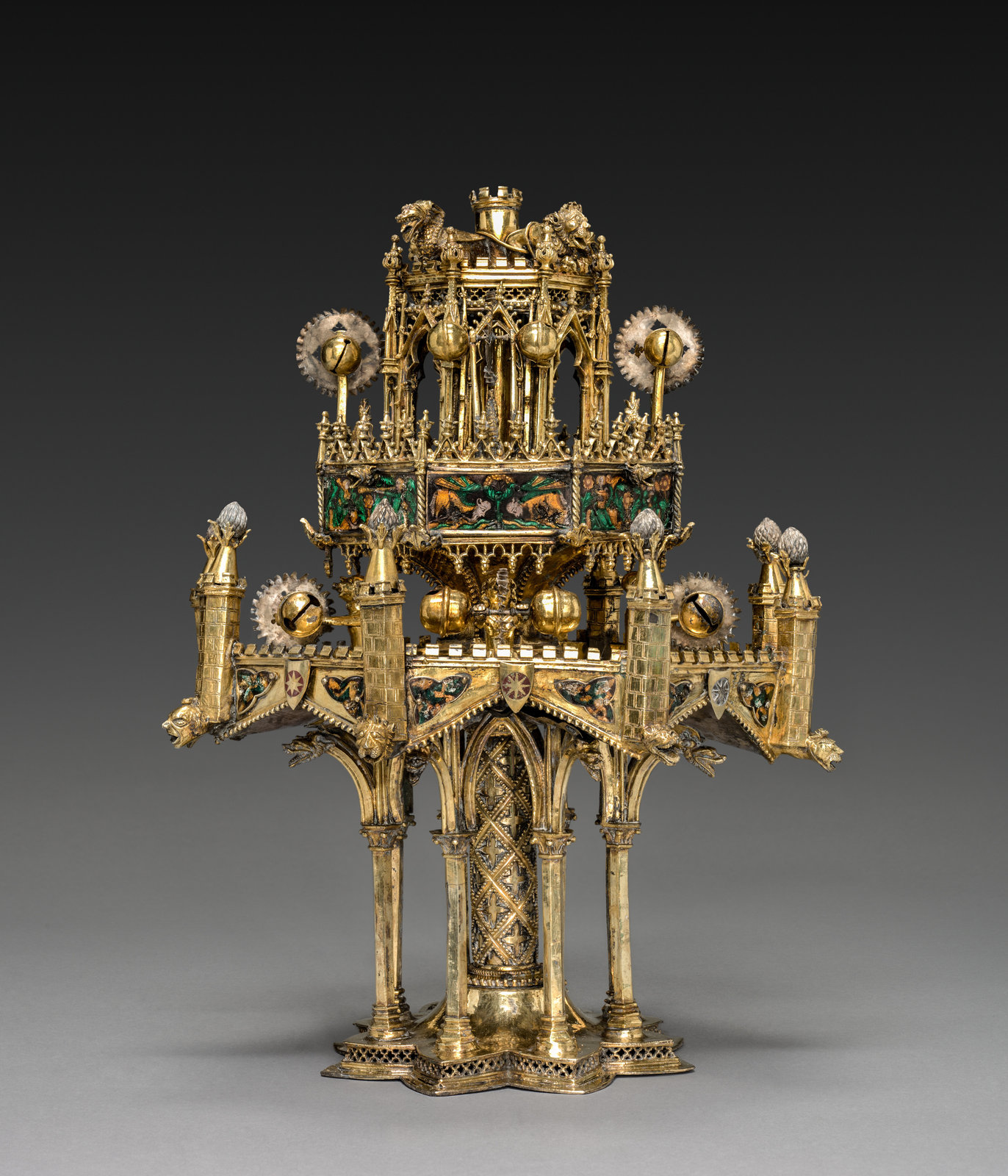
Image context: this article uses one real museum photograph of the fountain itself. It accurately records the surviving gilt-silver structure, enamels, wheels, and bells, but it also freezes an object designed to change through water, sound, and reflected light. Reading the photograph well therefore requires noticing both what it preserves and what a dry studio view cannot restore.[1][6]
On a museum page, the fountain resembles a tiny Gothic building after closing time. Arcades stand empty. Pinnacles climb toward a central turret. Small wheels wait beside bells that will not ring. Colored figures occupy the walls, yet the whole structure is held in the even silence of object photography.
That silence is useful, but false.
Made in Paris around 1320–40, the Cleveland Museum of Art's Table Fountain was not conceived as a motionless arrangement of gilt-silver and translucent enamel. Water entered through its center, appeared high in the structure, issued from animal and grotesque-shaped nozzles, struck feathered wheels, sounded bells, and descended through gargoyle drains toward a basin that no longer survives. The water may have been perfumed. The object did not merely represent a fantastic building; under pressure, it performed one.[1][2]
The fountain asks for a different definition of an artwork. Its visible metal was only the score. Pipes, water, gravity, sound, room, and waiting guests supplied the event; perfumed water may also have added scent.[2] What survives in Cleveland is precious and extraordinarily complete, but completeness here is a paradox: the better the dry object can be inspected, the easier it is to forget that stillness was never its finished state.
The photograph hides the verb
The museum's frontal photograph makes the fountain wonderfully available. It separates the fine gilt-silver structure from a neutral background and allows the eye to travel from the broad lower arcade to the narrower upper stages. One can count openings, compare wheels, and inspect the small bright rectangles of enamel without spray interrupting the view.[6]
Yet the image turns simultaneous action into an inventory of parts. A wheel becomes a circular ornament. A bell becomes a pendant. A spout becomes a tiny animal head. The current condition encourages nouns precisely where the original experience depended on verbs: water rose, jetted, struck, turned, rang, pooled, and fell.
This is more than a romantic attempt to imagine a lost atmosphere. The hardware carries a legible sequence. The fountain is a three-tiered assembly made from cast elements and bent sheets of gilt-silver. Enamel plaques, several showing grotesque musicians, are fixed to its sides. Water wheels occupy the route between nozzles and bells.[1] Even without running water, the object describes the work it once expected water to do.
The distinction matters because medieval metalwork is often encountered through the reverent quiet of a treasury case. Here, quiet is the condition of preservation, not the work's original meaning. The fountain's luxury lay partly in metal and color, but also in its ability to make matter behave on cue.
A building compressed into thirty-four centimeters
At 33.8 centimeters high, the fountain is smaller than its architectural confidence suggests. Parapets, traceried arches, columns, vaults, arcades, and pinnacles compress the visual language of Gothic construction into a structure that could be approached at arm's length.[1][2] It is not a model of one identifiable cathedral or palace. It takes architecture's signs of height, enclosure, hierarchy, and technical daring and makes them intimate.
Miniaturization changes power rather than simply reducing it. A great church organizes the body by making the visitor small. This fountain lets an elite viewer look down, around, and through a complete vertical world. Its tiers remain imposing in form while becoming possessable in scale. What stone architecture accomplishes through mass, the goldsmith re-created through precision.
But the miniature does not stay obedient. Once activated, water exceeds every clean boundary the metal establishes. It crosses openings, flashes against gilding, interrupts sight lines, and converts stable elevations into a descending route. The building becomes weather for itself.
That tension—between exact structure and unruly flow—is the fountain's central pleasure. The metal tells water where to go, but water makes the metal difficult to see in only one way. Highlights flicker. Enamels change under a wet sheen. Wheels turn from profile to blur. The architecture keeps its shape while its surfaces refuse to hold still.
Water wrote the score
The Cleveland curator Stephen N. Fliegel reconstructs the hydraulic sequence cautiously. Water was pumped upward through a central tube, then emerged at the top turret and through nozzles shaped as animals and drolleries. Jets drove the small wheels and set adjacent bells ringing. Water then passed from tier to tier and drained through gargoyle heads into a large catch basin.[2]
Each stage translated one force into another. Pressure became a jet. The jet became rotation. Rotation became percussion. Gravity then carried the flow down through the architecture. The fountain was not simply kinetic; it was a chain of conversions made visible and audible.
Scent could extend that chain beyond the eye and ear. Fliegel's account allows for perfumed water, while the museum's exhibition history places such fragrant hydraulic wonders within traditions known through courtly inventories.[2][3] The claim should remain conditional: no surviving liquid can prove what this particular fountain carried on a particular occasion. Even as a possibility, however, perfume clarifies the work's ambition. It could occupy a room without filling it physically, reaching people who were not yet close enough to inspect an enamel plaque.
The missing catch basin is therefore not a minor accessory. It completed the water's descent visually and practically, receiving the flow after its fall. The surviving tower can be photographed as a self-contained masterpiece, but its operation depended on an absent lower field. What museums preserve as the artwork and what once made the artwork work are not quite the same thing.
The room belonged to the mechanism
The familiar name “table fountain” encourages a banquet scene: a glittering device among dishes, pouring for diners. The evidence has made that picture less secure. Fliegel notes that manuscript banquet images show elaborate vessels but not table fountains. He instead proposes that the Cleveland object may have stood on a metal pedestal in an interior courtyard, or on a side table within a wall niche. Its water could have arrived through under-floor pipes from a cistern or reservoir.[2]
That reconstruction enlarges the object. A thirty-four-centimeter fountain may have depended on palace-scale infrastructure hidden beneath the floor. Its apparent autonomy was theatrical. The metalwork presented the miracle; pipes, stored water, pressure, and labor made the miracle repeatable.
Placement would also have controlled encounter. In a niche, the fountain could appear as a concentrated burst of sound and spray against architecture. On a courtyard pedestal, it could address people from several directions. Either setting makes it less like a utensil and more like an event staged along a route through a residence.
The room was not a neutral container around the art. Hard surfaces would carry the bells. If perfumed water was used, air could carry its fragrance.[2] Distance would determine whether the first signal was sparkle, trickling water, or sound. Guests might hear the work before they understood its scale. Its boundary lay wherever its effects stopped.
Precious metal kept unruly company
The fountain joined extravagant materials to comic life. Its translucent enamels belong to the sophisticated metalworking culture of fourteenth-century Paris, where royal and aristocratic demand supported exceptional production in precious metal, manuscripts, ivories, and enamel.[2] Yet the plaques and nozzles do not maintain a single solemn register. Grotesques, hybrid beings, animal heads, and musicians populate the ordered Gothic frame.[1][3]
Water made that company more disruptive. Gargoyles ordinarily send rain away from buildings; here, their miniature relations helped choreograph an indoor cascade. Musicians represented in enamel shared the object with bells producing actual sound. Architecture, image, plumbing, and performance folded into one another.
This mixture prevents “luxury” from meaning mere material expense. The owner displayed access to silver, enamel, skilled labor, and hydraulic knowledge, but also the capacity to produce surprise. Courtly refinement included delight in a mechanism whose seriousness was inseparable from play.
Nor was hydraulic spectacle an invention sealed inside Western Europe. The museum's exhibition account places medieval European table fountains within longer histories of mechanical and water-driven wonders associated with Byzantine and Islamic worlds.[3] The Cleveland object is intensely Parisian in style, but its ingenuity belongs to routes of knowledge larger than Paris. Courtly marvel was mobile before the fountain itself was made.
Rarity can distort the past
Today the fountain appears singular because survival has made it so. Cleveland describes it as the most complete medieval example of its type; inventories and wills, however, indicate that precious-metal fountains once existed in substantial numbers.[1][3] A scholarly review of the museum's 2016 catalogue notes two other surviving medieval examples, both fragmentary and later reworked.[5]
The imbalance between written abundance and material scarcity is easy to explain. A hydraulic object wears out. Fashion changes. Silver can be melted and converted into a new vessel or coin. The exhibition proposes precisely this cycle of return to the goldsmith's shop as one reason so few fountains remained intact.[3]
Rarity therefore creates two opposite temptations. One is to treat the survivor as a freak object with no meaningful category. The other is to make it stand in for every fountain mentioned in every inventory. Neither works. Cleveland's fountain is unusually complete, but it belongs to a once-populated field whose lost members varied in form and setting.
Its survival is evidence and accident at once. The object can show how a wheel hangs beside a bell; documents can show that courts owned other fountains. Neither can recover a standard experience that probably never existed. What we have is one dense point where material, text, and reconstruction meet.
The patron remains behind the spray
The visible fountain supports some claims more firmly than others. Its style and technique place it in early-fourteenth-century Paris. Its precious materials and complexity indicate an owner of very high status.[1][2] Beyond that, the spray thickens.
Fliegel connected eight star-bearing shields on the fountain to the French Order of the Star and proposed possible royal patrons, including John the Good or his father, Philip VI. Yet the shields cannot securely identify the original commissioner: the Order was established after the fountain's likely manufacture, Fliegel argued that its star devices would therefore have been added later, and the catalogue review notes that several are modern additions.[2][5] A newer research project led by Philippe Cordez at the German Center for Art History in Paris offers another context. It compares the fountain with the Fountain of Youth in the Roman de Fauvel, a politically satirical manuscript completed in 1317, and suggests that related makers or patrons may have been involved. On that reading, the object evoked the Paris royal palace as a multisensory source of renewal for the kingdom.[4]
The proposals are valuable because they explain different features: later stars, courtly setting, music, rejuvenating water, and the concentration of Parisian skill. They should not be collapsed into certainty. No name appears simply because an interpretation is vivid.
Uncertainty is not a blank space to be decorated. It is part of the fountain's history. The most responsible close encounter holds two things together: the mechanism is materially specific, while the political occasion remains open. Water certainly needed a route. Meaning had several.
An artwork completed in time
Return to the photograph and the dry wheels no longer look ornamental. They are pauses. The bells are stored sound. Every tier anticipates a future action, while the missing basin and pipes mark dependencies the museum object cannot contain.[1][2][6]
This is why the fountain matters beyond the category of medieval curiosity. It unsettles the habit of treating an artwork as identical to the durable material a museum owns. The surviving silver and enamel are indispensable, but they were built to recruit elements that could not be kept: moving water, possibly perfume, reflections, resonance, a room full of bodies, and a particular duration.
Its greatest luxury was not gilt-silver architecture made miniature. It was control over an unfolding experience. A concealed system delivered water; the fountain translated it into motion, color, sound, and perhaps scent; the room distributed those effects to viewers. Then the performance ended, leaving the architecture dry again.
Seven centuries later, the object remains poised between those states. The museum photograph gives us the silence with extraordinary clarity. The art begins when we understand that the silence is full of instructions.
Sources
- Cleveland Museum of Art, “Table Fountain” — collection record for the object's date, origin, dimensions, materials, construction, imagery, mechanics, and status as the most complete medieval survivor of its type.
- Stephen N. Fliegel, “Myth and Mystique,” Cleveland Museum of Art (August 22, 2016) — curator's reconstruction of the hydraulic sequence, possible scented water, architectural placement, Parisian goldsmithing context, and patronage hypotheses.
- Cleveland Museum of Art, “Myth and Mystique: Cleveland's Gothic Table Fountain” — exhibition account of the object's wider type, likely display context, mechanical spectacle, non-Western precedents, and the loss of comparable precious-metal fountains.
- German Center for Art History Paris, “La fontaine musicale de Cleveland (Paris, vers 1320)” — research summary comparing the fountain with the Roman de Fauvel and proposing a royal Fountain-of-Youth interpretation.
- Penny Howell Jolly, review of Myth and Mystique: Cleveland's Gothic Table Fountain, The Medieval Review (2017) — independent scholarly account of the catalogue's evidence, lost basin, later star additions, textual record, and two fragmentary related survivors.
- Wikimedia Commons, “Clevelandart 1924.859.jpg” — source page for Gary Kirchenbauer's Cleveland Museum of Art photograph, with verified object match, dimensions, provenance, and CC0 record.