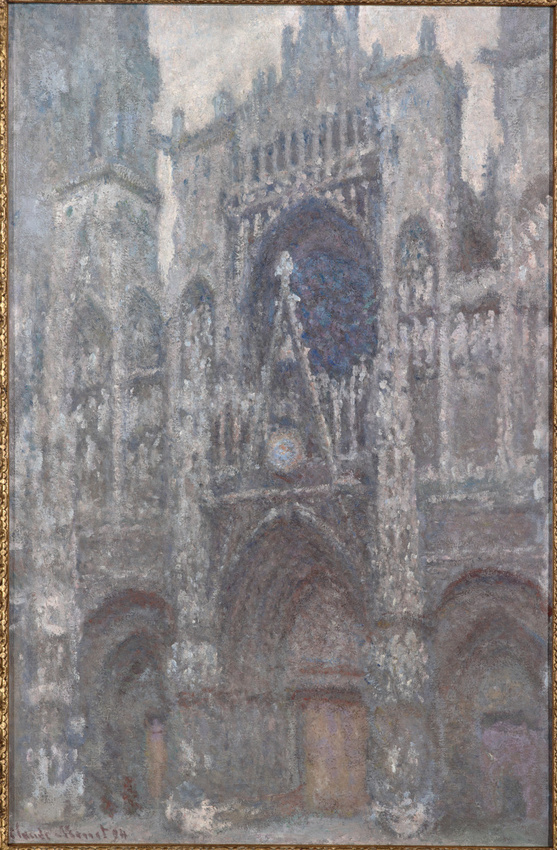
The Rouen Cathedral paintings are often introduced as proof that Claude Monet never tired of light. That is true, but it is still smaller than the achievement. What Monet discovered at Rouen was not merely a beautiful motif; it was a way to reorganize Impressionism itself. In this series, the cathedral stops behaving like a subject to be described and starts behaving like a constant against which differences can accumulate. Stone stays put. Weather shifts. Color shifts. The viewer's attention shifts. Painting becomes less a single impression than a controlled comparison among related canvases.[1][2][3]
That change matters because the series sits at a hinge inside Monet's career. The Met's object entry for Rouen Cathedral: The Portal (Sunlight) records that Monet painted more than thirty cathedral views in 1892-93, moving from one canvas to another as each day progressed, then finishing the works later in his studio at Giverny.[1] The Met's broader Monet essay pushes the same point further: the series paintings of the 1890s dominate his mature practice because they make repeated looking, rather than one-time capture, into the work's governing structure.[2] In other words, Rouen is where Impressionist sensation stops being enough on its own. It has to be organized, revised, and exhibited as a sequence.
Image context: the hero image uses the Musee d'Orsay's La Cathedrale de Rouen. Le Portail, temps gris because the title itself reveals the series logic. The painting is not named after a complete architectural identity; it is sorted by one atmospheric condition, "gray weather," as if cathedral and climate had become inseparable units of thought.[4]
The cathedral is a constant, not the subject
The National Gallery of Art's Rouen audio guide says the essential thing with unusual bluntness: the cathedral was chosen not for its spiritual implications, but as a neutral constant for recording the effects of light and atmosphere.[3] That observation helps explain why the paintings do not feel like devotional pictures, even though they are built from one of Europe's great Gothic facades. Monet is not asking the building to disclose its theology or civic symbolism. He is using it as an instrument.
Once that clicks, the series becomes easier to read. The facade is massive, old, carved, and stable, yet Monet keeps denying the viewer any secure stone identity. The western portal fills the canvas so aggressively that the cathedral loses some of its monumental distance and starts acting like a screen on which time of day and weather can register.[1][3] The architecture is still there, but it is there as a testing surface. When light hardens, the stone hardens. When gray weather flattens the day, the facade seems to turn porous and vaporous. The building is less a hero than a measuring device.
This is why the Rouen works feel different from a simpler plein-air exercise. Monet did not paint one facade once. He rented rooms across from the cathedral, kept multiple canvases in process, and moved among them as conditions changed.[2][3] The motif stayed constant precisely so the differences would become legible. Seriality is not an afterthought here. It is the method that allows atmosphere to become structure.
Serial painting changed what counted as finish
Rouen also changes the old Impressionist myth of spontaneity. The Met's essay notes that Monet often worked on large canvases outdoors and then reworked them in the studio, but in the 1890s this habit reaches a new level of ambition.[2] The object page for The Portal (Sunlight) makes the sequence concrete: Monet painted the cathedral campaign in 1892-93, then carefully adjusted the pictures at Giverny, both independently and in relation to one another, which is why many are signed and dated 1894.[1]
That matters for style. If the classic Impressionist fantasy is the direct seizure of a fleeting moment, Rouen shows Monet building fleetingness through revision. He is still dependent on changing light, but he no longer treats the first encounter with light as sacred. He compares canvases, recalibrates them, and finishes them as parts of a family. The result is not anti-Impressionist. It is Impressionism disciplined into a serial system.
The painting surface records that shift. In the Met entry, the brushwork of The Portal (Sunlight) is described as highly textured, making sculpted stone and palpable atmosphere arrive together.[1] The point is not that paint imitates masonry with archaeological fidelity. The point is that paint lets solidity and instability occupy the same surface. Light and shadow begin to feel as substantial as stone itself, a phrase the Met essay uses for the Rouen series more broadly.[2] Finish no longer means resolving the motif into stable form. It means calibrating how far form can dissolve without disappearing.
Titles and exhibition teach you how to read the series
The titles are part of that calibration. At the Met, the New York picture is The Portal (Sunlight). At the Musee d'Orsay, a related canvas is Le Portail, temps gris.[1][4] Those are not decorative labels. They tell the viewer what unit of meaning matters. The paintings are not being differentiated by narrative episode or architectural symbolism. They are being sorted by condition: sunlight, gray weather, fading light, morning clarity, bluish shadow.
Once titles start doing that work, the cathedral becomes a support for comparison. You do not approach each canvas as the definitive Rouen Cathedral. You approach it as one atmospheric proposition among others. That is why the 1895 Durand-Ruel exhibition matters so much. The Met notes that Monet exhibited twenty of the cathedral pictures there, and the Musee d'Orsay object page preserves the same exhibition history in its record for Le Portail, temps gris.[1][4] Seen together, these canvases would have taught viewers to compare weather, density, chromatic pressure, and time of day across repeated structure. The real artwork was not just a single facade. It was the oscillation from one facade-state to the next.
This is where Rouen begins to feel unmistakably modern. Serial display makes difference itself into the content. The subject is no longer exhausted by what the building is. The subject becomes what happens when the same thing is seen again, and again, under altered conditions. That logic travels forward into later modern art far beyond Monet.
Why Rouen still matters inside art history
The Met essay argues that Monet led the way to twentieth-century modernism by developing a style aimed at capturing the act of perceiving nature itself.[2] Rouen gives that claim a durable form. The cathedral series is not just about French weather or Gothic stone. It is about the instability of visual certainty. A building everyone assumes to be fixed becomes a field of variation. Looking stops being passive reception and turns into active comparison.
That is why the series still holds even in reproduction. One canvas may look gray, another blue, another almost overlit into cream and gold, but the deeper experience comes from mentally placing them beside each other.[1][2][4] The viewer begins doing what Monet did: testing constants against changes, asking what belongs to the motif and what belongs to the hour, the season, the studio correction, the title, or the neighboring picture.
Rouen does not abandon Impressionism. It reveals how much more pressure Impressionism could bear once Monet stopped treating one canvas as a complete answer. The cathedral remains standing. The method around it changes. That is the real breakthrough.
Sources
- The Metropolitan Museum of Art, Rouen Cathedral: The Portal (Sunlight), collection entry with object history, series context, and exhibition record.
- Laura Auricchio, "Claude Monet (1840-1926)," The Metropolitan Museum of Art Heilbrunn Timeline of Art History.
- National Gallery of Art, "Audio Tour Stop 162: Rouen Cathedral, West Facade, Claude Monet."
- Musee d'Orsay, La Cathedrale de Rouen. Le Portail, temps gris, object page and exhibition history.