Agnes Martin is often filed under the easiest visible fact about her work: the grid.[1][2][3][4] Thin graphite lines, pale bands, square canvases, almost nothing happening. That description is not false, but it is incomplete in the way a floor plan is incomplete. Tate's short film on Martin is useful because it shifts the question away from what the paintings look like at first glance and toward what kind of inner event they were built to stabilize.[1] The grids stop reading like cool systems and start reading like disciplined enlargements of something fragile: a sensation of calm, innocence, or beauty that first appears inwardly and then has to be carried into matter without being coarsened by too much personality.
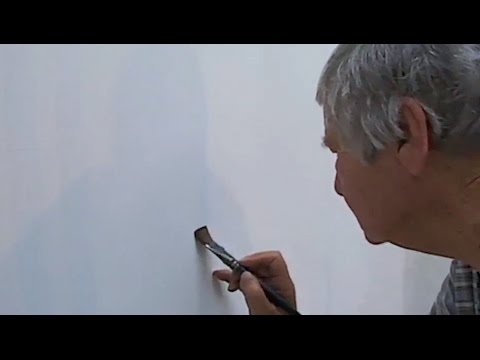
That is also why the video matters more than a standard artist-introduction clip. It uses rare archival footage of Martin in New Mexico, folds in Arne Glimcher's memories of her working habits, and lets Tate curator Frances Morris explain how much measurement and revision sits behind paintings that many viewers misread as effortless quiet.[1] The supporting written record points in the same direction. SFMOMA emphasizes that Martin's square compositions, ruled graphite lines, and muted bands were tied to ideas of joy, beauty, and perfection rather than to impersonal geometry alone.[2] Britannica and TheArtStory place her across several overlapping histories, from Abstract Expressionism to Minimalism, but neither classification is fully satisfying because Martin herself treated the painting less as an ideological object than as a way to tune perception.[3][4]
The result is a stronger way to enter the work. Instead of asking why these paintings look so restrained, Tate's film asks what had to be removed, recalculated, and refused before that restraint could appear at all.[1]
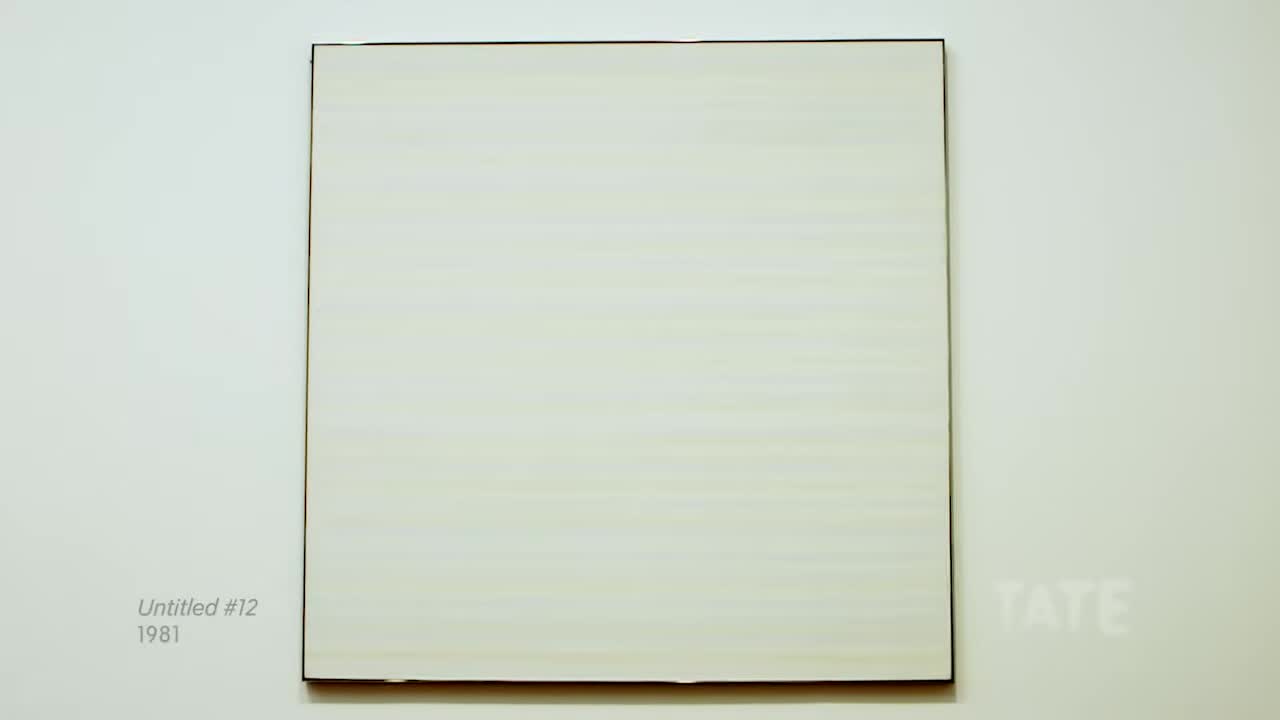
Image context: the cover image is a still taken from Tate's video at roughly the twenty-seven-second mark, where Untitled #12 (1981) appears on the wall as a pale, nearly atmosphere-like square. It fits this article because the film's central lesson is that Martin's paintings are not blankness in a casual sense. Their quiet depends on exact intervals that only begin to register when the viewer slows down.[1]
Around 0:25 to 1:30, the image begins as something inward and miniature
The first crucial move arrives early.[1] Martin describes asking for inspiration rather than generating ideas by force, and the film explains that the image first appeared in her mind at a very small scale, almost like a postage stamp, before being enlarged through careful mathematics to fit the self-imposed dimensions of the canvas.[1] That sequence matters because it prevents the grid from looking merely programmatic. The grid is not the originating idea. It is the structure that protects an originating sensation while it is being translated upward in size.
Once you hear the work described that way, Martin's reputation for serenity becomes harder and more interesting. SFMOMA notes that her paintings evoke joy, beauty, and perfection while remaining built from subdued color and loosely ruled graphite lines.[2] Tate adds the missing labor. The paintings are not spontaneous disclosures of peace. They are conversions. Something fleeting and inward has to survive scaling, drafting, spacing, and surface discipline without hardening into décor.[1] The hush of the finished object is therefore less innocent than it looks. It is manufactured calm.
That is also why Martin does not fit neatly inside the stereotype of Minimalism as detached industrial order.[2][3][4] Her means are reduced, but the reduction is being used to preserve delicacy, not to eliminate feeling. The grid behaves like a support for tenderness rather than a denial of it.
Around 1:55 to 3:55, innocence and beauty are relocated from objects to perception
The film's middle section contains the interpretive hinge.[1] Martin recalls waiting for inspiration about innocence, then seeing the grid come into her mind. Soon after, the film turns to one of her best-known teaching parables: a child sees a rose as beautiful; the rose is hidden; the beauty remains because beauty was never located in the object alone.[1] That small lesson is the key to the paintings. If beauty lives in perception rather than in the object's descriptive richness, then a painting does not need narrative incident, symbolic density, or visible drama in order to carry feeling.
This is the point at which many viewers either enter Martin's work or drift away from it. If one expects painting to provide explanation, her surfaces can seem withholding. Tate's film answers that problem directly by paraphrasing Martin's distinction between music, where people accept pure emotion, and visual art, where they demand a reasoned account.[1] Her grids are built to resist that demand without collapsing into vagueness. They narrow the pictorial field so that minute differences in interval, touch, and tonal drift do more of the work.
The written sources strengthen that reading. SFMOMA stresses that Martin saw her paintings as reflections of the innocence and beauty of nature, even though they remain abstract.[2] Britannica and TheArtStory both underline the spiritual and philosophical dimensions of her practice, from transcendentalism and Zen-inflected restraint to her refusal to treat the visible world as the only source of form.[3][4] Put beside the video, those facts suggest a cleaner conclusion: Martin's paintings are not about roses, skies, deserts, or horizons as depicted subjects. They are about what survives of those experiences after description has been pared away.
Around 4:15 to 5:40, the real drama is editing
The film becomes especially sharp when it turns from inspiration to destruction.[1] Frances Morris explains that Martin painted every day, kept only what met her standard, and was willing to cut up or repaint works that came close without arriving. This is where the myth of effortless quiet finally breaks down. Martin's surfaces do not come from passivity. They come from an editorial severity so strong that near-success was often treated as failure.[1]
That severity matters for the paintings themselves. A Martin canvas may initially look almost anonymous, but the film makes clear that anonymity was not the natural condition of the work. It had to be won against hesitation, overstatement, and the wrong interval.[1] TheArtStory and Britannica both emphasize how unusual her path was: years of experimentation, a break from New York, a move back to New Mexico, and later paintings that shifted from grids toward bands and stripes without abandoning restraint.[3][4] Seen through Tate's video, those biographical facts become technical facts. The calm in Martin is not a default mood. It is what remains after disturbance has been edited out again and again.
That is why the grid should not be mistaken for a shortcut. It is closer to a test. Can a hand move steadily enough, a line sit lightly enough, and a field stay open enough that the painting does not tip into either emptiness or fuss? Martin's achievement was not that she found a formula. It was that she kept the formula exposed to risk.
Around 6:40 to the end, the grid becomes a map rather than a cage
The closing minute of the film offers the best instruction for viewing the work now.[1] The repeated lines and pale color are compared to a mantra, and the painting is described as a map to inward response: joy, happiness, calm.[1] That analogy is useful because it rescues repetition from monotony. A mantra repeats not because it has nothing else to say, but because recurrence is the method by which attention is deepened. Martin's lines behave the same way. They keep returning so that the eye can stop looking for novelty and begin noticing pressure, breath, and minute deviation.
That is the article's main claim about the video. Tate does not make Agnes Martin easier by translating her work into biography alone.[1] It makes her work clearer by showing three linked operations: inspiration arrives small, beauty is lodged in the perceiver, and discipline is what lets an inward state survive enlargement into paint.[1][2][3][4] The paintings are quiet, but not because nothing happened. They are quiet because a great deal happened and almost all of it was pared down before it reached us.
Sources
- Tate, "Artist Agnes Martin - 'Beauty is in Your Mind' | TateShots," YouTube video.
- San Francisco Museum of Modern Art, "Agnes Martin" - artist biography on grids, muted palette, Coenties Slip, and New Mexico.
- Encyclopaedia Britannica, "Agnes Martin" - biography and movement context across Abstract Expressionism and Minimalism.
- TheArtStory, "Agnes Martin Paintings, Bio, Ideas" - overview of her development, methods, and philosophical framing.