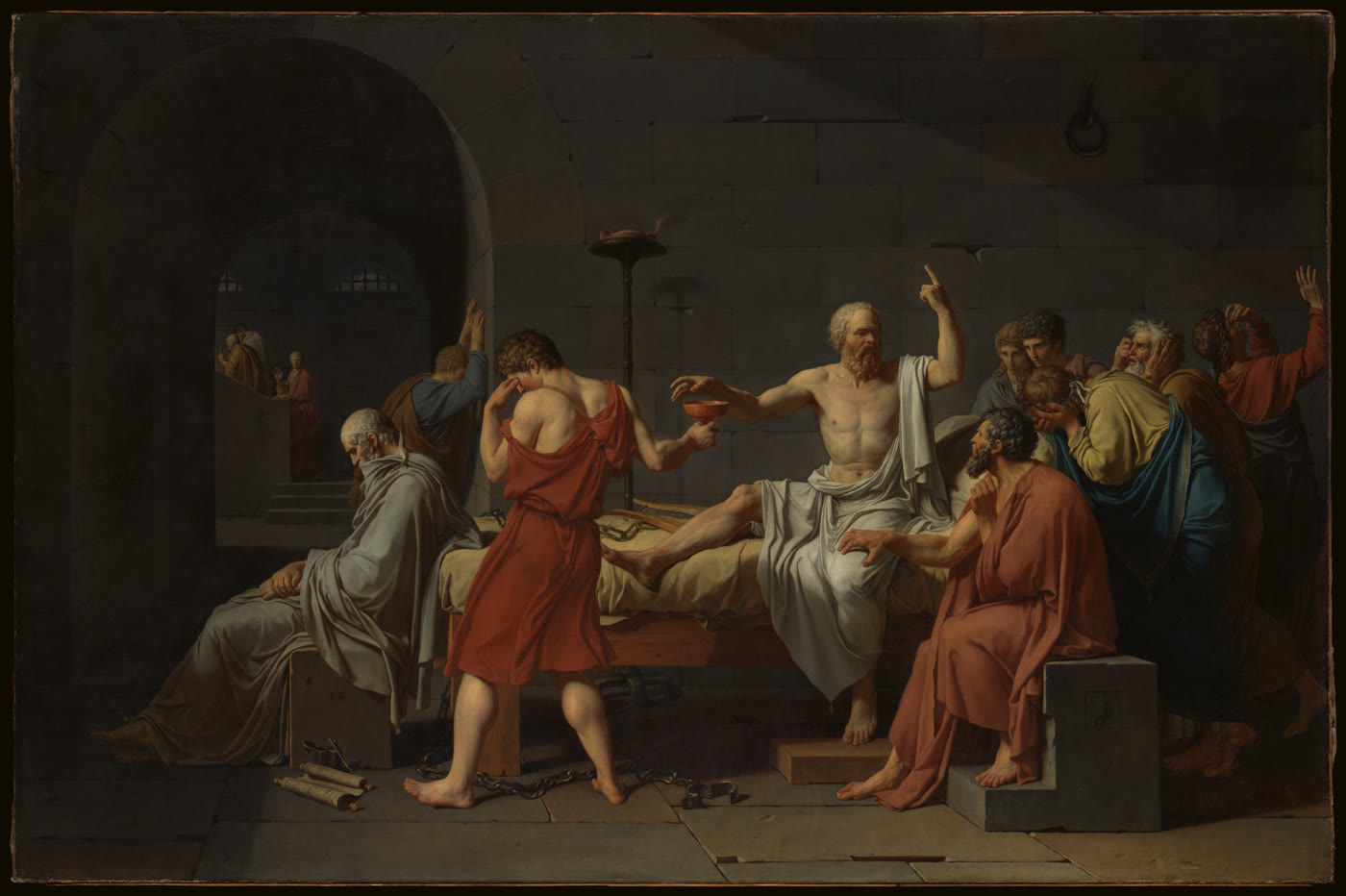
Jacques Louis David's The Death of Socrates is often remembered as a neoclassical sermon in paint: clear contour, hard virtue, ancient subject, moral lesson.[1][2] All of that is true, but it is not yet the reason the canvas keeps its hold. The painting's real force lies in delay. David gives us the instant before completion, when the cup has arrived but the poison has not yet been drunk, when the condemned philosopher is still speaking, and when everyone else in the room has already begun to live in the aftermath.[1][3][5] Conviction and grief occupy the same space, but they do not move at the same speed.
That tension is easiest to feel once scale is restored. The Met records the canvas at 129.5 by 196.2 centimeters, wide enough that the scene behaves less like an illustration than like a staged frieze.[1] Socrates sits upright on the prison bed, one hand extending toward the cup, the other index finger lifted sharply upward. Around him, his companions collapse into a chain of bent shoulders, covered faces, clenched hands, and retreating bodies.[1][3] The image is severe, but not static. Every figure is caught inside an argument about where the eye should go first: to the poison, to the doctrine, or to the human cost.
Image context: the cover uses the painting itself because the article depends on the relation between the lifted finger, the outstretched receiving hand, the cup-bearer's recoil, and the diagonal escape line running toward the stair. This is a work whose meaning sits in the whole arrangement, not in one expressive detail.[1]
The gap between hand and cup does the deepest work
The most important space in the painting is tiny. It lies between Socrates' left hand and the cup being offered to him.[1][3] David could have shown the vessel already in Socrates' grasp, or the poison already at his mouth. Instead he stops the action one beat earlier. That decision changes the picture from narrative record into moral theater. We are not looking at an accomplished death. We are watching resolve move toward its test.
Khan Academy's close reading gets at the compositional intelligence of this pause: Socrates' body projects certainty before the deed is complete, while the surrounding figures answer with fear, sorrow, and disbelief.[3] The scene is therefore split between two clocks. On Socrates' clock, the crucial act has already happened internally. He has chosen. On everyone else's clock, the event is only now becoming real. The cup has entered the room like a legal instrument; grief trails behind it as a delayed consequence.
That delay becomes even sharper when you look at the attendant holding the poison. He leans away from Socrates even as he extends the cup toward him.[3] The gesture is involuntary and revealing. The servant's hand performs the sentence, but the rest of his body recoils from the man who is accepting it so calmly. David makes execution look physically possible and emotionally intolerable at the same time.
Socrates is built from verticals while the room falls sideways
Socrates does not merely stand out because he is central. He stands out because he is the only figure whose body keeps converting the scene into a set of verticals.[1][3] His torso is upright. His raised finger is nearly a line. Even the bent leg beneath the robe feels less slack than anchored. The philosopher's body acts like a column installed inside a room of collapse.
Every other figure answers with a different kind of motion. Crito grips Socrates' thigh and leans in from below, as if thought can still be turned back by touch.[3] The man at the far left folds over himself. The cup-bearer twists away. At the edge of the bed, the younger men dissolve into overlapping gestures of mourning. Behind them, a figure mounts the stair and exits into shadow.[1][3] These bodies do not organize the room; they break apart under the pressure of what Socrates is saying and what they know must follow.
This is where David's neoclassicism stops feeling merely tidy and starts feeling cruelly exact. Kathryn Calley Galitz describes David's history paintings as moral exemplars, built from rigorous contours, sculpted forms, and polished surfaces.[2] In The Death of Socrates, that formal discipline becomes the instrument that separates the philosopher from everyone around him. The contour line does not generalize virtue. It isolates it. Socrates looks less comforted than carved into consistency.
The upward finger turns argument into architecture
The raised finger is one of the most famous details in eighteenth-century painting, but it matters less as a rhetorical flourish than as a structural device.[1][3] It gives the scene a second axis. The cup pulls the eye horizontally across the bed toward the fatal transaction; the finger redirects vision upward and away from the body that is about to die. One gesture points to poison, law, and the immediate room. The other points to the soul, doctrine, and whatever exceeds the room.[3][5]
That is why the figure can feel so improbable and so persuasive at once. Britannica's account of Socrates' death stresses the philosopher's commitment to the examined life, his refusal to evade the consequences of his trial, and the ancient tradition that he accepted death by poison rather than escape dishonorably.[5] David condenses that philosophical biography into one bodily contradiction. Socrates reaches toward death with one hand while the other insists that death is not the final horizon.
The painting would be weaker if the gesture were simply inspirational. It is stronger because David lets the upward finger cut across visible sorrow rather than erase it. The room does not become serene. It becomes divided between what the philosopher says death means and what death feels like to the people who must witness it.
Plato's old age brings memory into the cell
One of the painting's strangest choices is also one of its best. Plato appears seated at the foot of the bed, withdrawn into thought, and David paints him as an old man.[3] Historically, that is impossible. Plato would not have looked like this in 399 BCE. Khan Academy notes that David knowingly compresses different moments, giving us not a strict reconstruction but a philosophical memorial.[3]
Once you accept that distortion, the composition sharpens. The old Plato is not there to report the event as a neutral witness. He is there as memory already formed. The painting does not only show Socrates dying. It shows the future author of the dialogue through which this death will continue to be read.[3][5] In other words, David places recollection inside the room before the body is even cold.
That decision changes the emotional temperature. The younger men grieve in real time, but Plato sits in another register, closer to authorship than panic. He turns the prison into a site of transmission. Socrates' body will die; the argument will not. David therefore stages the birth of philosophical afterlife as part of the death scene itself.
The stone room is bare on purpose
The architecture is almost offensively spare.[1][3] There is bed, bench, wall, chains, cup, drapery, stair. No decorative abundance diffuses the event. The room behaves like a chamber stripped down for demonstration. In David's hands, poverty of setting becomes moral concentration.
This also explains why the painting feels so different from later nineteenth-century melodrama. David does not fill the prison with anecdotal realism in order to increase sympathy. He reduces the scene until every object has argumentative weight. The chain at the bed foot marks the body as legally confined.[3] The cup marks the civic sentence. The stair creates the line of departure. The wall holds everything in a severe, almost theatrical enclosure. If Socrates is the only vertical, the room is the instrument that tests whether that vertical can hold.
A MetCollects essay on David's related drawing makes the painting's precision even more legible. In the study, Socrates' left hand originally sat behind the cup; David later moved it above, creating the clearer suspended handoff that organizes the finished canvas.[4] That is not a minor revision. It shows David tightening the moral mechanics of the scene. He wanted the viewer to feel decision as action, not simply to infer it after the fact.
Why the painting still holds
The Death of Socrates lasts because David refuses two easier pictures.[1][2][3] He does not give us a sentimental deathbed, where feeling would wash doctrine away. He also does not give us a dry emblem of stoic reason, where philosophy would float free of bodies. Instead he lets both orders remain active. Socrates is magnificent, but the room is wrecked by his magnificence. The poison has not yet reached his lips, yet the cost is already visible in everyone who cannot follow him upward.
That is the painting's true severity. Conviction is shown not as private certainty but as a force that redistributes every body around it.[1][3][5] One man points upward. Another man cannot bear to hand him the cup without looking away. Friends reach, withdraw, sink, and leave. The stone room becomes a machine for measuring what a principle demands once it enters mortal time.
Sources
- The Metropolitan Museum of Art, The Death of Socrates - collection entry with object data, dimensions, and image record.
- Kathryn Calley Galitz, "The Legacy of Jacques Louis David (1748-1825)," The Metropolitan Museum of Art Heilbrunn Timeline of Art History.
- Khan Academy, "Jacques-Louis David, The Death of Socrates" - close reading of the composition, gesture system, and historical compression.
- MetCollects, "Jacques-Louis David's Drawing The Death of Socrates" - on the related study and David's compositional revisions.
- Encyclopaedia Britannica, "Socrates" - overview of the philosopher's trial, death, and later intellectual legacy.