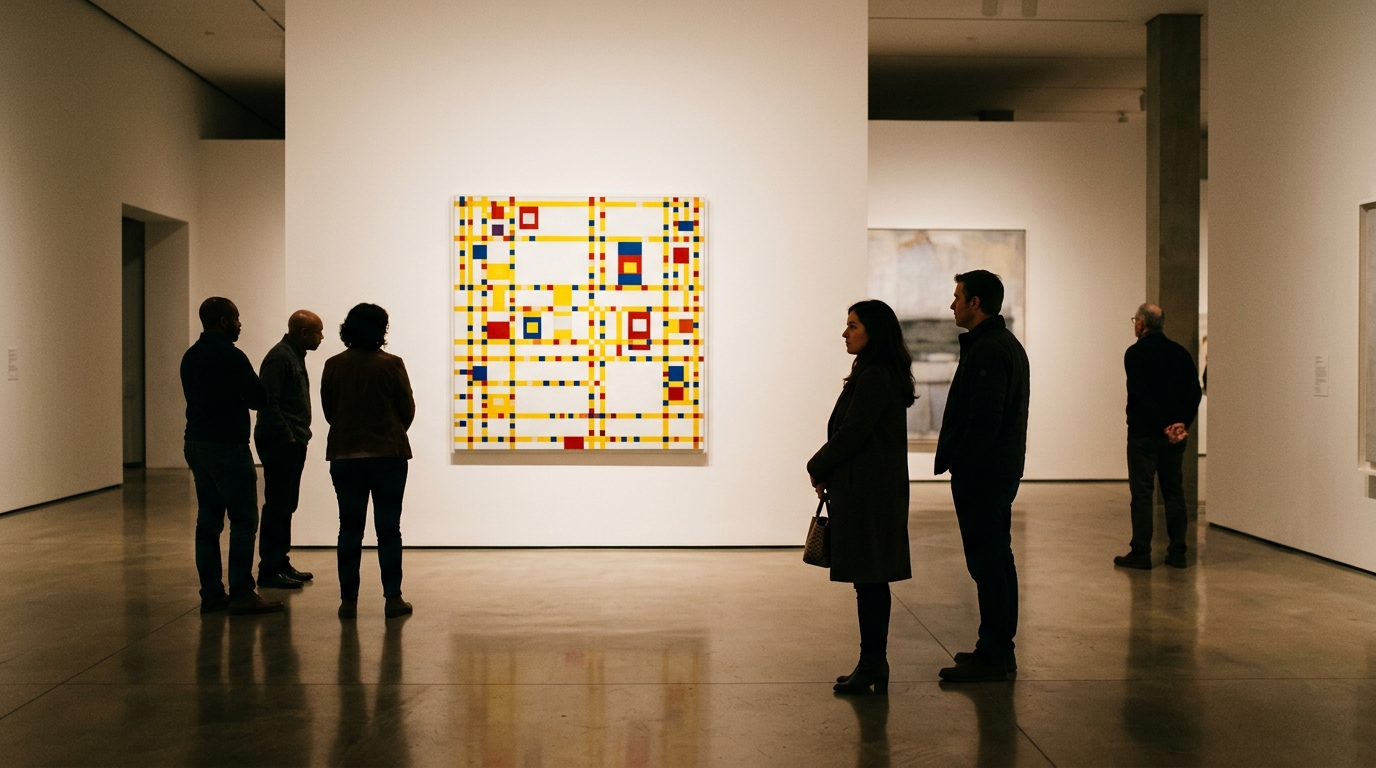
People often greet Broadway Boogie Woogie as if it were a cheerful piece of evidence: Mondrian came to New York, loved jazz, liked the city grid, and painted all three at once.[2][4] That summary is useful, but it stops too early. The painting's real excitement begins where description becomes unstable. This is not simply a square canvas decorated with bright geometry. It is a late work in which Mondrian loosens the old severity of his own grid until order starts to pulse.
The Museum of Modern Art's audio guide gives the clearest first foothold. Ann Temkin says the horizontal and vertical lines are built from rectangles and squares that guide the eye much as streets guide movement through a city, or dancers through a floor, and that the title joins two things that thrilled Mondrian in New York: Broadway and boogie-woogie.[2] The point is not that the picture resembles a street plan in some literal sense. The point is that movement has entered the grid from inside. The line no longer behaves as a fence. It behaves as traffic.
Image context: the lead image keeps the whole canvas visible because this argument depends on how the eye travels across the complete surface. Cropping the painting would reduce it to decorative fragments and lose the way the yellow bands keep redirecting motion from edge to edge.[5]
Yellow does the work black used to do
What changes first is the role of the line. In earlier Mondrians, black bars often enforce the architecture of the picture with absolute clarity. Here that structuring job has been transferred to yellow.[1][4] The MoMA collection page fixes the basic facts: the painting is a square oil on canvas from 1942-43, his last fully completed major painting in New York.[1] Within that square, yellow is no longer a highlight laid over an armature. Yellow becomes the armature itself.
That shift matters because yellow carries a different visual temperature from black. Black closes. Yellow vibrates. Even before a viewer starts assigning meanings such as traffic, taxi lights, marquee bulbs, or swing rhythm, the eye already feels a difference in pressure. The lines do not cut the canvas into sealed compartments. They keep the surface open and active. The grid remains intact, yet it has stopped feeling judicial. It now feels inhabited.[2][4]
The Art Story's Neo-Plasticism overview is useful here because it notes that Mondrian's late New York paintings use brighter color, thinner line, and a renewed sense of the city's liveliness.[4] Broadway Boogie Woogie is the place where that renewal becomes unmistakable. A strict geometry survives, but its energy changes register. Structure stays visible while rigidity dissolves.
The small color hits act like syncopation
The second thing to notice is that the yellow lanes are never left alone for long. Red, blue, gray, and white rectangles interrupt them at irregular intervals, and those interruptions are the source of the painting's rhythm.[1][2] If the yellow bands supply continuity, the smaller color incidents break continuity into beats. The picture advances by accent.
Jason Moran's MoMA response gives a strong vocabulary for that experience. In the playlist audio, he describes the painting as a score, hearing the smaller repeating units almost like a left hand moving across the surface while larger color events land more like solo notes.[3] That musical analogy is persuasive because it does not reduce the work to illustration. It explains why the canvas feels animated without pretending that Mondrian literally translated one tune into painted notation. The painting behaves musically because it distributes emphasis unevenly while keeping an overall pulse.
White is crucial to this effect. Viewers often absorb the red and blue first because they puncture the yellow so sharply, but the white blocks do subtler work. They prevent the surface from becoming a continuous run of bright signals. They create air, delay, and rest. The painting's movement therefore comes from alternation rather than speed alone. Every push outward meets a pause. Every lane carries both flow and interruption.
Broadway enters as tempo, not as illustration
The title tempts viewers to look for Manhattan in a direct, top-down way. Yet the painting refuses stable orientation.[2] There is no single privileged avenue, no skyline, no point from which the city resolves into diagram. The all-over square format keeps the image from settling into one readable map. What comes through instead is a metropolitan condition: crossing, stopping, restarting, sliding sideways, and feeling many signals at once.
That is why Temkin's phrasing about streets and dancers matters so much.[2] The painting does not choose between urban grid and dance floor. It fuses them. Broadway enters as width, spectacle, electric brightness, and public tempo; boogie-woogie enters as broken regularity, repeated figures, and forward drive. The work holds together because both references are patterns of organized motion. Mondrian found a way to make geometry hospitable to that motion without abandoning his own discipline.
This is also where the picture escapes the stereotype of late Mondrian as merely "happier" or "jazzier." Those words catch something real, but they soften the intelligence of the construction. The painting is exacting. Every interruption has to keep the grid alive without shattering it. Every colored pulse has to intensify movement without turning the surface into noise. Ease is achieved here through severe editing.[1][3][4]
Why the painting still feels so current
The MoMA audio also emphasizes the biographical pressure underneath the liveliness: Mondrian arrived in New York during World War II as an older exile rebuilding life in a new city, and adapted with remarkable enthusiasm.[2] That historical fact deepens the painting's brightness. The work is not carefree in the shallow sense. It is structurally alert. It turns order into something flexible enough to survive acceleration.
That is why Broadway Boogie Woogie still holds its ground so firmly. It offers no illusion of urban totality. It gives a field of crossings, accents, and delays that never quite stop reorganizing themselves.[1][2][3][4] The grid remains visible, but it is no longer static law. Under Mondrian's late hand it becomes pulse: a city grammar carried by yellow, broken into syncopation, and kept permanently in motion.
Sources
- The Museum of Modern Art, "Piet Mondrian. Broadway Boogie Woogie. 1942-43" - collection page with title, date, medium, dimensions, and object record.
- The Museum of Modern Art, "Piet Mondrian. Broadway Boogie Woogie. 1942-43" audio - Ann Temkin on streets, dancers, Mondrian's New York exile, and the title's Broadway/boogie-woogie double reference.
- The Museum of Modern Art, "Piet Mondrian. Broadway Boogie Woogie. 1942-43" playlist audio - Jason Moran's reading of the painting as a score built from repeating small units and larger accented notes.
- TheArtStory, "Neo-Plasticism Movement Overview" - late Mondrian context on New York vitality, brighter color, thinner line, and the work's relation to jazz and Manhattan.
- Wikimedia Commons, "File:Piet Mondrian, 1942 - Broadway Boogie Woogie.jpg" - source page for the photographic reproduction used as this article's image.