Alberto Giacometti is usually introduced through the silhouette everyone already knows: a thin bronze walker, rough on the surface, existential by reputation, stranded in the moral weather of postwar Europe.[1][8] That description is not false, but it is too efficient. It makes the work look like a style before it has time to become a problem. Giacometti's deeper question was more exacting. How does a person actually appear in space when seen from a distance, in fragments, under unstable conditions of attention?[2][4][7]
That question runs through almost everything he made. It is there in the surrealist objects and cages of the early 1930s, in the obsessive return to heads, in the tiny wartime figures made from memory, and in the later walkers and standing women that seem at once monumental and on the verge of vanishing.[1][3][4] Giacometti did not simplify the human figure in order to make it symbolic. He kept stripping and rebuilding it because ordinary looking never arrived as a stable whole.
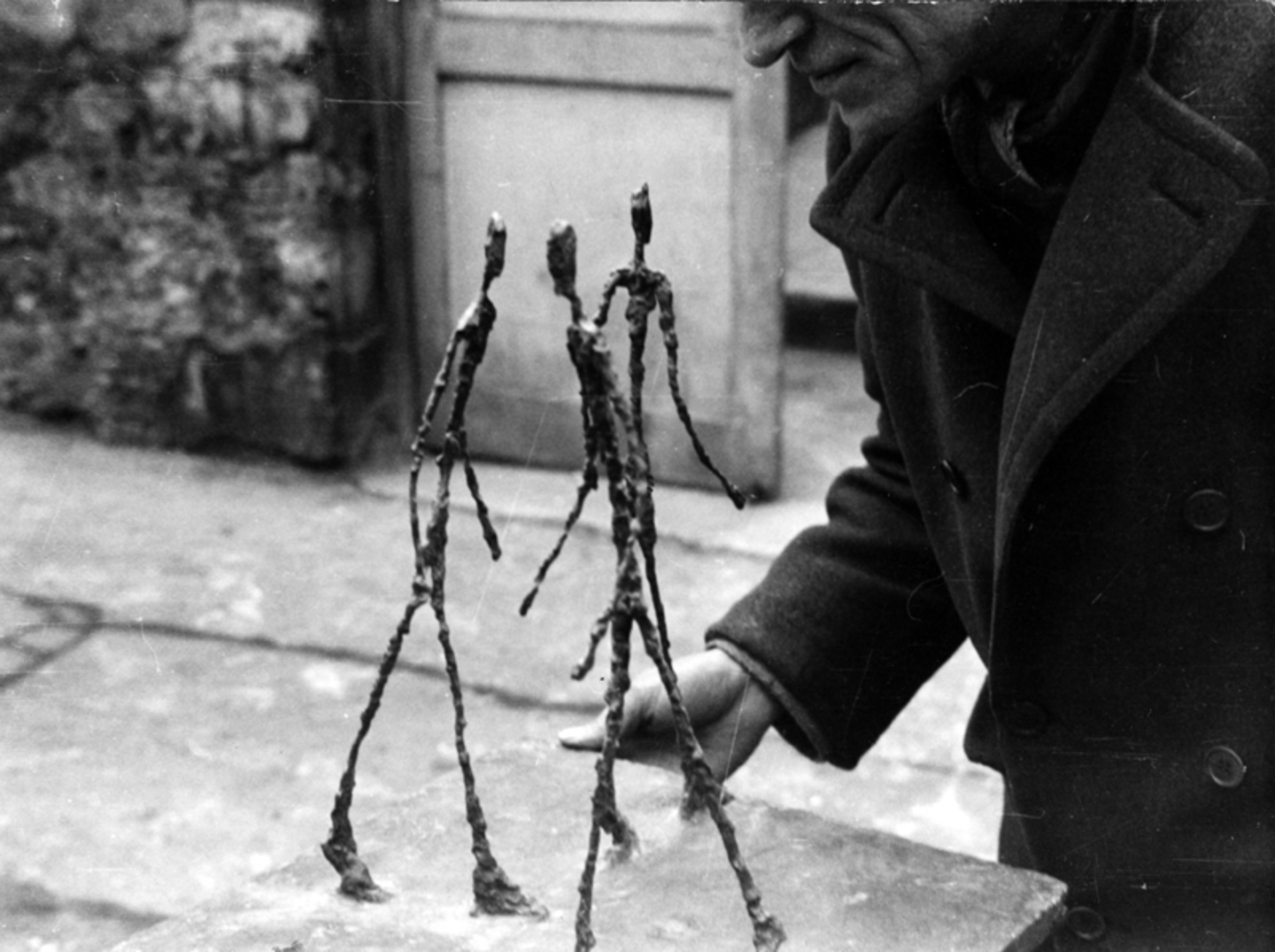
Image context: the lead image uses an archival photograph of Giacometti with Three Men Walking I (large base) rather than a polished standalone reproduction. That choice fits the argument here because the work is about relation before it is about finish: tabletop, hand, body, and miniature public space all remain visible at once.[4]
The head was the real center of the work
The surest way into Giacometti is not through the walking man but through the head. The Fondation Giacometti states it plainly: the human head was the central subject of his research throughout his life, and in 1935 it was one of the reasons for his break with the Surrealist group.[2] What sounds like a conventional academic subject became, for him, a crisis of exactness. A head was not merely anatomy. It was the place where life seemed to gather most intensely, especially in the eyes.[2][7]
The crucial point is that scale and distance were built into that problem from the start. On the Fondation's account, Giacometti's variations on heads became inseparable from the question of how far away the subject had been seen.[2] The same archive preserves one of his sharpest formulations: he could not see the eyes, hands, and feet of a person all at once, but the one part he did focus on still carried the sensation of the whole body's existence.[7] That sentence explains why his sculptures can look simultaneously reduced and complete. He was not translating a full survey of the body into bronze. He was translating a lived encounter with partial sight.
This is also why his portraits feel so unlike conventional likeness. The Fondation describes them as translations of the model's irreducible otherness rather than psychological summaries.[1] Giacometti was not trying to smooth the person into a finished public image. He was trying to hold the vibration of an encounter that never settled.
Surrealism gave him a stage, but not a solution
Before the famous postwar bronzes, Giacometti had already built a strange and rigorous sculptural world. He joined Andre Breton's Surrealist movement in 1931 and quickly became one of its rare sculptors.[1][3] The Fondation's overview of the surrealist years emphasizes dreamlike visions, montage, metaphorical objects, and magical treatments of the figure.[3] MoMA's The Palace at 4 a.m. from 1932 remains the clearest emblem of that phase: a fragile structure of wood, glass, wire, and string that behaves less like a solid sculpture than like a stage set for a memory one cannot fully enter.[6]
But surrealism did not solve his problem of appearance. It dramatized it. Even while he was making dream-objects and theatrical constructions, the representation of the head kept returning as an unresolved demand.[2][3] That is why Giacometti's break with Breton matters. He was not abandoning invention for realism in any simple sense. He was moving toward a harsher question: how to render what is actually seen when vision is unstable, incomplete, and pressured by distance.[2][7]
The later work kept some surrealist logic anyway. Cages, suspended forms, and magical isolation never disappeared from his art; they were absorbed into a different research program.[3][4] Giacometti's mature sculpture is not anti-surrealist. It is surrealist tension made answerable to observation.
After the war, space itself became visible
The most famous Giacomettis are often described as emaciated bodies, as if wartime history had simply thinned the figure down. The Fondation's postwar essays suggest something more specific.[4][5] While in wartime Switzerland, Giacometti found the image that would generate the standing figures of the next two decades, beginning with Woman with Chariot.[4] From there, the figure became a tool for investigating what the Fondation calls the "space of representation": bodies set on pedestals that isolate them from the ground, or placed within cages that establish a virtual room parallel to our own.[4]
That idea sharpens the walking figures. The Fondation writes that with Three Men Walking Giacometti tried to grasp the fleeting sight of figures in motion.[4] The Met's text on Three Men Walking II then explains why the work still feels so difficult: the men stride in different directions, and the empty space around them acts as an obstacle to communication.[9] This is the real Giacometti pressure. Space is not a neutral background through which the figures move. It is an active resistance that separates them while making their relation legible.
Once that is clear, the famous thinness looks different. The figures are narrow because Giacometti is less interested in anatomical fullness than in the fact of apparition. They have to hold the eye at a distance, like something glimpsed across a street or at the far edge of a square, still unmistakably human and yet continually threatened by disappearance.[2][4][7]
Monumentality had little to do with size
Giacometti's late monument projects make the point even harder. In 1958 he was invited to propose a work for the plaza of the new Chase Manhattan Bank tower in New York.[5] His response, as the Fondation recounts it, was not a single dominating statue but a spatial set of three recurring motifs: a giant standing woman, a large walking man, and a monumental head placed on the ground in relation to the others.[5] For the first time, spectators would have been able to enter his world physically, moving among figures that behave like trees, stones, and passing people all at once.[5]
The project was never installed, but its failure is revealing.[5] Giacometti kept chasing monumentality as an experience of relation rather than mass. He did not want bigness for its own sake. He wanted a figure, a head, and a walker to reorganize the viewer's sense of surrounding space.
That is why his sculpture can feel larger than it is and, sometimes, smaller than memory expects. Monumentality in Giacometti is a function of interval.
Why Giacometti still feels current
Jean-Paul Sartre's essays helped fix Giacometti inside the postwar existential imagination, and the Fondation rightly notes that Sartre's writing on the artist turns on perception.[8] That part of the existential label still matters. But Giacometti lasts because he is harder than the label. He does not merely give postwar Europe a damaged human emblem. He makes seeing itself look effortful, unstable, and exact.
The heads, the cages, the walkers, the standing women, the miniature groups, and the unrealized monuments all keep circling the same discovery.[2][4][5][7][8][9] A person does not arrive to us as a complete package of information. A person appears through distance, obstruction, angle, memory, and the thick room around them. Giacometti made sculpture answer to that fact. That is why the bronzes still feel less like symbols than like sightings. They stand there, but they also keep happening.
Sources
- Fondation Giacometti, "Biography" - official biography outlining Giacometti's upbringing, recurring themes, portrait method, and long career arc across sculpture, painting, and printmaking.
- Fondation Giacometti, "5. What is a head ?" - foundation essay on the centrality of the head, the eyes, scale, and the role of distance in Giacometti's search for exact representation.
- Fondation Giacometti, "3. The surrealist experiment" - foundation essay on Giacometti's years with Breton, surrealist procedures, and the place of The Palace at 4 a.m. within that dreamlike sculptural world.
- Fondation Giacometti, "6. A woman like a tree, a head like a stone" - foundation essay on Woman with Chariot, the postwar standing figures, Three Men Walking, and the archival photograph used for this article's image.
- Fondation Giacometti, "12. Monument" - foundation essay on the Chase Manhattan Plaza project and Giacometti's late attempt to let viewers enter a spatial set of walker, woman, and head.
- The Museum of Modern Art, "Alberto Giacometti. The Palace at 4 a.m. 1932" - object page with date, medium, dimensions, and museum context for the key surrealist sculpture.
- Fondation Giacometti, "7. Fragments and visions" - foundation essay on partial sight, heads suspended in space, and Giacometti's statement that one visible part can imply the existence of the whole.
- Fondation Giacometti, "8. Encounters" - foundation essay on Giacometti's conversations with Sartre and Yanaihara and the role of perception in the artist's postwar thinking.
- The Metropolitan Museum of Art, "Three Men Walking II" - object page describing the 1949 bronze's divergent strides and the empty space that acts as an obstacle to communication.