
Public monuments are usually encountered at the wrong end of their lives. A viewer meets the bronze after argument has hardened around it: after dedication speeches, after pigeons and weather, after schoolchildren have been told what virtue it stands for, and often after the city has forgotten how much workshop labor had to accumulate before the thing could look inevitable. The Met's 1922 film The Making of a Bronze Statue reverses that order.[1][2] Instead of starting with Theodore Roosevelt as a finished civic symbol, it starts with scale problems, plaster fragments, enlarging devices, molds, and foundry sequence.
That reversal is what makes the film more valuable now than it might have seemed when it was first made. The short follows Alexander Phimister Proctor as he develops Portland's Theodore Roosevelt, Rough Rider from small clay conception to monumental bronze, and The Met's accompanying note brings the object's later history into the frame: the statue stood in Portland until demonstrators toppled it in October 2020.[1][2] Portland's current monuments pages push the story further. The sculpture is now offsite, in storage and in need of repair, with return tied to restoration and new interpretive signage rather than to any simple restoration of consensus.[4][5]
Seen from that angle, the footage does not merely document how a monument is made. It exposes how monumentality itself is manufactured.[1][2] Heroic public sculpture depends on enlarging, sectioning, fitting, casting, chasing, shipping, and assembling. The rider eventually reads as certainty. The film shows certainty being built out of provisional matter.
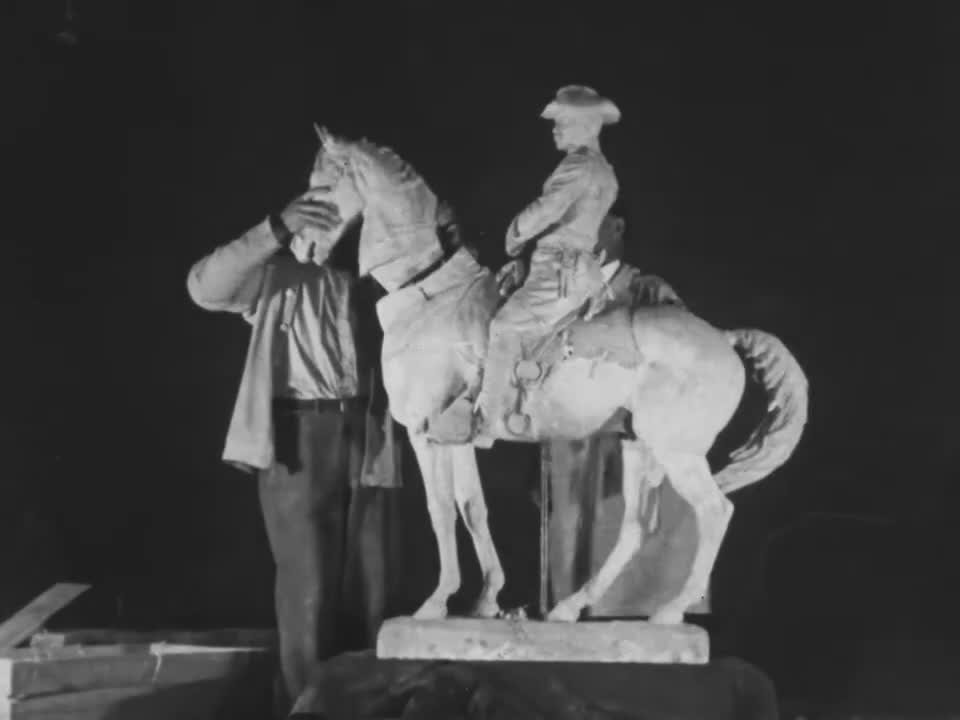
Image context: the cover uses a frame from the film in which Proctor stands beside the plaster rider. It belongs here because the article argues that public grandeur begins at this smaller, stranger scale, where Roosevelt is not yet a civic verdict but a workable model beside the sculptor's own body.[1][2][3]
The provenance is unusually clean. The embedded video is The Met's official republication of The Making of a Bronze Statue, 1922, uploaded to YouTube on January 24, 2023, from the museum's From the Vaults series.[1][2] The museum's note identifies the subject precisely: Proctor's process of sculpting Theodore Roosevelt, from small clay sketch to plaster model to lost-wax bronze. That clarity matters for an archival spotlight. This is not a stray clip detached from authorship or date. It is a documented institutional film whose survival lets viewers watch monument-making as a legible technical sequence.
Historical context: the monument was commissioned as memory work, but the film keeps dragging it back into process
Portland's public-art record makes clear how deliberate the commission was.[4] Dr. Henry Waldo Coe, a friend and hunting partner of Roosevelt, donated the monument to the city after Roosevelt's death as a memorial to what he had come to symbolize for an America imagining itself as vigorous, expansionist, and newly powerful.[4] Proctor, himself known for bronzes of western animals and frontier figures, was a fitting sculptor for that symbolic task. Portland's description emphasizes the sculpture's intended rhetoric: determination, strength, and a bridge back to the Wild West.[4]
The Buffalo Bill Center of the West adds a second layer that matters for reading the film.[3] Proctor was not working from generalized likeness alone. He consulted Eleanor Roosevelt, who supplied anecdotes about Theodore Roosevelt's character and lent the Spanish-American War cavalry uniform along with photographs so the sculptor could sharpen the figure's accuracy.[3] In other words, the monument was designed to look natural only after a heavy preparatory effort in costume, likeness, and pose. Commemoration begins long before bronze.
The Portland account also records a detail that the film makes easy to overlook but that belongs to the object's later aura: the sculpture was cast in Brooklyn and shipped by sea through the Panama Canal so it would not have to be cut into sections for rail transport, and Vice President Calvin Coolidge was present at the groundbreaking.[4] That is civic theater at a high level. Yet once the film rolls, even those ceremonial ambitions are repeatedly interrupted by the stubborn physicality of making.
The first half of the film matters because it turns a heroic rider into a scaling problem
Around the early modeling sequences, Roosevelt does not yet look monumental at all.[1] He looks workable. Proctor sketches the equestrian pose on a wall, handles a smaller model, and places the rider inside a chain of enlargements that depend on measurement rather than inspiration alone. One of the film's most revealing intertitles introduces the pointing machine, described as similar in principle to a pantograph and used to enlarge the model to the required size.[1] That sentence changes the emotional key of the footage. Monumentality is not a surge of feeling. It is a translation system.
This is where the film quietly corrects a familiar misunderstanding about public sculpture. The pedestal encourages viewers to think in finished symbols. The studio scenes insist on intermediate states: horse's heads separated from bodies, armatures exposed, volumes tested, proportions transferred, plaster built up and pared back.[1] The Center of the West's studio note helps explain why that matters. Its preserved plaster cast of Rough Rider can be displayed in sections so viewers can literally see into the guts of the cast and understand the complexity required before bronze ever enters the picture.[3] The film gives the same lesson in motion.
The central visual fact is scale by fragmentation.[1][3] A monument that will later read as a single rider had to be conceived as a set of problems solvable only in parts. The horse's head becomes easier to follow precisely because it has been detached from the totality. The film therefore strips heroism of its seamlessness. Roosevelt's public image arrives only after segmentation, enlargement, and repeated acts of fitting.
The foundry sequences matter because they return authorship to workshop labor
The film's second half is even more important. Once the plaster hardens, molds are removed, shells are chipped away, bronze sections are prepared, and foundry workers move in and out of the frame handling the real conversion from model to metal.[1][2] If the early footage demystifies scale, the later footage demystifies singular authorship. Proctor remains central, but the monument no longer looks like the expression of one commanding hand. It looks collaborative, industrial, and dependent on the skilled labor that public memory usually compresses into the phrase "sculpted by."
This is where the archival image becomes especially strong for contemporary viewers. The workers carry, brace, fit, and join the monument piece by piece.[1] Surfaces must be made to meet. Technical sequence governs the pace. The rhetoric of lone genius survives only because the workshop disappears after installation. The film refuses that disappearance.
That refusal is also why the footage keeps its edge after the statue's political meaning has become contested.[2][5] One can debate Roosevelt, empire, frontier myth, donor ideology, and public commemoration. The Portland monuments page shows that those debates are now inseparable from the sculpture's future presentation.[5] But beneath those arguments sits another fact the film preserves with unusual honesty: a monument is a fabricated object before it is a public doctrine. Its authority depends on material joins that can be made, unmade, damaged, stored, repaired, and recontextualized.
Legacy: why this footage still matters after the pedestal has lost its old certainty
The strongest reason to watch The Making of a Bronze Statue in 2026 is that it neither settles the monument's politics nor hides from them.[1][2][5] The Met's note explicitly names the 2020 toppling, and Portland's official pages now situate the work inside repair, storage, and reinterpretation rather than inside untouched reverence.[2][5] That makes the film more than a charming process document. It becomes a record of how a city once wanted heroic identity to be built: horse, rider, scale, bronze, dedication, permanence.
At the same time, the footage loosens that old permanence from within.[1] Because it shows every intermediate stage, it becomes harder to believe that the final monument was ever naturally fixed. The horse could be sectioned. The rider could be measured. The bronze could be cast elsewhere and shipped. The object could be toppled. The city could decide that if it returns, it must return with additional interpretation.[4][5] The archival film makes all of that imaginable because it shows public memory starting as a managed studio-and-foundry event.
That is the deeper value of this archival spotlight. It does not ask viewers to admire or condemn first. It asks them to look at monumentality as a produced condition.[1][2][3] In Proctor's 1922 film, Roosevelt on horseback is still only becoming. Once that is visible, the later afterlife of the sculpture stops feeling like a violation of some original purity and starts looking like one more stage in the object's long public manufacture.
Sources
- The Met, "The Making of a Bronze Statue, 1922 | From the Vaults," YouTube video, published January 24, 2023.
- The Metropolitan Museum of Art, "The Making of a Bronze Statue, 1922" - From the Vaults page on the 1922 film, Proctor's process, lost-wax casting, and the statue's 2020 toppling.
- Buffalo Bill Center of the West, "Object Spotlight: Proctor's Rough Rider" - on the plaster cast, Proctor's training, Eleanor Roosevelt's assistance, and the sectional display that reveals the complexity of casting.
- Portland.gov, "A complete list of monuments in the City of Portland's public art collection" - on Proctor, Coe, the commission's symbolic intent, Brooklyn casting, Panama Canal shipment, and Portland installation context.
- Portland.gov, "Theodore Roosevelt" - on the monument's October 11, 2020 toppling, current storage status, and planned restoration with new interpretive signage.