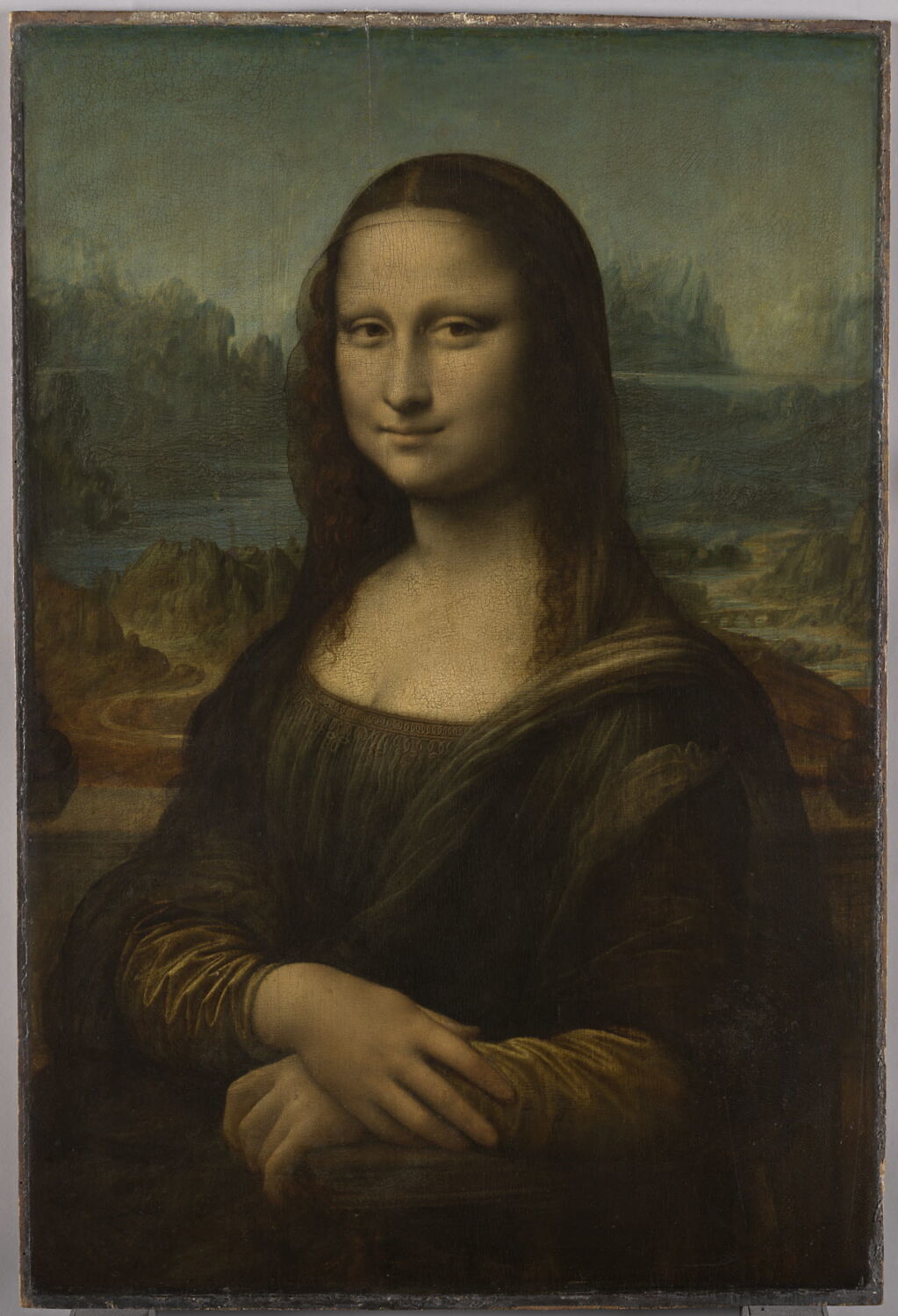
The Mona Lisa remains difficult not because it is obscure, but because Leonardo makes closeness and distance operate at the same time.[1][3][4] The Louvre's collection record is unusually concrete on the object itself: this is a portrait of Lisa Gherardini, wife of Francesco del Giocondo, painted between 1503 and 1519, now hanging in Salle 711 of the Denon wing.[1] Britannica adds the larger formal point that the work helped normalize the three-quarter, half-length portrait as a durable model for later European painting.[4] Put those facts together and the picture starts to read less like a riddle and more like a deliberate threshold machine. The body is scaled to human encounter; the handling keeps edges from fully locking; the landscape behind her keeps opening away from any stable domestic setting.
1) Natural scale is the first shock
The Louvre notes that Leonardo chose a thin poplar panel and a relatively large support, about 79.4 cm high by 53.4 cm wide, specifically large enough to present the sitter at something close to natural scale.[1] That matters more than the painting's fame usually allows us to notice. Many reproduced masterpieces survive endless shrinking: postcard, phone screen, mug, airport tote. The Mona Lisa does not fundamentally belong to that small-image regime. It was built so a standing viewer meets a body that still feels proportionate to lived encounter.
This is one reason the painting's celebrity can be misleading. Viewers often arrive prepared to hunt for a code inside the smile. The stronger formal fact is simpler. Leonardo gives the sitter enough bodily presence that she does not read as a symbolic head floating in a dark field. She occupies space as a person would, but the image never settles into the frictionless clarity of everyday seeing.[1][4] Nearness is established first; certainty is withheld second.
2) The softness is engineered, not vague
The 2019 Louvre exhibition catalogue helps here because it pulls the work back toward process.[3] Its infrared reflectogram entry says Leonardo began the portrait in 1503 and that the reflectogram reveals a preparatory underdrawing, alterations to the hands and the seat balusters, and a clearer sense of the arrangement now partly masked by oxidized varnish.[3] Those details matter because they make the painting legible as revision rather than apparition.
In other words, the softness associated with Leonardo's late manner is not a refusal of structure. Structure is present, then partly submerged. Hands were adjusted. The chair's side elements shifted. Underdrawing exists, but the final surface does not perform that scaffolding loudly.[3] This is where sfumato matters in practical terms. It is less a mystical haze than a method for preventing contours from hardening too early. The painting keeps transitions mobile, so the face seems present without becoming blunt.
Britannica's description of Leonardo working on the picture over years, adding multiple thin oil glazes at different times, supports the same point from a different angle.[4] The work's immediacy is slow-made. What looks effortless is the result of repeated temporal layering.
3) Body and landscape obey different logics
Britannica's summary includes a line that can sound obvious until you stay with it: the portrait presents a woman in half-length before a distant landscape.[4] That pairing is the whole painting's tension. The sitter is scaled to encounter; the background belongs to another order entirely. Roads, water, rock, and horizon do not stabilize the figure by giving her a believable social location. They do the reverse. They keep the world behind her expansive, old, and unmastered.
That split is why the picture continues to feel both intimate and unreachable. The body invites portrait reading. The landscape blocks closure. It turns a sitter who could have belonged to one Florentine household into a figure held against geological time. The painting never needs allegorical props to enlarge its meaning. It only needs two incompatible distances held in one frame: the distance at which you recognize a person and the distance at which the world stops belonging to anyone.
4) Infrared viewing returns weight to the body
The Louvre collection page makes another useful correction to the painting's modern myth. Infrared reflectography and comparison with the restored Prado workshop copy make the costume more legible than the familiar darkened surface does.[1] The page describes a probably dark green dress, detachable yellow sleeves, a white chemise, and a large transparent silk veil fixed at the chest with embroidered gold threads.[1]
That description changes the work's emotional weather. A lot of popular writing treats the Mona Lisa as if Leonardo painted pure psychological atmosphere. The technical record says otherwise. This sitter was built with textile specificity, with dress logic, with a veil that catches and organizes the upper body. The painting's mystery does not come from an absence of material fact. It comes from Leonardo's ability to keep material specificity and perceptual softness in the same image.
This is also why the smile should not be isolated as the sole expressive event. The smile works because the whole surface teaches your eye to accept near-decisions rather than hard declarations. Mouth, cheeks, veil, hairline, and distant terrain all participate in one continuous regime of moderated edges.[1][3]
5) Public distance became part of the work
The modern viewing contract adds one more layer. Britannica notes the 1911 theft, the media sensation that followed, and the painting's later 1963 U.S. tour, which drew about 40,000 people per day during its six-week stay.[4] The Louvre's Salle des Etats page confirms the current staging logic: the museum now frames the room itself through the axis from the Mona Lisa to Veronese's Wedding Feast at Cana.[2] The painting is therefore not only a Renaissance portrait. It is a museum event engineered around lines of movement, crowd behavior, and controlled access.
That history matters because public distance has become part of the picture's meaning. Bulletproof glass, tourism, and the expectation of once-in-a-lifetime contact all encourage viewers to consume the work as a solved icon.[2][4] But the object itself still resists that flattening. It asks for a slower sequence:
- Register the near-life scale of the torso and hands.[1]
- Notice that the understructure exists without fully surfacing as contour.[3]
- Let the landscape push the figure out of ordinary portrait space.[4]
Seen in that order, the Mona Lisa stops being a celebrity image with a famous smile and becomes something harder and better: a portrait that keeps human nearness intact while refusing to let nearness turn into possession.
Sources
- Louvre Collections, Portrait de Lisa Gherardini, épouse de Francesco del Giocondo, dit La Joconde ou Monna Lisa (object record, dimensions, display location, and infrared-based costume notes).
- Musée du Louvre, From the "Mona Lisa" to "The Wedding Feast at Cana" - The Salle des Etats (current room context and display framing).
- Musée du Louvre, Leonardo da Vinci exhibition catalogue PDF (2019-2020), reflectogram entry for the Mona Lisa and technical process notes.
- Encyclopaedia Britannica, Mona Lisa (support, viewing history, theft, tours, and formal summary).